Independent comparisons. We may earn from shop links. More info

How to fit skirting boards before or after the floor

Updated: 21 October 2026

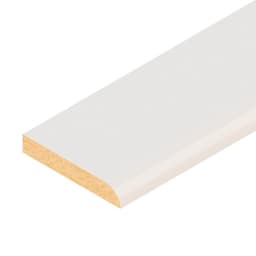
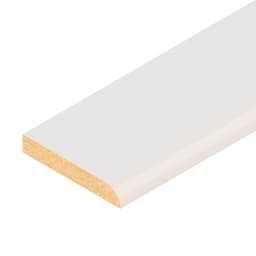
You have a rigid MDF or pine board, a saw, and a wall that is not straight. This is how to fit skirting boards when the board is timber or MDF: set the floor order, scribe the inside corners, mitre the outside corners, and fix the board to the wall. The 8–10 mm figure on a laminate leaflet is the floor’s expansion gap, not a slot you fill under the board. A peel-and-stick roll is a different method. The only rigid boards on the [skirting board comparison](/hub/flooring/skirting-board) are two short Austin Commerce lengths. They are not a fitting manual, and there is no lab test.

You have a rigid MDF or pine board, a saw, and a wall that is not straight.

Our top picks

On this page

Carpet first, floating floors after

Wickes’ fitting guide separates the two floors that change the order. Fit skirting before carpet, so the carpet tucks to the board. Fit skirting after laminate, engineered wood, or LVT, and fix it to the wall only. Quick-Step’s UK laminate instructions specify an 8–10 mm expansion gap and tell you not to pin through the floor. If you do, the floor cannot move and the joints can open later. Checkatrade also mentions about 1–2 mm under a board on a hard floor. That is not the expansion gap. Do not add the numbers and leave a 10 mm slot. If the old board stays, use a scotia fixed to the board or the wall, not a pin through the floor. Caulk the top edge once the fix has cured. Do not caulk the floor joint shut. If you cannot remove the existing skirting, you are on the peel and stick skirting board page, not this one.

Mitre the outside, scribe the inside

An external corner is a mitre. Cut both pieces at 45 degrees, test the joint dry, and expect the angle to be slightly off because few UK walls are a true 90 degrees. A mitre box is enough for a simple bullnose, which is the cut the Austin notes describe. A rushed saw chips a deeper ogee. An internal corner should be scribed, not mitred. A mitre there opens as the wall wanders. Homebuilding’s sequence: fix the first board square into the corner, cut the second at 45 degrees so the profile shows, then cope that line with a slight back-cut so only the face touches. Test the fit before any adhesive. A cope that still gapes on a period profile is a carpenter’s joint. Mark the length on the back of the board, scribe a dipping floor, and only then cut. A board cut short cannot be stretched. Measurements you have not taken are on the skirting board buying guide.

Adhesive holds the board, pins hold it while it cures

Checkatrade’s glue note is solvent-free grab adhesive on a sound, dust-free wall. Caulk is not the adhesive. Silicone is not the adhesive. A continuous wavy bead on the back, kept off the top and bottom edges, is the usual pattern. Press the board on, pull it off for a moment if the product asks for that, then press again. Pins or screws hold the board while the grab adhesive cures. On plasterboard, fix into the studs or use plugs. On masonry, plugs and screws beat pins into soft plaster. Wickes allows adhesive alone on a flat dry wall. On an uneven Victorian wall the board springs off as the adhesive skins. New plaster needs to be dry. Staircraft says not to fix boards to damp plaster. Expanding foam used instead of adhesive can bow a thin MDF face. MDF dust is an irritant: wear a mask when you cut it, and seal cut ends before a humid room.

Stop when the wall or the cable is the real job

Stop and call a plasterer if the wall is blown, damp, or so far out that every scribe is a wedge. Stop and call an electrician before you hide a new 230 V cable behind the skirting. SELECT’s guidance on BS 7671 Regulation 522.6.204 is that the strip behind ordinary skirting is not a safe zone for concealed mains. A rebate is not earthed trunking. Stop for a wet room, for stairs, and for any joint you cannot test dry. The Austin lengths are a mitre-box repair, not a staircase blank.

Common questions

Do I fit skirting before or after laminate?
After. Lay the floating floor first, leave the expansion gap, and fix the skirting to the wall. Quick-Step states 8–10 mm. Do not caulk that gap shut.
What about carpet?
Fit the skirting first, then the carpet, so the carpet can tuck against the board. Fitting the board on top of carpet leaves a soft fixing and a line that crushes. If you are only adding a cover because the carpet is already in, you are not using this rigid-board method.
Should an internal corner be mitred?
No. Mitre external corners. Scribe internal corners, with a back-cut and a dry test fit. An internal mitre opens as the wall and the timber move.
Can I use adhesive only?
Wickes allows it on a sound flat wall when you have no nails. Caulk is only the finish at the top. Pins hold a sprung board while grab adhesive cures. Adhesive on dusty or glossy paint lets go later.
Do I caulk the gap at the floor?
Caulk the top, where the board meets the wall. Leave the floor joint free so a floating floor can move and so carpet can tuck. The 1–2 mm clearance some fitters leave under the board is not an invitation to fill 10 mm of expansion gap.
When do I stop and call a carpenter or an electrician?
Call a carpenter for stairs, blown plaster you are about to board over, and period profiles you cannot scribe. Call an electrician before any new concealed 230 V cable. The space behind ordinary skirting is not a safe zone under the SELECT note on BS 7671.

Related pages

Sources

Public UK sources and amazon.co.uk listings, checked on 19 October 2026. Shelf prices and star lines are the figures in the display file. The Wickes per-metre band is a 15 October 2026 snapshot, not one of these amazon.co.uk shelf prices.

  1. SkirtingBoards.com, MDF skirting ranges (retrieved 19 October 2026)
  2. CE Skirting, skirting buying guide (retrieved 19 October 2026)
  3. BuildWiz, skirting board profiles and a Wickes price snapshot (retrieved 19 October 2026)
  4. Staircraft, skirting boards technical data sheet (retrieved 19 October 2026)
  5. MEDITE MR datasheet (retrieved 19 October 2026)
  6. Skirting 4 U, bathroom skirting boards (retrieved 19 October 2026)
  7. Wickes, how to fit skirting (retrieved 19 October 2026)
  8. Quick-Step, laminate installation instructions (retrieved 19 October 2026)
  9. SELECT, installation of cables and BS 7671 Regulation 522.6.204 (retrieved 19 October 2026)