Independent comparisons. We may earn from shop links. More info

Dimpled membrane vs damp proof membrane: which job

Updated: 21 October 2026

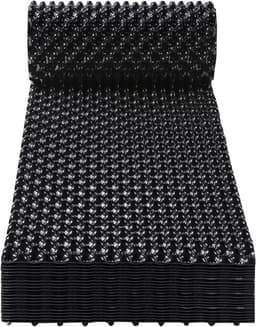
You have two products in the basket and you are not sure they are different: a studded roll, and a roll of 1,200-gauge polythene. A dimpled membrane vs damp proof membrane choice is a choice of job, not of thickness. Flat polyethylene of at least 300 µm is the English example for capillary damp under a ground-bearing slab that is not under water pressure. A studded cavity membrane is the drained layer where water is collected and removed. Using one in the other’s place leaves you with the wrong kind of dry. The studded rolls in this set are in the [dimpled membrane comparison](/hub/flooring/dimpled-membrane). A purchase through our links can earn a commission at no extra cost to you.

You have two products in the basket and you are not sure they are different: a studded roll, and a roll of 1,200-gauge polythene. A dimpled membrane vs damp proof membrane choice is a choice of job, not of thickness.

Our top picks

On this page

Two sheets, two jobs

A damp-proof membrane here is a flat sheet that blocks capillary moisture. It has no studs and no drained void. Newton’s explainer is plain: a DPM is a capillary barrier and it has no resistance to water pressure. A dimpled membrane is high-density polyethylene formed into studs so a gap stays open. In a Type C arrangement that gap is the cavity. PCA says the cavity takes controlled seepage. It is not the barrier. The Basement Information Centre puts cavity-forming sheet in Type C and barrier materials in Type A. Type A is meant to resist groundwater. Tape does not turn a dust sheet or an uncertified studded roll into Type A. Tanking slurry is a different product. The flat sheet is for damp rising into a slab. The studded sheet is for a void that has to drain.

When the flat sheet is the specified example

Approved Document C in England gives polyethylene of at least 300 µm, 1,200 gauge, as an example for a ground-supported floor. Joints are sealed. The sheet lies on a bed that will not puncture it, often sand blinding. It runs continuously to the damp-proof course in the wall. That example applies where the floor is not under water pressure. Paragraph 4.12 points you to BS 8102 where water pressure is present. Use 1,200-gauge polythene for a ground-bearing slab without water pressure, lapped and sealed as the Approved Document describes.

When the studded sheet is the right family

Use a studded sheet for a drained cavity, or for an external foundation detail that keeps soil off a primary membrane. On an internal wall the studs face the structure, which the fitting notes describe. The sheet does not pump itself. Outside, a dimpled layer is still not the waterproofing. HydroBond 410 GeoDrain is used with a primary membrane, not instead of one. The Einside rolls are 8 mm, 400 g/m² foundation sheets. They name no certificate and include no plugs or drain. They can be a foundation sheath if you accept those gaps. They are not the 300 µm slab sheet and they are not a finished Type C system.

What to buy in each case

Choose flat 300 µm polythene for a ground-bearing floor in England that is not under water pressure, with sealed joints lapped to the damp-proof course. Choose a studded sheet only as the drained layer in a design that collects water and removes it. A habitable cellar needs a Type C system, often with a Type A or Type B measure, not a lone amazon.co.uk roll. If water pressure is possible, paragraph 4.12 sends you to BS 8102. Grades and pumps are on the basement page. A dimpled sheet under a new slab is not the Approved Document C example. It is not illegal under a slab. It does not replace the specified DPM. A smooth film is still the flat-sheet family, and studs are still the cavity family.

Common questions

Is a dimpled membrane a DPM?
No. A DPM here is the flat capillary barrier, typically the 300 µm polythene in Approved Document C’s English floor example. A dimpled membrane forms a void. Newton’s explainer treats the DPM as having no resistance to water pressure. The studded sheet is not that barrier, and the barrier is not a cavity.
When is 1,200-gauge polythene the right buy?
When the floor is ground-bearing, the joints can be sealed, the sheet can run to the damp-proof course, and the slab is not under water pressure. That is the Approved Document C example. A cheaper horticultural sheet with no stated gauge is not automatically that product, even if it is also flat polythene.
Can that polythene line a cellar wall?
Not as a waterproof lining. Flat polythene does not resist water pressure, and a cellar wall with possible ingress is the case paragraph 4.12 sends to BS 8102. Taping a dust sheet to masonry is not Type C and it is not Type A tanking. If the room has to stay dry in use, that is a basement design, not a polythene swap.
Can a studded sheet go under a new slab instead of a DPM?
It is not the Approved Document C example, and it does not replace a designed waterproofing where there is water pressure. A dimpled roll leaves a void. A DPM is a continuous capillary break. If a designer specifies a studded layer under a slab, that is their detail, not a swap you make because the studded roll was in the same search.
What is Type A if neither of these is it?
Type A is barrier protection intended to resist groundwater, which the Basement Information Centre separates from cavity-forming Type C sheet. A DPM stops capillary damp and is not that barrier. A studded membrane drains a cavity and is not that barrier either. Slurry tanking is a Type A material, and it is a different purchase from both rolls.
Does this differ in Scotland?
The 300 µm example is England’s Approved Document C. Scotland uses its own technical handbook, so you should not treat the English paragraph as the rule on a Scottish warrant. The physical split still holds: a flat sheet and a studded cavity sheet do different jobs. Check the handbook that applies to the building before you order either roll.
Which page has the actual rolls?
The dimpled membrane comparison lists the four studded listings in this set: two Einside HDPE rolls with a stated area, and two generic panels whose sizes conflict. Flat polythene from this search was kept out of that table because it is not dimpled sheet. Match stud height and grams to the job before you treat a studded roll as the slab sheet.

Related pages

Sources

Public UK sources used for this comparison. Listing prices, stars and review counts are the amazon.co.uk lines kept with these four products.

  1. PCA Type C guidance, June 2022 (retrieved October 2026)
  2. Newton BS 8102:2022 technical paper (retrieved October 2026)
  3. Approved Document C, GOV.UK (retrieved October 2026)
  4. Newton CDM 508 and BBA 22/6357 (retrieved October 2026)
  5. Wykamol CM20 BBA sheet (retrieved October 2026)
  6. Newton on a DPM versus waterproofing (retrieved October 2026)
  7. Newton HydroBond 410 GeoDrain (retrieved October 2026)
  8. ABG Roofdrain (retrieved October 2026)