Independent comparisons. We may earn from shop links. More info

Artificial grass for dogs

Updated: October 2026

The dog still needs to go out at 11pm, the garden is mud, or there is no garden and the hallway pad has already failed. Artificial grass for dogs is either a small draining pad in a flat or a permeable piece in a garden, and the words pet friendly do not tell you which. Smell and chewing are what the amazon.co.uk reviews actually argue about. Peter F. used the listings in the [artificial turf comparison](/hub/flooring/artificial-turf) and the review notes attached to them. We did not run a laboratory odour test. A family lawn ranking is a different page. How the base goes down stays on the laying page.

The dog still needs to go out at 11pm, the garden is mud, or there is no garden and the hallway pad has already failed.

Our top picks

On this page

Pad or roll

In a flat, the product that matches the job is the two-pad pack at about £18.99, each pad about 46 by 58.5 cm, with the technical details also saying 46 by 58 cm. The listing states a pile of about 1.37 inches and a pack weight of 670 g, and the rating is 4.0 from 67 reviews. Urine is supposed to pass through the holes and not soak into the pad. Reviewers without a garden used it to toilet-train a dog, including one who rinsed the pads with no detergent and reported fewer accidents than with an ordinary pad. The listing says you can join the two pads for a larger dog. That join is still a tray, not a lawn. A garden toilet is a different object. Lawn pieces in this set that mention pets include Cotford, GardenKraft, WADOODI, LITA, Petgrow and tonchean. Cotford’s 1 m by 2 m piece is 35 mm, about £21.95, and the specification says no sand infill is required. GardenKraft’s 15 mm roll at about £24.99 for 4 square metres has been used as a terrace strip for visiting dogs and in a catio. LITA’s 20 mm piece at about £24.99 for 2 square metres has been used as a small dog toilet. The pad wins in a flat because you can lift it into a sink. The roll wins in a garden because 2 to 4 square metres gives the dog a place to stand. A pad on a ruined lawn drains when it is outside, and it still only covers the area of two tea towels. The pile on the pad is sparse. Some very small dogs found it spiky.

Smell and the base

A pet label does not move urine off the backing. Installers who sell dog grasses, including Perfectly Green and As Good As Grass, say the smell depends on where the liquid goes after it leaves the fibres. They tell you not to put sharp sand on top, not to sand-infill, and not to lay a weed membrane directly under the grass, because urine sits in those layers. That is installer guidance for their systems, not a test of these ASINs. It lines up with the only infill sentence in this folder: Cotford says no sand infill is required, and the other listings do not mention sand at all. The review that should stop a guarantee is on LITA. Someone used the 20 mm piece as a dog toilet and could not wash the urine smell out. WADOODI’s 30 mm piece has a puppy-toilet review as well, and one dog owner thought the backing looked sprayed on and the drainage holes sparse. Holes that are too few leave the liquid on the mat. Holes that work still leave it on whatever is underneath, which is why a tray under a flat pad matters, and why a garden base that holds water will smell even if the yarn is labelled non-toxic. You do not need a named enzyme cleaner to start. The pad listing says the urine is not absorbed, and one reviewer rinsed with water alone. If the smell remains after a rinse and a dry, another bottle will not change a backing that holds liquid.
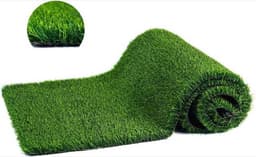
WADOODI WADOODI 30 mm, 1 m x 4 m

Testsieger

WADOODI WADOODI 30 mm, 1 m x 4 m
9.0/10about £30.99

What the listings do not prove

Several pet bullets say non-toxic, lead free or safe for children. None of the files includes a certificate, so those lines are claims, not results you can quote as a test. A flame-retardant line is in the same position. Sports-pitch rules about rubber crumb and PAHs are about infill on pitches, not about these mats, and they should not be borrowed to make a pad sound regulated. Chewing is the hazard the reviews do record. A puppy chewed through one of the about £18.99 pads quickly, and the reviewer called the plastic unsafe if it was swallowed. Other dogs refused the pad or tried to eat it. That is foreseeable with a loose plastic mat and a young dog, and it is a reason to supervise, not a reason to call the pad indestructible. The General Product Safety Regulations 2005 require a consumer product to be safe in normal use. A chewed fragment is a reason to take the pad away, not a laboratory finding we can attach to every ASIN. UV and easy-clean lines have the same limit. Petgrow’s 35 mm mat, about £39.99 for 3 square metres, drew both thick and soft and thin, smelly plastic, fibres coming off from a sample of 33 reviews. You cannot average that into a dog-proof lawn.

Which situation you are in

In a flat with no garden, start with the two pads on a tray, at about £18.99, and accept that some dogs will refuse them. Rinse after use. If the puppy chews, remove the pad. Do not step up to a 10 metre roll indoors to solve a tray problem. On a balcony, wind is the extra fault. Petgrow’s 20 mm mat, about £29.99 for 2 square metres, was trimmed for a small balcony and used for pups, and the corners rolled up in the wind during training. Weigh it down or fix it only if you are allowed to. A Cotford square at about £14.95 covers 1 square metre of the same 35 mm specification as the larger piece, if you want a stated pile on a tiny balcony rather than a pad. It is still not a smell guarantee. In a garden, use a permeable lawn piece and skip the sand. Cotford states that no infill is required. A short GardenKraft strip can mark a terrace toilet for visiting dogs, and it will feel like 15 mm carpet rather than a deep lawn. If washing does not clear the smell, as on the LITA review, the base under the grass is the next place to look, which is the laying guide. Pile and price per square metre are sorted on the buying guide. Wildlife and runoff, if you are about to cover a whole living lawn for the dog, belong on the real grass page. A qualifying purchase can earn us a commission at no extra cost to you.

Common questions

Can a dog toilet on artificial grass?
Yes, some dogs do. Reviews in this set include a flat trained on the two pads, a terrace strip used for visiting dogs, and lawn pieces used as a puppy toilet. That is use, not a promise. Other reviews include dogs that refused the pad. You still need a tray indoors, or a base outdoors that lets liquid leave the mat, otherwise you have a green sponge.
Will artificial grass smell of urine?
It can. One LITA reviewer could not wash dog urine out of a 20 mm piece. Installers say the smell follows liquid that sits in sand or on a membrane directly under the grass. That is their guidance. A rinse with water is what one pad reviewer actually did, with no detergent named. If the smell stays after the pad has drained and dried, the product is not solving the problem the title suggested.
Is a pad better than a roll in a flat?
For a flat, the pad is the better match. Two pads at about £18.99, about 46 by 58 cm each, fit a tray and can be rinsed. A garden roll is wider, heavier and pointless in a hallway. The pad is worse if you wanted something that looks like a lawn, because reviewers call it sparse, and it is useless if your dog will not stand on it.
What if the puppy chews the pad?
Take it away. A reviewer said a puppy chewed through a pad quickly and treated the plastic as a swallowing risk. The listing does not claim the pad is chew-proof. Supervision is part of using it. Do not read non-toxic on another brand’s lawn piece as a reason to let a dog eat this one.
Does lead free on a bullet mean the mat was tested?
Not on the evidence in these files. Listings say non-toxic or lead free, and the pages do not attach a certificate. You can repeat the claim as a claim. You cannot repeat it as a lab result. The same limit applies to flame-retardant lines on the lawn pieces.
Should you add sand for a dog?
Cotford says no sand infill is required, and the other listings here do not specify sand. Dog-grass installers warn against sand on top because urine sits in it. Adding a bag because a patio tutorial mentioned kiln-dried sand is how a toilet patch starts to smell. Leave the sand off unless the maker of the piece you bought tells you to use it.
Will every dog use the pad?
No. The 4.0 from 67 reviews includes dogs that took to it outdoors or in a flat, and dogs that refused it or tried to eat it. A very small dog may find the pile too spiky. If yours ignores it for several days, another roll from this set is unlikely to change that habit on its own. Training still matters more than the millimetres.

Related pages

Sources

Public UK sources and amazon.co.uk listings used for this comparison, last checked on 19 October 2026.

  1. Planning Portal — replacing a grass lawn with artificial grass (retrieved 19 October 2026)
  2. BSI, BS EN 15330-1:2013 — synthetic surfaces for outdoor sport (retrieved 19 October 2026)
  3. HTA / APL domestic guide to artificial grass (retrieved 19 October 2026)
  4. ESTC — UK REACH work programme for 2022–2023 (retrieved 19 October 2026)
  5. GOV.UK — General Product Safety Regulations 2005 (retrieved 19 October 2026)
  6. WWF — artificial grass and its impact (retrieved 19 October 2026)
  7. Natural History Museum — artificial grass controversy, August 2022 (retrieved 19 October 2026)
  8. amazon.co.uk — Artificial Grass Direct listing, checked 19 October 2026 (retrieved 19 October 2026)