Independent comparisons. We may earn from shop links. More info

Vapour barrier under laminate

Updated: 21 October 2026

On a concrete slab, a vapour barrier under laminate is the film the flooring maker specifies, taped at the joints, after you know the slab is dry enough. A green wall roll, a yellow film and a sauna foil are not that film. On timber boards the usual aim is to let the boards dry. The [vapour barrier comparison](/hub/flooring-tools-and-accessories/vapour-barrier) is the table for the five sheets. The warm-side sheet and the membrane under a slab are split on [vapour barrier vs damp proof membrane](/hub/flooring-tools-and-accessories/vapour-barrier/sub/vapour-barrier-vs-damp-proof-membrane). Peter F. compared the listings and public UK fitting notes. No floor was laid. A qualifying purchase can earn a commission at no extra cost to you.

On a concrete slab, a vapour barrier under laminate is the film the flooring maker specifies, taped at the joints, after you know the slab is dry enough.

Our top picks

On this page

Concrete and timber are different floors

On concrete, moisture can leave the slab long after it feels dry. Wickes says you use a damp-proof membrane or an underlay that already has damp-proof protection. The European Producers of Laminate Flooring recommend a water-vapour control layer on mineral subfloors, with a practical sd-value of at least 75 m. A polyethylene film of 150 micrometres or more can reach that, and thickness alone is not the point. That bulletin is not a test of these rolls. On suspended timber, polythene over the boards can stop them drying. Follow the laminate maker’s note before you unroll a 500 gauge wall sheet.

Dry enough is a measurement

The Concrete Society’s note says the preferred test is the insulated hygrometer in BS 8203. Many suppliers still say 75% surface relative humidity or less, and a new slab often will not reach that before flooring. The 75% figure is not printed on these five listings. Wickes describes an overnight polythene patch as a rough check. Droplets on the underside mean you stop. Covering that slab with any sheet from this comparison hides the symptom.
B2C B2C yellow 0.2 mm, 20 m²

Testsieger

B2C B2C yellow 0.2 mm, 20 m²
5.2/10about £19.79

Underlay film or a separate sheet

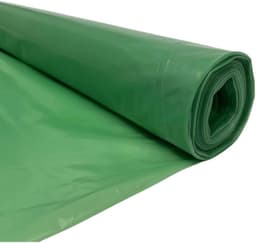
Many foam underlays already carry a thin film. If it is built in, tape the joints. An untaped seam is a slot the width of the room. A 500 gauge green roll is a different object: about 125 micrometres, often 2.7 m wide, and awkward in a living room. It can be thicker than the film in the EPLF bulletin and still be the wrong product. None of these five listings is sold as a laminate underlay. If the underlay has no film, buy the film the flooring maker names. If the slab failed the moisture check, stop.

What these listings actually say

The yellow B2C sheet, B0FZL66X8N, is the only row whose bullets name concrete floors and screeds. It is £19.79, 0.2 mm with ±30%, and the coverage field says 20 m² while the title also says 2 m by 50 m. That is not an sd-value of 75 m, and the bullets do not answer laminate. GVC2 at £12.60 has a laminate question and no answer. The ndcpolipak roll at £63.69 names walls, roofs and floors, not laminate. The foil at £42.25 is for a sauna. If the underlay already includes a film, tape it and leave these rolls for the wall. Stapling a warm-side sheet is on how to fit a vapour control layer. Thickness is on the vapour barrier buying guide.

Common questions

Do I need a separate sheet under laminate on concrete?
You need a damp-proof approach, which may already be inside the underlay. Wickes says that on concrete you use a damp-proof membrane or an underlay with damp-proof protection. Tape the joints if the foam includes a film. Fibreboard needs a separate layer. A 500 gauge roll bought for a timber frame is not automatically that layer, and it is not the membrane under the slab.
Is a foam underlay with a film enough?
It can be, when the flooring maker accepts that film and you tape every joint. Wickes notes that foam underlay often includes the protection. An untaped seam leaves a gap the length of the room. The film still has to meet the moisture limit for the slab. A built-in film does not dry a wet screed, and it does not replace a missing membrane below a new slab.
Can I use the green 125 micron roll as that film?
Only if the flooring maker accepts that sheet, and only after you measure it. These green rolls are sold as vapour control layers, with general bullets for walls, roofs and floors, not as laminate underlay. GVC2 has an unanswered laminate question. The ndcpolipak roll states 500 gauge and EN 13984, and a review says one sheet was 2.45 m wide, with another report of holes at the folds.
How do I know the concrete is dry enough?
Use the test the flooring maker requires. The Concrete Society points to the insulated hygrometer in BS 8203, and notes that many suppliers still want 75% surface relative humidity or less. A new slab often will not reach that in time, so the moisture has to be designed out. Prong-meter percentages on a shop guide are not that hygrometer. We have not tested your floor.
Will the yellow 0.2 mm sheet do, given the size clash?
It is a short yellow film whose coverage field says 20 m², at £19.79, and whose bullets mention concrete and screeds. The title also says 2 m by 50 m, and the thickness carries ±30%. That is not an sd-value of 75 m. Use it only if 20 m² is the area you can reconcile and the flooring note accepts this film.
What if the overnight polythene test shows droplets?
Stop, and find out why the slab is still giving up moisture. Droplets under a taped patch mean the surface is not ready for a floating floor. Any sheet from this set laid over those droplets hides the water. It does not meet BS 8203, and it does not replace a damp-proof membrane that should have been under the slab. Get the cause checked before you buy underlay.

Related pages

Sources

Public UK sources used for this comparison. Listing prices, stars and review counts are the amazon.co.uk lines kept with these five products. Shelf date 19 October 2026.

  1. Approved Document C, 2013 (retrieved October 2026)
  2. Approved Document L Volume 1 (retrieved October 2026)
  3. LABC Warranty vapour control layers (retrieved October 2026)
  4. NHBC 7.2.15 pitched roofs (retrieved October 2026)
  5. BS EN 13984:2013 (retrieved October 2026)
  6. NDC Polipak damp proofing (retrieved October 2026)
  7. Wickes Damplas VCL sheet (retrieved October 2026)
  8. Wickes laminate flooring guide (retrieved October 2026)