Independent comparisons. We may earn from shop links. More info

Hand tamper for a patio

Updated: 21 October 2026

You are laying a few slabs outside a UK back door, or setting a small shed where the mower will not drive, and you want to know whether a hand tamper can prepare the base. It can, when the area stays a foot-traffic patch and you compact thin layers. It cannot stand in for a vibrating plate once the same patch becomes a drive. The tools are the manual heads on the [Tamping rammer](/hub/flooring-tools-and-accessories/tamping-rammer) comparison, from 2.1 kg to 5.4 kg. This page stays with patios and pads. Peter F. used Pavingexpert and amazon.co.uk review themes on 20 October 2026. A purchase through our links can earn a commission at no extra cost to you.

You are laying a few slabs outside a UK back door, or setting a small shed where the mower will not drive, and you want to know whether a hand tamper can prepare the base.

Our top picks

On this page

A patio base is two layers

The layer under a slab is often bedding sand. Under that, where the ground needs building up, sits a sub-base, commonly Type 1. Sand needs a light, flat pass so you do not punch holes in a screeded bed. Type 1 needs enough mass, in thin lifts, that the stone stops moving under your boot. Hitting a deep loose heap from the top firms the crust and leaves the bottom soft. Pavingexpert's light-duty example for paths and patios is about 75 mm of compacted Type 1, with a plate or roller where space allows. A sledge or an asphalt punnel is named as a hand alternative, and the page still prefers a plate. Treat 75 mm as that example, not a rule for every clay in Britain. Bedding sand is not a substitute for the stone. The how to use a hand tamper page is the flat drop, the overlap and the underfoot check.

What reviewers actually tamped

Gekufa comments mention sand, border trenches and about eight extra slabs. Roughneck reviews include a 1.5 × 3 m Type 1 pad over several sessions, and say a plate is more consistent once the area grows.One OENBATOM user treats about 10 square metres as a personal limit. That is one review, not a British Standard. That comment is not evidence that 20 square metres will behave the same. BlumeTrec's 25.5 cm face covers more of a shed pad per drop than a 20 cm face, and it remains a hand tool. Amtech never states a square plate, so this page will not recommend it by face area. If you need the square on the listing, stay with the 20 cm heads or the 25.5 cm BlumeTrec.

Light head or 5 kg head

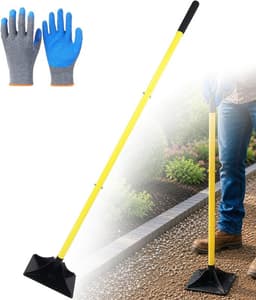
Use a light head for bedding sand and a short run of slabs. Gekufa at 2.43 kg, with gloves in the box and 4.6 from seven reviews, sits next to those eight-slab comments. About £37.99 does not buy Walensee's 4.08 kg. Use a heavier head for Type 1 under a shed or a small paved pad. Roughneck at 5.4 kg on amazon.co.uk, with Toolstation listing the same model at 4.5 kg and those figures not averaged, is the one-piece cast-iron option, 4.7 from 754 reviews. Walensee at 4.08 kg and about £38.99 has 4.5 from 1,650, and bolts that loosen. BlumeTrec at 5.32 kg gives the wider face. One piece if you will not retighten joints, sectional if the shaft must fit a cupboard, wider face if each drop should cover more of a 1.5 × 3 m pad. Spread 75 mm of Type 1 only if you compact it as you go.

When the patio is really a drive

A patio that will only see feet is the light-duty case. The same rectangle, once it must carry a car, a motorbike or a trailer, is a vehicle sub-base. Pavingexpert says hire plant at that point. A hand tamper remains useful for the edge the plate cannot reach. Boels mentions drives among places a manual tool can work. That is not permission to skip a plate under a car. The tamper versus wacker plate page is the three-machine choice. Stop when the surface still dents under your heel after a thin lift, or when you are too tired to land the face flat.The hand tamper is enough for the eight slabs and the small shed pad in these reviews. It is the wrong sole tool for the drive those slabs sometimes turn into.

Common questions

Can I lay a patio without a wacker plate?
You can prepare a few slabs or a small shed pad with a hand tamper if you compact thin layers and the surface stops moving underfoot. Pavingexpert still prefers a plate or roller where space allows, and names a hand method as the lighter-duty alternative. Once vehicles will use the area, hire a plate for the open sub-base and keep the hand head for the edges.
How thick is a foot-traffic sub-base?
Pavingexpert's light-duty example is about 75 mm of compacted Type 1 for paths and patios, and the FAQ often cites 75–100 mm where patio flags need the levels built up. Block paving always wants a sub-base on that guidance. Treat 75 mm as an example for foot traffic, not a depth for every soil. Build extra depth in lifts rather than one loose layer.
Is sand bedding the same job as Type 1?
No. Bedding sand is the thin layer that levels the slabs. Type 1 is the stone sub-base under it. A light tamper suits the sand if you land it flat. Type 1 in the shed-base reviews is where the 4–5 kg heads show up. Sand on uncompacted soil will settle however careful the screed looks.
What size of pad is still a hand job?
The review-sized jobs are about eight slabs, a 1.5 × 3 m pad, and one user's comment of about 10 square metres. That last figure is one person's limit, not a standard. Beyond a small pad, or anywhere a car will stand, a plate is the normal tool. You can still tamp the strip the plate cannot reach.
Will a light tamper bed slabs?
A 2.1 kg or 2.43 kg head can firm bedding sand on a short run, which is the Gekufa pattern. It is a weak choice for Type 1 under a shed, where reviews sit on the heavier tools. Land the face flat so you do not crater a screeded bed, and do not expect the light head to add compaction you can only get from mass or from a plate.

Related pages

Sources

Sources taken from the research digest. Listings were checked in October 2026.

  1. DfT Practical Guide to Street Works (retrieved 20.10.2026)
  2. GOV.UK: how to reinstate a road after street works (retrieved 20.10.2026)
  3. HAUC NG10.3 compaction requirements (retrieved 20.10.2026)
  4. HSE hand-arm vibration regulations (retrieved 20.10.2026)
  5. HSE PUWER overview (retrieved 20.10.2026)
  6. Pavingexpert: sub-bases (retrieved 20.10.2026)
  7. Coppard rammer hire (retrieved 20.10.2026)
  8. Toolstation Roughneck tamper ROU64379 (retrieved 20.10.2026)