Independent comparisons. We may earn from shop links. More info

How to use a suction lifter without dropping the piece

Updated: 21 October 2026

The first stick on a clean offcut felt fine, and the shower screen or the slab still ended up on the floor. Dust, a red line still showing, or a release knocked in the air is the usual UK failure. Clean and dry both faces, pump or lock until the indicator agrees, lift a few centimetres, and release only when the piece is supported. This guide, updated on 20 October 2026, follows the listings in our [Suction lifter](/hub/flooring-tools-and-accessories/suction-lifter) comparison. A qualifying purchase can earn us a commission at no extra cost to you.

The first stick on a clean offcut felt fine, and the shower screen or the slab still ended up on the floor. Dust, a red line still showing, or a release knocked in the air is the usual UK failure.

Our top picks

On this page

Clean the face and the pad, and leave them dry

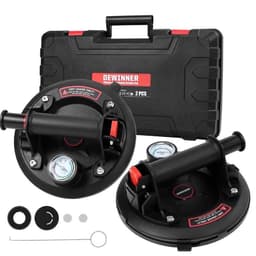
Vacuum needs two smooth surfaces touching. Dust, grinding residue, and the film on a new pane hold the rubber off the face. A seam or hard rubber, the Faithfull complaint, stopped a seal and let a tile drop. Wipe the pad and the tile with a dry cloth. A UK review of the DEWINNER cups says they work dry, and that you should not wipe the tile wet. The orange pair asks for a clean, dry, smooth surface before you pump. SEESII notes say dust stopped the seal until the face was wiped. Peel any film off the face you intend to cup.

Pump until the indicator agrees

Seat the whole pad. On SEESII you pump until the red line disappears. If the line is still visible, that cup has not reached its own check. DEWINNER’s gauge is what reviewers used before they committed to the tile. Faithfull has no line: press the pad and lock the handle, and both 120 mm pads have to seal. On SHALL or TengXcel, read the LCD the same way. A hidden red line is permission to test a few centimetres, not to cross the patio.

Test a few centimetres, then watch it

Lift a few centimetres and hold it. If the red line returns, or the gauge falls, set it down and pump again. The orange listing says real capacity depends on the surface, the angle, and the seal. The dangerous moment is the flip, when one hand leaves the slab. A UK review of the DEWINNER pair lost the slab during that flip without hitting the release. If one cup loses vacuum, you stop. You do not ask the remaining cup to inherit a doubled title. Mapei expects two people and clean pads. Crew and format sit on suction lifter for porcelain slabs.

Put it down, then press the release

The release is a valve you open after the piece is supported. SEESII reviews say the lever can be knocked and dump the vacuum. Carry so it sits clear of the hand taking the weight. When the piece is on the stack or in the frame, press the release. If the sequence is fighting the face, the buying choice is on the suction lifter buying guide. A battery cup does not skip the test, which is the choice on manual or electric suction lifter.

Common questions

Do you wet the pad or keep it dry?
Keep it dry when the listing says dry. A UK review of the DEWINNER cups says they work dry and that you should not wipe the tile wet. The orange pair asks for a clean, dry, smooth face before you pump. Dust and a film of slurry sit between the rubber and the surface. Wipe both with a dry cloth, and take any protective film off first.
What does the red line mean, and what do you do when it comes back?
On SEESII and the orange pair, a hidden red line means you have pumped enough to test. If the line shows again, the vacuum has fallen. Set the piece down and pump until the line hides, with the cup still on the face. A gauge, on DEWINNER or Taskstar, is the same warning on a dial. Either mark is a check, not a weighed capacity.
How do you test the seal without committing to the lift?
With the piece still supported, seat the pad, pump or lock until the indicator is in its safe zone, and lift a few centimetres. If the line returns, or the lever cup slips, put it down. Try a clean offcut of the same tile before you cup the slab you cannot afford to chip. The orange bullet tells you to test in a safe position first.
Where do you put your hands so you do not hit the release?
Keep your palm and any strap off the release while the piece is off the ground. SEESII reviews say that lever can be knocked during a lift and dump the vacuum. Carry with the indicator in sight and the release pointing away from the hand that takes the weight. The other hand stays on the slab, not on the valve.
What do you do if one cup of a pair loses vacuum?
Set the piece down. Do not finish the carry on the cup that remains, and do not add the two title loads to argue that it can cope. Re-seat the weak cup on a clean patch, pump until its own indicator agrees, and test a few centimetres again. If one pad of a Faithfull lever is dead, that cup is finished for this lift.
When should you stop and get a second person or a fitter?
Get a second person for a large slab even when the cup holds. A 200 kg title is not a one-person rule. Call a glazier or a fitter for a heavy sealed unit, structural glass, work above other people, or a stone worktop joint you have not done. If a clean, dry offcut will not hold after you have pumped to the indicator, stop. An aid does not replace knowing the weight.

Related pages

Sources

Public UK sources from the research digest, checked in October 2026. Prices, stars, and review themes come from the amazon.co.uk snapshot in the display file.

  1. HSE: vacuum lifting equipment (retrieved 20 October 2026)
  2. LOLER 1998, regulation 9 (retrieved 20 October 2026)
  3. HSE: thorough examination of lifting equipment (retrieved 20 October 2026)
  4. Manual Handling Operations Regulations 1992 (retrieved 20 October 2026)
  5. HSE: construction manual handling (retrieved 20 October 2026)
  6. Consumer Rights Act 2015, section 9 (retrieved 20 October 2026)
  7. BSI: BS EN 13155 (retrieved 20 October 2026)
  8. Mapei: installing large-format ceramic tiles, chapter 3 (retrieved 20 October 2026)