Independent comparisons. We may earn from shop links. More info

Suction lifter buying guide: the face before the kilogram

Updated: 21 October 2026

You are about to order a cup for a shower screen, a patio slab, or a worktop joint, and the titles shout 200 kg, 440 lb, and 880 lb. A suction lifter buying guide starts with the face in front of you. The printed maximum on these twelve amazon.co.uk listings is a marketing figure with no separate safe working load. This guide, updated on 20 October 2026, uses our [Suction lifter](/hub/flooring-tools-and-accessories/suction-lifter) comparison. We did not run a lift test. A qualifying purchase can earn us a commission at no extra cost to you.

You are about to order a cup for a shower screen, a patio slab, or a worktop joint, and the titles shout 200 kg, 440 lb, and 880 lb. A suction lifter buying guide starts with the face in front of you.

Our top picks

On this page

Match the cup to the face

Smooth glass, glazed ceramic, and polished stone are the faces the pump-pair bullets name. Structured, porous, and wood-effect porcelain are where no-grip notes cluster. The orange 8 inch pair at £39.99 excludes textured and rough faces. SEESII, at 4.1 from 648 reviews, has porcelain after a wipe and a note of no suction on a flat stone tile. Those paving cases are on suction lifter for porcelain slabs.

Read the load in the direction you will carry

Faithfull’s FAISUCPAD2, at £11.34, states 45 kg vertical and 30 kg horizontal. A pane in a frame is the vertical case. A slab carried flat is the lower number. SEESII states 200 kg and DEWINNER’s tensile field says 660 lb. The orange pair says 800 lb with both cups is not the sum of two 440 lb ratings. Bluebow writes 880 lb, which is that sum.

A seal you can see

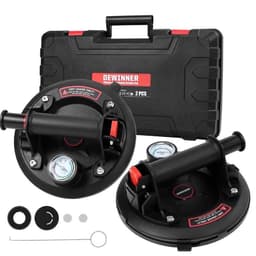
A red line, a gauge, or an LCD tells you the vacuum is falling. It does not raise the kilogram. On SEESII you pump until the red line disappears. DEWINNER and Taskstar fit a gauge. SHALL, TengXcel, and ONEVAN claim automatic top-up. If the rubber never sealed, there is no vacuum to maintain. Faithfull, BILITOOLS, Aleker, and HIGHTOP state no indicator.

Case, spares, and the battery that may be missing

SEESII at £35.99 lists spare seals and a case. TengXcel at £60.99 leaves the DeWalt battery out of the box. ONEVAN at £80.99 lists two batteries and two UK chargers, and the only UK review says it did not work. SHALL puts 2500 mAh in a bullet and one AAA cell in the spec. The battery-versus-pump choice is on manual or electric suction lifter.

Which type for which job

A lever cup is for a flat sheet you can also support. Faithfull states 30 kg horizontal. An 8 inch pump pair is the patio tool when you can see a red line or a gauge. HIGHTOP’s 6 inch setter is for a worktop joint. A battery cup earns its place when the pack is one you own. Who should leave each listing is on best suction lifter.

Common questions

What should you check before the kilogram on the title?
Check the face, then the direction, then whether you can see the seal. Pump-pair bullets ask for a smooth, dry, non-porous surface. A flat slab is the horizontal case, and only Faithfull prints a lower figure for it, 30 kg against 45 kg vertical. A red line or a gauge shows the vacuum falling while the piece is still close to the ground. The kilogram is the seller’s maximum, not a safe working load printed beside it.
When is a lever cup enough, and when do you want an 8 inch pump pair?
A lever cup is enough for a light, glossy pane inside the horizontal limit, when you can also hold the glass. Faithfull at £11.34 is that tool if both 120 mm pads sit flat. You want an 8 inch pump pair for a large tile or a patio slab, because the UK notes of those lifts sit on DEWINNER, SEESII, and Taskstar. The pair still needs a face the rubber can seal.
Why does vertical capacity differ from horizontal?
The pad resists a different pull. Faithfull states 45 kg vertical and 30 kg horizontal, so a pane in a frame and a slab carried flat are different claims. The 8 inch listings print one maximum and leave the flat carry inside it. HSE’s note of about 35 kg describes a simple aid. It does not turn a 200 kg title into a horizontal rating, and it does not ban a heavier cup you use with a second person.
Can you add two cup ratings and call that the pair?
The orange listing states 440 lb each and up to 800 lb with both cups, and it says the dual figure is not the sum of the two ratings. Bluebow writes 880 lb for two 440 lb cups, which is that sum. Two pads help only while both hold. The cup that loses vacuum is the limit of the pair, whatever the title adds together.
What does a red line or a gauge change about the purchase?
It gives you a check before the carry. You pump until the line hides or the gauge agrees, and you set the piece down if the line returns. It does not prove the title kilogram. On Bluebow the bullets describe an exhaust valve and the reviews describe a gauge. An LCD that tops the vacuum up is the same check with a motor.
Is a seam setter a lifter, and do stars put a cup outside LOLER?
HIGHTOP uses two 6 inch cups, and one UK review describes a joiner carrying a 3 m laminate worktop. The tool is still an adjuster for a joint. Reviews say suction can collapse as you tighten, and the file does not treat it as the carry cup for 20 mm pavers. Stars are amazon.co.uk ratings. LOLER 1998 applies to lifting equipment used at work. A high rating is not a thorough examination, and HSE’s 35 kg line is not a star threshold.

Related pages

Sources

Public UK sources from the research digest, checked in October 2026. Prices, stars, and review themes come from the amazon.co.uk snapshot in the display file.

  1. HSE: vacuum lifting equipment (retrieved 20 October 2026)
  2. LOLER 1998, regulation 9 (retrieved 20 October 2026)
  3. HSE: thorough examination of lifting equipment (retrieved 20 October 2026)
  4. Manual Handling Operations Regulations 1992 (retrieved 20 October 2026)
  5. HSE: construction manual handling (retrieved 20 October 2026)
  6. Consumer Rights Act 2015, section 9 (retrieved 20 October 2026)
  7. BSI: BS EN 13155 (retrieved 20 October 2026)
  8. Mapei: installing large-format ceramic tiles, chapter 3 (retrieved 20 October 2026)