Independent comparisons. We may earn from shop links. More info

How to use a concrete poker

Updated: 21 October 2026

The mix is in and you want a number of seconds to count. How to use a concrete poker is a sequence of vertical dips. You insert the head, you leave it until the large bubbles stop, and you pull it out slowly. You place the concrete where it needs to be, then compact it there. Peter F. followed the British Ready-Mixed Concrete Association guide of July 2020. There was no lab test. A qualifying purchase can earn a commission at no extra cost to you. Shaft lengths are on the [concrete poker comparison](/hub/flooring-tools-and-accessories/concrete-poker). Trenches and post holes are on [concrete poker for footings](/hub/flooring-tools-and-accessories/concrete-poker/sub/concrete-poker-foundations). Head and power are on the [concrete poker buying guide](/hub/flooring-tools-and-accessories/concrete-poker/sub/concrete-poker-buying-guide).

The mix is in and you want a number of seconds to count. How to use a concrete poker is a sequence of vertical dips. You insert the head, you leave it until the large bubbles stop, and you pull it out slowly.

Our top picks

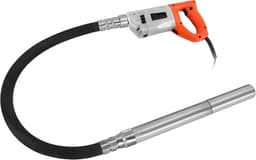
Hanchen Hanchen 1500 W 50 mm poker

Best overall

Hanchen Hanchen 1500 W 50 mm poker
8.4/10about £235.00
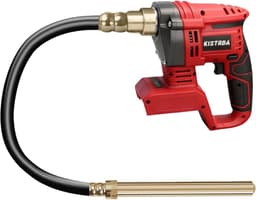
Kistrba Kistrba M18 cordless poker

Alternative

Kistrba Kistrba M18 cordless poker
5.6/10about £109.95
On this page

Put the head in and wait for the bubbles

Start the poker, then push the head in vertically. The British Ready-Mixed Concrete Association’s practical guide, July 2020, is the method this page follows. This dip is finished when the large air bubbles stop, the sound settles, and, on concrete that is not air-entrained, a thin glistening film appears. Those signs replace a clock. There is no 30-second rule in that guide. On a slab, move on once the surface has tightened. Take the head to the bottom of the layer you have just placed. On the next layer, go about 100 mm into the concrete below so the joint knits.

Space the next dip so the zones overlap

The Association’s spacing is about four to six head diameters between insertions. On a 35 mm head that is about 140–210 mm between centres. On the 50 mm Hanchen it is about 200–300 mm. Vibratechniques publishes a separate rule of thumb: an influence of about ten times the head diameter, on the order of 350 mm for a 35 mm head. That is their figure, not an average with the four-to-six spacing. Use the Association’s spacing to place the next hole. Neither number was measured on these amazon.co.uk listings. A drawing that sets the spacing outranks both.
Hanchen Hanchen 1500 W 50 mm poker

Testsieger

Hanchen Hanchen 1500 W 50 mm poker
8.4/10about £235.00

Lift it slowly and do not drag the concrete

Pull the head out steadily, slowly enough that the hole closes. A jerk leaves a channel. Lingering after the bubbles stop drives paste up and aggregate down. Do not flow the concrete sideways with a live head. The Association’s guide says to place the concrete where it is needed and compact it there. Dragging the poker into an empty corner builds a mortar skin on top and a stony layer under it. Fill the corner with the shovel, then dip. Keep the head off the formwork. Doncaster Tool Hire’s leaflet says not to bend the flexible shaft hard over the shuttering.

If the head is silent, tap the nose, then clean the shaft

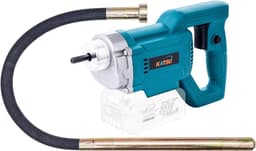
Some of these tools spin before they vibrate. Hocomay’s bullets say to tap the metal end on something solid, including after a pause. KATSU and Kistrba reviewers describe the same tap. Hire leaflets say to tap the nose, not the motor casing. That tap is a start procedure, not a repair. If it does nothing, stop. A Hanchen 35 mm review says the inner spring broke and the needle stopped vibrating. Get the head out and rod the rest by hand, or fetch another poker. Clean the shaft before the paste hardens, with the pack off or the lead unplugged. The Health and Safety Executive treats wet cement as an alkaline burn risk. Gloves do not cut hand-arm vibration. These listings publish no vibration magnitude, so there is no honest minute count.

Common questions

Do I push the poker in vertically?
Yes. Insert it upright to the bottom of the new layer, and on later layers about 100 mm into the concrete below, which is the Association’s overlap. Start the motor before the head is buried. A slanted pass across the top leaves the bottom untouched. Watch the surface beside the dip, not a clock you chose indoors.
How long do I leave it there?
Until the large bubbles stop, the sound settles, and, on concrete that is not air-entrained, a glistening film shows. Then withdraw. There is no 30-second rule in the Association’s guide. A fluid slab segregates if you linger. Vibratechniques’ “a few seconds” warns against staying too long. Stiff concrete may need longer to show the same signs.
How far apart are the dips?
About four to six head diameters in the Association’s guide: roughly 140–210 mm between centres on 35 mm, and about 200–300 mm on 50 mm. Vibratechniques’ influence of about ten times the head diameter is a separate rule of thumb. Do not average the two. Overlap the zones. A drawing that sets spacing outranks both.
Can I drag it sideways to fill the corner?
Place concrete in the corner first, then compact it with a vertical dip. The Association’s guide says not to use the poker to make concrete flow. Dragging a live head raises paste and bends the shaft over the shutter, which hire leaflets tell you to avoid. If the head cannot reach the corner, the hose is too short for that bay.
What if it spins but does not vibrate?
Tap the nose, not the casing, on something solid. Hocomay prints that step, and KATSU and Kistrba reviewers describe it. If the vibration starts, expect to repeat the tap after a pause. If the head stays silent, treat the inner drive as failed. A Hanchen review describes a broken spring. Rod what is left or fetch another poker.
Should it touch the shutter or the rebar?
Keep it off the formwork, or you mark the face and can loosen a stop-end. Close to the bars is normal in a tight cage. Levering on the steel, or kinking the hose over the boards, is the damage Doncaster Tool Hire’s leaflet warns about. Withdraw steadily. Place the concrete where the head can enter it.
How soon do I clean it?
As soon as the sequence is finished, before the paste hardens, with the tool isolated from the battery or the mains. Do not spin the head clean on the paving. Wash splashes off your skin the same hour. Wet cement is alkaline. Gloves are for that burn risk. They are not vibration control.

Related pages

Sources

Sources taken from the research digest. Listings were checked in October 2026.

  1. BRMCA practical guide, July 2020 (retrieved 20.10.2026)
  2. HSE hand-arm vibration for employers (retrieved 20.10.2026)
  3. Control of Vibration at Work Regulations 2005, regulation 4 (retrieved 20.10.2026)
  4. HSE construction electricity (retrieved 20.10.2026)
  5. HSE cement (retrieved 20.10.2026)
  6. Vibratechniques poker types (retrieved 20.10.2026)
  7. Enar UK selection note (retrieved 20.10.2026)
  8. Seddon Plant ENAR Spyder Pro (retrieved 20.10.2026)