Independent comparisons. We may earn from shop links. More info

Concrete poker for footings

Updated: 21 October 2026

The hole is open and a short poker is the only vibrator you own. A concrete poker for footings works when the head can stand at the bottom of the concrete you have just placed. It cannot compact an 800 mm trench from the lawn in one plunge. Peter F. checked the stated lengths against the Association guide and Enar’s note. There was no lab test. A purchase through our links can earn a commission at no extra cost to you. The cards are on the [concrete poker comparison](/hub/flooring-tools-and-accessories/concrete-poker). The dip itself is on [how to use a concrete poker](/hub/flooring-tools-and-accessories/concrete-poker/sub/concrete-poker-how-to-use). What to buy before you dig is on the [concrete poker buying guide](/hub/flooring-tools-and-accessories/concrete-poker/sub/concrete-poker-buying-guide).

The hole is open and a short poker is the only vibrator you own. A concrete poker for footings works when the head can stand at the bottom of the concrete you have just placed.

Our top picks

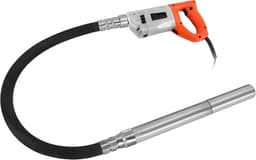
Hanchen Hanchen 1500 W 50 mm poker

Best overall

Hanchen Hanchen 1500 W 50 mm poker
8.4/10about £235.00
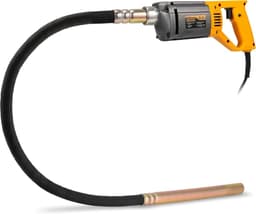
Hanchen Hanchen 1080 W 35 mm poker

Alternative

Hanchen Hanchen 1080 W 35 mm poker
5.5/10about £235.00
On this page

A post hole is not a strip footing

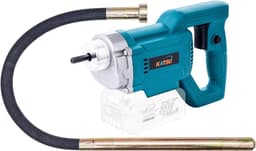
A fence-post hole is a narrow column, often with one bar or none. A 35 mm head, five of the six listings here, is the nose for that hole. A shed pad is wider, so you walk a grid of dips. A strip repeats that along the trench, and the hose has to clear the spoil at the edge. KATSU reviewers, on the 1.2 m body, describe a 700 mm slab, pads, a small raft and an extension foundation. A finished 700 mm slab is not a warranty that 1.2 m reaches an 800 mm trench from the side. A shed base about 100–150 mm thick is a shallow pad if the head goes through it. Leave the £59 DCSYOG, electric in the title and petrol in the table, out of an engineer’s foundation.

The shaft has to arrive at the bottom

Enar’s UK note asks for at least a metre more shaft than the depth you insert. An 800 mm footing then wants something nearer 1.8 m, and a 1.2 m hose is already short of that rule of thumb. UK reviews of the Kistrba describe about 1 m. The KATSU bullets state 1.2 m. The Hanchen 1080 W title states 1.5 m, while the bullets also offer 1.0 m. The Hanchen 50 mm, the Hocomay and the DCSYOG titles state 2 m, still not a deep foundation from ground level. If the head cannot reach the first layer, everything above it sits on uncompacted concrete. National Tool Hire listed a handheld electric poker from £21.73 a day including VAT.
Hanchen Hanchen 1500 W 50 mm poker

Testsieger

Hanchen Hanchen 1500 W 50 mm poker
8.4/10about £235.00

Pour deep concrete in layers

The Ready-Mixed Concrete Association’s guide places concrete in layers and puts the poker about 100 mm into the layer below. You compact a layer you can still reach, then place the next. A 1.2 m KATSU can follow a deep post hole down if each layer suits the remaining shaft. It cannot repair a trench that was filled from the mixer in one drop. Withdraw slowly so the hole closes. Dragging the head along the trench to save walking leaves the bottom of the layer short. The footing mistake is stabbing a short hose at a hole you have already filled. If the mix was ordered as self-compacting, leave the vibrator in the van.

35 mm for the hole, 50 mm only if the steel allows

A plain post hole takes 35 mm. The only 50 mm poker is the Hanchen SY 74C (B07Q813SKG), at £235.00, with a 2 m hose and a 12.8 kg package. The Association’s guide gives about 130–250 mm radius for a 35–40 mm head and about 180–350 mm for 50–75 mm. Those are the guide’s figures. On an open pad the larger head covers more per dip. In a tight cage it may not enter. This set does not sell the 60–75 mm heads some trade notes suggest. The 12.8 kg package is the other limit, against 5.12 kg for the KATSU body. A structural foundation is past these shafts.

Common questions

Will a 35 mm head do a fence post?
Yes, when the hole is narrow and the head reaches the bottom of each layer. Five of these pokers are 35 mm, from the £69.99 KATSU at 1.2 m to the 2 m titles. A single bar does not need the 50 mm Hanchen. Compact until the large bubbles stop, and take the head about 100 mm into the layer below. Choose 50 mm only when the cage has room for it.
Will a 2 m hose reach an 800 mm trench?
Only if the head still arrives after the hose leaves the motor and clears the edge. Enar’s rule of thumb is at least a metre more shaft than the insertion depth, so 800 mm sits near the end of a 2 m hose and beyond 1.2 m. A 2 m title is not a measured reach from the lawn. If the first layer is out of reach, hire.
Is a 50 mm head better for a pad?
On an open pad it covers a wider zone. The Association’s figures are about 180–350 mm radius for 50–75 mm, against about 130–250 mm for 35–40 mm. The only 50 mm listing is the Hanchen SY 74C at £235.00 and 12.8 kg. It suits a pad when the steel lets it in and you can lift it. A tighter cage wants 35 mm. The radius is the guide’s table, not a lab result for this poker.
What did reviewers pour with the short cordless tool?
KATSU reviewers describe a 700 mm slab, pads, a small raft and an extension foundation, with a 1.2 m, 35 mm, tool-only body. A separate reviewer would not use it on large pours. Those notes do not rate the tool for an engineer-specified foundation. The battery-shoe complaints are about starting it, not about how deep the hole was.
When do I hire a longer poker?
Hire when the head cannot reach the first layer, when the site needs a known 110 V kit, or when the foundation is structural and you will pour once. National Tool Hire’s handheld electric example started at £21.73 a day including VAT. A 1–2 m poker you own still suits repeated post holes and shallow pads you can reach.

Related pages

Sources

Sources taken from the research digest. Listings were checked in October 2026.

  1. BRMCA practical guide, July 2020 (retrieved 20.10.2026)
  2. HSE hand-arm vibration for employers (retrieved 20.10.2026)
  3. Control of Vibration at Work Regulations 2005, regulation 4 (retrieved 20.10.2026)
  4. HSE construction electricity (retrieved 20.10.2026)
  5. HSE cement (retrieved 20.10.2026)
  6. Vibratechniques poker types (retrieved 20.10.2026)
  7. Enar UK selection note (retrieved 20.10.2026)
  8. Seddon Plant ENAR Spyder Pro (retrieved 20.10.2026)