Independent comparisons. We may earn from shop links. More info

Cordless or electric concrete poker

Updated: 21 October 2026

You are choosing a poker for a house socket or for a site that only has a yellow outlet, and the advert may say cordless, 220 V and petrol on one page. A cordless or electric concrete poker decides the lead, the battery you already own, and whether 230 V belongs where you are standing. Peter F. checked these amazon.co.uk listings against HSE electricity guidance. There was no lab test. A purchase through our links can earn a commission at no extra cost to you. The six listings are on the [concrete poker comparison](/hub/flooring-tools-and-accessories/concrete-poker). Who each model is for, after this fork, is on [best concrete poker](/hub/flooring-tools-and-accessories/concrete-poker/sub/concrete-poker-best). Head and hose are on the [concrete poker buying guide](/hub/flooring-tools-and-accessories/concrete-poker/sub/concrete-poker-buying-guide).

You are choosing a poker for a house socket or for a site that only has a yellow outlet, and the advert may say cordless, 220 V and petrol on one page.

Our top picks

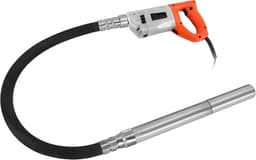
Hanchen Hanchen 1500 W 50 mm poker

Best overall

Hanchen Hanchen 1500 W 50 mm poker
8.4/10about £235.00
Kistrba Kistrba M18 cordless poker

Alternative

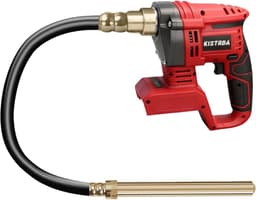
Kistrba Kistrba M18 cordless poker
5.6/10about £109.95
On this page

On a building site, lose the 230 V lead

On a construction site the Health and Safety Executive prefers battery tools, or 110 V equipment centre-tapped to earth. HSE describes ordinary DIY 230 V kit as unsuitable for site conditions. Where 230 V equipment is used, HSE expects an RCD. Mammoth Hire’s handheld electric poker is 110 V and needs a transformer, a generator or a 110 V supply. A yellow 110 V plug will not enter a household 13 A socket. A battery tool removes the mains lead.

At home, a mains poker is a plug you can identify

At a house, 230 V is the straightforward supply when you can name the plug. UK mains are 230 V and a domestic socket takes a BS 1363 plug. HSE’s electricity guidance points to a 30 mA RCD, tested on the day, with the lead kept out of the splash. Two £235.00 Hanchens are called electric, and neither states a voltage or a plug. The 50 mm table says no battery is included or required, which points away from a cordless body and still does not confirm a UK 13 A plug. A Schuko-only lead stops the pour. The DCSYOG title says 1500 W electric at 220 V, at £59.00, and the table says petrol. The Hocomay table says ac and, on another line, an included lithium-ion battery, at £82.99. Leave both unresolved. At home you need one machine you can plug in or start.
Hanchen Hanchen 1500 W 50 mm poker

Testsieger

Hanchen Hanchen 1500 W 50 mm poker
8.4/10about £235.00

Cordless in this set means tool only

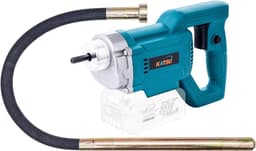
The KATSU 102713 is £69.99, tool only, 35 mm and 1.2 m. The bullets say batteries and a charger are not included, name Makita LXT packs such as the BL1850 and BL1830, and also say 18 V or 21 V. Reviewers report shoes that pinch, drop the pack or need filing, including on packs they describe as genuine Makita. If your pack clicks and stays, this is the cheaper pour without a lead. The Kistrba is the Milwaukee version, at £109.95, and advises 4.0 Ah or higher. The battery is not in the box. Two UK reviews describe about a 1 m hose. That price is a weak trade if you still have to buy a 4.0 Ah pack for the shortest hose in the set. Neither listing gives a runtime, so a second pack is the spare.

What neither choice fixes

Cordless removes the lead. It does not add reach, and a mains lead does not either. Lengths here run from about 1 m in the Kistrba reviews to 2 m on the Hanchen 50 mm title. Enar’s note asks for at least a metre more shaft than the insertion depth. Volts do not add that metre. Both families vibrate, and none of these listings prints a magnitude. The Control of Vibration at Work Regulations 2005 set an action value of 2.5 m/s² A(8) and a limit of 5 m/s² A(8). On site, use a battery tool or 110 V centre-tapped to earth. At home, use 230 V only when the plug is real and the 30 mA RCD has been tested.

Common questions

Is cordless safer on site?
Cordless removes the 230 V lead, which is what HSE wants off a construction site, alongside 110 V centre-tapped-to-earth kit. It does not remove vibration, wet cement or a short shaft. A body with no battery in the box is a poor site plan if the pack falls out and you improvise a mains lead. On site, battery or 110 V. At home, 230 V can stay when the plug and the RCD are real.
Will the KATSU run on my Makita batteries?
The bullets claim Makita LXT packs, including the BL1850 and BL1830, and they also say 18 V or 21 V. Batteries are not included. Reviewers report shoes that pinch, drop the pack or need filing, including on packs they call genuine Makita. If yours clicks and stays, you can pour. If it does not, £69.99 has not bought you a Makita tool.
Will the Kistrba run on my Milwaukee M18 pack?
It is a tool-only M18 body at £109.95 and names packs such as 48-11-1850. The advice is 4.0 Ah or higher so the poker does not shut down on overload. The battery is not in the box. Reviews are 3.9 from four, and they describe about a 1 m hose. Runtime is not stated, so take a second charged pack for anything longer than a couple of holes.
Can I plug a 110 V poker into a house socket?
A yellow 110 V plug does not fit a 13 A household socket. You need a transformer, a generator or a 110 V supply, which is how Mammoth Hire describes its handheld electric poker. Take the transformer with the tool. An adaptor that forces a site plug onto a ring main is the arrangement to avoid. At home, start from a 230 V tool whose plug the listing describes.
What if the advert says 220 V and petrol?
Treat it as unresolved. The DCSYOG title says 220 V electric, 1500 W, 35 mm and 2 m, at £59.00, and the table says petrol. The Hocomay, at £82.99, says ac and an included lithium-ion battery on different lines. One review each does not pick a winner. Choose a listing that names one drive before the concrete is wet.

Related pages

Sources

Sources taken from the research digest. Listings were checked in October 2026.

  1. BRMCA practical guide, July 2020 (retrieved 20.10.2026)
  2. HSE hand-arm vibration for employers (retrieved 20.10.2026)
  3. Control of Vibration at Work Regulations 2005, regulation 4 (retrieved 20.10.2026)
  4. HSE construction electricity (retrieved 20.10.2026)
  5. HSE cement (retrieved 20.10.2026)
  6. Vibratechniques poker types (retrieved 20.10.2026)
  7. Enar UK selection note (retrieved 20.10.2026)
  8. Seddon Plant ENAR Spyder Pro (retrieved 20.10.2026)