Independent comparisons. We may earn from shop links. More info

Kindling vs firelighters

Updated: 22 October 2026

Kindling and firelighters land in the same amazon.co.uk search, and they are not substitutes. Sticks build heat up to your logs. A firelighter holds a flame long enough for those sticks to catch. If you buy only one of them for a cold stove, the lay usually fails. This page says when you need both, when a hot ember bed lets you skip a lighter, and how wool, cubes and a stick box differ. The rows and prices live on the [kindling comparison](/hub/fireplaces-and-stoves/kindling). A qualifying purchase through our amazon.co.uk links can earn us a commission at no extra cost to you.

Kindling and firelighters land in the same amazon.co.uk search, and they are not substitutes. Sticks build heat up to your logs. A firelighter holds a flame long enough for those sticks to catch.

Our top picks

On this page

Two jobs, not two brands

HETAS describes both the traditional lay and the top-down lay as needing a firelighter, kindling and your firewood. A lighter that dies in a couple of minutes leaves the sticks unlit. Wet or over-thick kindling dies after the lighter has done its job. You use both, except on a bed of embers already hot enough to take a stick. A cold grate in the morning is not an ember bed. Log Barn’s bullets say one lighter on the kindling, or two or three if you start kiln-dried logs with no kindling layer. That is their instruction, not a rule for every box. The counted sequence is on how to light a wood burner with kindling. A lighter has no moisture percentage. A splitter makes sticks. It does not light them.

What the lighters are made of

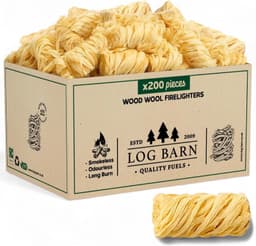
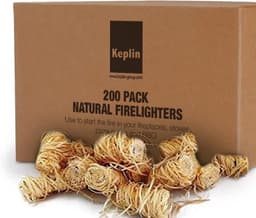
The wool boxes are wood wool plus wax, sold as loose pieces. Log Barn, £12.99 for 200 on 20 October 2026, says wax-dipped wood wool and up to 10 minutes, with United Kingdom on the origin field. KEPLIN, £11.99 for 200, says wood, wax and wool, and around 10 minutes, with China on the origin field. Firewood Hub’s 50-pack is £7.95 and an 8-minute claim. Per piece, the 50-pack is about 16p and the two 200-packs are about 6p and 6.5p. B0BX6FYT1Z is not wool. It is £14.99 for a stated 288 cubes of compressed sawdust and vegetable oil, about 5.2p each, with an 8 to 10 minute claim. The bullets say no palm oil and no fossil fuels. The pieces arrive as scored blocks that do not always snap cleanly. One review needed half a pack where four cubes of another brand had worked. Burn-time lines of 8–10 minutes are claims. One KEPLIN review timed a burn under 5 minutes. One Firewood Hub wool box would not stay lit until a replacement arrived.

Smell, cooking, and the word natural

Odour matters when food is above the flame, on a BBQ or in a pizza oven, more than in a closed stove. Log Barn’s bullets say odourless and non-toxic, and most of the first 50 UK reviews agree. KEPLIN’s file is similar, with one waxy comment. Firewood Hub’s 50-pack says odourless, and one review disagrees. The cube bullets say odour and taste free. Those lines are not a food-safety certificate. Natural does not tell you the wax. Log Barn and KEPLIN say wax and do not name it. Only the cube listing says vegetable oil and rules out palm oil and fossil fuels. Call a lighter paraffin-free only when that listing says so. Log Barn’s Ready to Burn sentence is about the brand’s firewood and kindling wood, not the wool. If you cook over the flame, test the odour with the food off to one side, and stop if you smell fuel.

The listing that says both

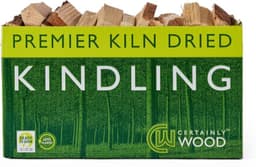
Certainly Wood, B01LXA92FN, is the trap in a mixed search. The title says natural firelighters. The form is kindling sticks, 110–120 pieces at 2.5–3.5 kg for £8.99. You still need a flame under them, unless the embers are already hot. The brand’s Flamers are not in this box. If you wanted 200 wool pieces, the 4.6 from 4,362 ratings will not help: that is the deepest wood file, not a lighter file. If you wanted sticks with a below-12% claim and a Ready to Burn sentence, it is the wood row. The certificate number is not in the listing, and one order was metered well above 12%. For a cold log burner, buy sticks and a lighter. For a hot ember bed, sticks alone are the exception.

Common questions

Do I need both kindling and firelighters?
For a cold stove, yes. HETAS lists a firelighter, kindling and firewood for both lays. A hot ember bed can take dry sticks without a new lighter. Log Barn’s two-or-three-lighters line is one brand’s bullet, not a rule for every box.
Can a firelighter replace kindling?
On the Log Barn instruction, two or three lighters can start kiln-dried logs. A single lighter that burns out in a few minutes will not replace a layer of dry sticks. Test that claim once. It is not the default lay.
Can sticks replace a firelighter?
On a hot ember bed, dry sticks can. In a cold stove the lighter sits under the kindling. Loose newspaper, about cricket-ball size, is HETAS’s other option. Tight paper smoulders. Petrol and paraffin are not options.
Wool nests or compressed cubes?
Wool lighters are loose wax-dipped pieces, about 6–6.5p in the 200-packs and about 16p in the 50-pack. The 288-cube box is sawdust and vegetable oil at about 5.2p per stated cube, sold as sheets you snap. Choose wool to drop on the kindling. Choose cubes only if you will break the blocks.
Which lighters claim no odour for cooking?
Log Barn says odourless, and most of the first 50 UK reviews agree. KEPLIN has one waxy comment. One Firewood Hub review disagrees with odourless. None of those lines is a food-safety certificate. If you smell fuel, keep food off that flame.
Are natural lighters free of petroleum wax?
Only if the listing says so. The cube bullets rule out fossil fuels and palm oil. Log Barn and KEPLIN say wax and do not name it. Natural on a title is not a wax specification.

Related pages

Sources

Public UK sources used for Ready to Burn, smoke control and lighting. amazon.co.uk prices, stars and review counts were taken from the listings on 20 October 2026.

  1. GOV.UK, smoke control area rules (retrieved 20 October 2026)
  2. GOV.UK, selling wood for domestic use in England (retrieved 20 October 2026)
  3. Ready to Burn, consumers (retrieved 20 October 2026)
  4. HETAS, how to light a fire (retrieved 20 October 2026)
  5. HETAS, using a wood burner responsibly (retrieved 20 October 2026)
  6. Woodsure, woodfuel schemes (retrieved 20 October 2026)