Independent comparisons. We may earn from shop links. More info

Firewood drill vs axe

Updated: 22 October 2026

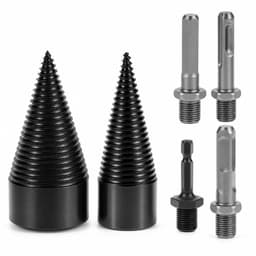
A listing calls the cone safer than an axe because there is no swing. The other half is a threaded bit that can spin the billet and twist the drill. A firewood drill vs axe decision is which risk you are taking with this week's wood. We used the amazon.co.uk listings in this set and public safety notes, and did not run a lab test. Updated 20 October 2026. A qualifying purchase can earn us a commission at no extra cost to you. Which cone to buy is the [firewood drill comparison](/hub/fireplaces-and-stoves/firewood-drill). Lighting sticks are on [drill bit for kindling](/hub/fireplaces-and-stoves/firewood-drill/sub/firewood-drill-kindling). The first hole is [how to use a firewood drill bit](/hub/fireplaces-and-stoves/firewood-drill/sub/firewood-drill-how-to-use).

A listing calls the cone safer than an axe because there is no swing. The other half is a threaded bit that can spin the billet and twist the drill.

Our top picks

On this page

The risk moves, it does not vanish

An axe fails when the swing misses. The cone removes that arc and replaces it with a thread that can twist the drill. RV Daily, an Australian account and not a test of these listings, describes timber hitting the ankles. One FOROREH reviewer called the cone safer than an axe. A WEDAMOO reviewer reported a wrist injury on a Milwaukee drill and preferred a small axe. HSE guidance in HSG172 is about workplace wedge splitters, not a ban on these cones. The narrow case is small, dry, straight softwood and a braced log.

When a cone is the tool

The cone earns a place on short, straight softwood you could almost open by hand, where you do not want a blade swinging in a small room. Stop when the drill yanks. You are not processing a winter of oak. A UK review on WEDAMOO failed on a 6 inch oak log and went back to an axe. Knotty, twisted or wet softwood fails the same test.

When an axe or a ring splitter is the tool

A hatchet is the better tool when the wood is hardwood, large, knotty or wet. A maul takes over when a hatchet is too light. A ring splitter, the Kindling Cracker pattern, is a third tool. The Wood Burner says it keeps hands off the edge, and that knotty rounds still want a maul. BBC Gardeners' World noted a 16 cm ring and an RRP of £129, which is not a price in this cone set.

One recommendation with a condition

Use a cone only for a few small, dry, straight softwood pieces, with a drill that will not stall and a log you can brace. If the pile is hardwood, large, knotty or wet, use an axe, a maul or a ring splitter. A cone does not replace a hydraulic splitter. It has neither the cradle nor the guarded wedge. The firewood drill bit buying guide is the checklist after you accept that limit.

Common questions

Is a firewood drill safer than an axe?
It can be safer for the swing, and worse for your wrists. One FOROREH reviewer called the cone safer than an axe. A WEDAMOO reviewer reported a wrist injury on a Milwaukee drill and preferred a small axe. An Australian account, not a test of these listings, describes spinning timber hitting the ankles. Safer applies only to small, dry, straight softwood, a drill that will not stall, and a braced log. It is not a blanket over every stove pile.
When is a hatchet the better tool?
A hatchet is the better tool when the wood is hardwood, large, knotty, or wet, and you can still swing onto a block. A UK WEDAMOO review failed on a 6 inch oak log and went back to an axe. A splitting maul takes over when the hatchet is too light. A tired swing is still how axes injure people. The cone only suits a narrower pile, and it does not remove the need to stop when you are tired.
What about a Kindling Cracker?
A Kindling Cracker is a ring and a wedge, not a drill cone. The Wood Burner says it keeps hands off the edge, and that knotty rounds still want a maul. BBC Gardeners' World noted a 16 cm ring, a separate hammer, and a safety best-buy in that axe article, at an RRP of £129. Do not treat £129 as a cone price, and do not read the review as safer in every way. It is a third option when the wood fits the ring.
Can a cone replace a hydraulic splitter?
No. A hydraulic splitter cradles the log and drives a wedge with a force a hand drill does not have. A screw cone is plausible only for a few small, dry, straight softwood pieces with the log braced. A 6 inch oak log already sent one UK WEDAMOO reviewer back to an axe. HSE notes about not holding a log belong to workplace wedge machines. They do not ban the bit.
I have bad wrists. Which risk is mine?
Yours is the twist, if you choose the cone. The thread can bind and the drill can orbit, which is what a WEDAMOO reviewer reported on a Milwaukee drill before preferring a small axe. An axe moves the risk to the swing. A ring splitter moves it to a hammer on a wedge, if the piece fits, though knots can still refuse the ring. If a stall already hurts, leave the cone in the drawer.
Will a cone split the oak my axe already manages?
Do not plan on it. A UK WEDAMOO review failed on a 6 inch oak log and the reviewer went back to an axe. Hardwood, large rounds, and knots belong with an axe, a maul, or a ring splitter. A stronger drill does not rewrite that review. The wrist injury on a Milwaukee drill, on the same brand's listing, is the other warning. If your axe already opens the round, the cone is a different tool for a smaller, softer job.
What should I buy if I only need kindling?
Decide the tool before you decide a cone diameter. A cone is a maybe for a few straight softwood pieces you can brace, not the default British method. UK kindling writing more often starts with a hatchet or a ring splitter, gloves, and eye protection, on a block. Size, the 32 mm cones in this set, and moisture sit on the kindling page. A large cone bought because a title mentions oak is how a lighting job turns into a stall.

Related pages

Sources

Public UK sources used for this comparison. amazon.co.uk prices, stars and review counts were taken from the listings on 19 October 2026.

  1. GOV.UK, selling wood in England (retrieved 19 October 2026)
  2. Woodsure, Ready to Burn (retrieved 19 October 2026)
  3. Air Quality (Domestic Solid Fuels Standards) (England) Regulations 2020 (retrieved 19 October 2026)
  4. Consumer Rights Act 2015, section 9 (retrieved 19 October 2026)
  5. Consumer Rights Act 2015, section 22 (retrieved 19 October 2026)
  6. HSE, firewood-processor bulletin (retrieved 19 October 2026)
  7. HSE, PUWER overview (retrieved 19 October 2026)
  8. Electrical Safety First, drills (retrieved 19 October 2026)