How to use a firewood drill bit
The video made the first hole look like a ten-second job. It is not that job if the log can spin, the drill is in hammer mode, or you reach for reverse. Fit the shank with the drill dead, brace a small dry piece, start at the edge unless the listing says otherwise, stay in low gear, and quit when it binds. We used the amazon.co.uk listings captured on 19 October 2026 and did not run a lab test. A qualifying purchase can earn us a commission at no extra cost to you. Which cone is worth owning is the [firewood drill comparison](/hub/fireplaces-and-stoves/firewood-drill). Hardwood, wet or knotty timber belongs on [firewood drill versus an axe](/hub/fireplaces-and-stoves/firewood-drill/sub/firewood-drill-vs-axe).
The video made the first hole look like a ten-second job. It is not that job if the log can spin, the drill is in hammer mode, or you reach for reverse.
The video made the first hole look like a ten-second job. It is not that job if the log can spin, the drill is in hammer mode, or you reach for reverse. Fit the shank with the drill dead, brace a small dry piece, start at the edge unless the listing says otherwise, stay in low gear, and quit when it binds. We used the amazon.co.uk listings captured on 19 October 2026 and did not run a lab test. A qualifying purchase can earn us a commission at no extra cost to you. Which cone is worth owning is the firewood drill comparison. Hardwood, wet or knotty timber belongs on firewood drill versus an axe.
Our top picks
| Badge | Product | Edge start | Drill named | Shanks | Note | Price | Offer |
|---|---|---|---|---|---|---|---|
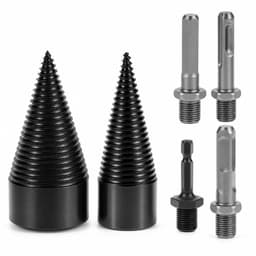
| Best overall |  Holy Feather Holy Feather 32 mm and 42 mm set | UK review: crack near the middle | Rotary hammer in drill-only mode | Four adapters; attribute says Straight | 5.2 | about £9.97 | View offer |
 KATUR KATUR 32 mm firewood drill bit | Not stated | Electric hammer, percussion and hand drill | Square, round, small hex and large hex | 6.0 | about £16.99 | View offer | |
 QWORK QWORK 45 mm and 32 mm drill set | Start from the log edge | Drills above 750 W | Round, square, 3/8 hex and 1/4 hex | 3.6 | about £21.80 | View offer |


On this page
Fit the shank while the drill is unplugged
Brace the wood and start at the edge
Low gear, drill mode, both hands
When it binds, stop
Common questions
Where do I start the hole?
Should the drill be in hammer mode?
What do I do when it sticks?
Why does reverse take the shank off?
How do I stop the log spinning?
Can I hold the log between my feet?
When should I put the drill down and use an axe?
Related pages
Sources
Public UK sources used for this comparison. amazon.co.uk prices, stars and review counts were taken from the listings on 19 October 2026.
- GOV.UK, selling wood in England (retrieved 19 October 2026)
- Woodsure, Ready to Burn (retrieved 19 October 2026)
- Air Quality (Domestic Solid Fuels Standards) (England) Regulations 2020 (retrieved 19 October 2026)
- Consumer Rights Act 2015, section 9 (retrieved 19 October 2026)
- Consumer Rights Act 2015, section 22 (retrieved 19 October 2026)
- HSE, firewood-processor bulletin (retrieved 19 October 2026)
- HSE, PUWER overview (retrieved 19 October 2026)
- Electrical Safety First, drills (retrieved 19 October 2026)