Independent comparisons. We may earn from shop links. More info

Tempered fire glass buying guide

Updated: 22.10.2026

You are choosing a bag of fire glass before you have settled on a colour, and the search mixes three products that do not do the same job. A tempered fire glass buying guide, for this set, is an order of checks: the appliance manual, the fuel, the piece size, the kilograms, the colour, and only then a printed temperature. The [fireplace glass comparison](/hub/fireplaces-and-stoves/fireplace-glass) holds the six amazon.co.uk bags and the prices captured on 19 October 2026, from £14.99 to £24.99. Products Compared read those listings and public UK sources. There was no lab test. A qualifying purchase can earn us a commission at no extra cost to you.

You are choosing a bag of fire glass before you have settled on a colour, and the search mixes three products that do not do the same job.

Our top picks

On this page

Media, not a stove pane

Loose fire glass is decorative media. It sits in a burner pan so the flame has something to play over. It is not a fuel, and it is not the sheet you look through on a wood stove. SCHOTT describes ROBAX as a glass-ceramic viewing panel, with a manufacturer heat line up to 760 °C, and UK pane shops cut that sheet to the door. If the door is cracked, you are in a stove-glass shop. If the pan looks dull, you are choosing media. The check that decides the purchase is the manual for the pit or the fire you already own.

Fuel the manual allows

Start with the appliance, then the fuel the manual allows, and only then the fuel the bag names. In this set the overlap is outdoor gas or propane. Teamson's clear and red listings point at outdoor garden gas fire pits. The blue listing says propane gas pits. yarlung says propane and natural gas. Hiland says natural gas or propane and also prints indoor or outdoor, which is not permission for a living-room coal bed. Firebrand Direct is the only title that names ethanol burners, on a 1 kg jar. None of these six listings is a wood fuel, and the Teamson pages ask about a wood fire without recording a yes. An indoor gas fire is a different stop, because the ceramic coals it came with are part of the type approval. Aquashi's PDF says that supplier's glass cannot be used with propane. That is one seller's limit. The fuel check is done when the manual and the listing name the same fuel.

Piece size and pack weight

No listing in this set gives a screened minimum and a maximum. Hiland's amber crush states no piece size, and UK reviews call it very small, including almost powder. Teamson quotes an average length of 1.3 cm. yarlung quotes diamonds about 2.5 cm across. Firebrand's listing is silent, and the three UK texts do not agree. Firebrand's title is 1 kg and the weight field says 1.24 kg. The other bags are about 4 to 4.54 kg. A 1 kg jar can top up a small ethanol burner. A 4 kg bag can still be too much if you pour all of it over a burner the manual wants barely covered. Teamson clear's title says 4 kg and the item-weight field says 1 kg. Blue and red state 4 kg without that clash.

Colour, then the temperature claim

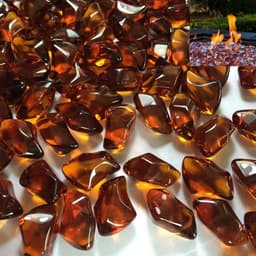
Colour is what you see in daylight, and the flame can change it. UK texts say Teamson red turns black, or loses its colour, once the flame is on. One buyer who mixed two colours said they did not discolour. One UK review of the clear bag says the pieces went black on the first light-up. Blue is a mirrored backing on the same 1.3 cm rock. Hiland and Firebrand are amber. yarlung mixes three colours in one bag. Only the three Teamson listings print 600 °C. We did not test any bag. If the manual allows glass and you know the fuel, the size and whether 1 kg or about 4 kg matches the pan, the best fire glass page names a bag. This page does not rank one.

Common questions

Is tempered fire glass the same as stove-door glass?
No. Stove-door glass in UK shops is a glass-ceramic pane, often SCHOTT ROBAX, cut to the door, with a manufacturer line up to 760 °C on that product family. The bags in this comparison are loose media: crush, diamonds, small rocks or beads, from about 1 kg to about 4.5 kg. A cracked stove door needs a pane cut to the opening. A dull fire-pit pan needs a bag the manual allows.
What should you check before colour?
The manual, then the fuel, then piece size, then pack weight. Colour is a daylight choice, and the flame can change it, as the red Teamson reviews describe. A temperature claim comes after those checks. A 600 °C line on a Teamson bag does not tell you whether the pieces are 1.3 cm or whether the pit was approved for glass at all.
Does a 600 °C line mean the bag was tested?
It means the Teamson listings print up to 600 °C. Hiland, yarlung and Firebrand do not print a Celsius figure. Products Compared did not run a heat test, and the saved listings do not include an independent report. Treat 600 °C as the seller's claim. UK reviews of popping, blackening and, on the yarlung diamonds, explosions still sit on the record beside that claim.
Why does piece size matter more than the photograph?
The photograph is the picture the seller chose. Hiland's listing gives no piece size, and UK reviews call the amber crush very small, sometimes almost powder, and smaller than the advert. Teamson states an average of 1.3 cm. yarlung states about 2.5 cm. If you need pieces you can see across a table, an average or an about figure is the number to compare, and you still will not get a screened minimum and maximum from these six pages.
Is a 1 kg jar the same job as a 4 kg bag?
Firebrand Direct's title is 1 kg, with a weight field of 1.24 kg, and it is the listing that names ethanol burners. The other five bags are about 4 to 4.54 kg. Use the jar for a small burner or a top-up. Use a 4 kg bag only up to the depth the pit manual allows. Buying 4 kg does not mean the burner should disappear under the whole bag.

Related pages

Sources

Public UK sources used for this comparison. amazon.co.uk prices, stars and review counts were taken from the listings on 19 October 2026.

  1. Approved Document J (retrieved 19 October 2026)
  2. Gas Safety (Installation and Use) Regulations 1998 (retrieved 19 October 2026)
  3. HSE, Domestic gas FAQs (retrieved 19 October 2026)
  4. GOV.UK, Smoke control areas (retrieved 19 October 2026)
  5. HETAS, standards (retrieved 19 October 2026)
  6. SCHOTT ROBAX (retrieved 19 October 2026)
  7. Flamecrafters, fire glass or lava rock (retrieved 19 October 2026)
  8. Brightstar natural-gas pit manual (retrieved 19 October 2026)