How to install a wireless smoke alarm
You have a battery pack from amazon.co.uk on the table and about an hour before you want the first test beep finished. This is how to install a wireless smoke alarm from the sets in the [wireless smoke alarm comparison](/hub/fire-protection/wireless-smoke-alarm): ceiling position, a fixing that stays up, then a test where one button makes every linked head sound. If you are still choosing the pack, use the [buying guide](/hub/fire-protection/wireless-smoke-alarm/sub/wireless-smoke-alarm-buying-guide) first. Stop if the job is mains. These steps are for sealed or replaceable battery heads. A qualifying purchase can earn a commission at no extra cost to you.
You have a battery pack from amazon.co.uk on the table and about an hour before you want the first test beep finished.
You have a battery pack from amazon.co.uk on the table and about an hour before you want the first test beep finished. This is how to install a wireless smoke alarm from the sets in the wireless smoke alarm comparison: ceiling position, a fixing that stays up, then a test where one button makes every linked head sound. If you are still choosing the pack, use the buying guide first. Stop if the job is mains. These steps are for sealed or replaceable battery heads. A qualifying purchase can earn a commission at no extra cost to you.
Our top picks
| Badge | Product | Mounting | Test or hush | Linking | Note | Price | Offer |
|---|---|---|---|---|---|---|---|
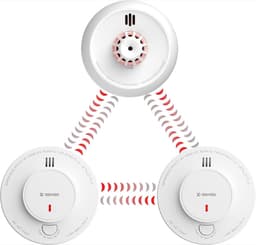
| Best overall |  LINKD LINKD smoke, heat and CO | Pads or screws | Hush from any head | RF, pre-linked | 9.2 | about £99.99 | View offer |
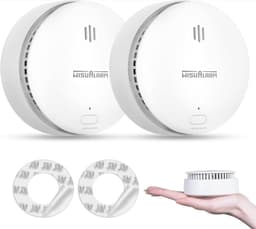
| Alternative |  WISUALARM WISUALARM SA20A 2-pack | Sticker or screws | Silence button | Standalone | 9.2 | about £18.69 | View offer |
| Best value |  X-Sense X-Sense HS21 | Screws and plugs | n/a | Link+ radio | 8.4 | about £47.99 | View offer |

On this page
Where each head goes
Fix the base before you trust the pad
Power, pair, then twist on
Test the local alarm and the interlink
Common questions
Should the alarm go on the ceiling or the wall?
Are sticky pads acceptable?
How do I add a spare to a pre-linked pack?
How do I prove the interlink works?
Where does the heat alarm go, and how often do I test?
Related pages
Sources
Public UK sources listed below, plus amazon.co.uk shelf prices and ratings for these ASINs, last checked on 19 October 2026.
- Scottish Government: fire and smoke alarms in Scottish homes (retrieved 19 October 2026)
- Scottish Government: where and what to buy (retrieved 19 October 2026)
- Scottish Government: Tolerable Standard guidance on fire and carbon monoxide detection (retrieved 19 October 2026)
- Scottish Government: changes to fire safety laws (retrieved 19 October 2026)
- GOV.UK: smoke and carbon monoxide alarms, England regulations Q&A for landlords (retrieved 19 October 2026)
- legislation.gov.uk: Wales regulation 5, smoke alarms (retrieved 19 October 2026)
- GOV.WALES: fitness for human habitation guidance (retrieved 19 October 2026)
- EDA summary of BS 5839-6:2019 changes (retrieved 19 October 2026)