Independent comparisons. We may earn from shop links. More info

How to light a Swedish torch

Updated: October 2026

The log is by the back door, the listing said one match and little smoke, and you want it drawing before anyone sits down. How to light a Swedish torch is the cut and the surface, not a special match. The Products Compared editorial team used the Topline reviews and fire-service advice on 16 October 2026. We did not time a burn. The packs are on the [Swedish fire torches comparison](/hub/fire-protection/swedish-fire). Stay outdoors, with water ready. Devon and Somerset Fire and Rescue Service say stay with a fire, use water, and make sure it is fully out.

The log is by the back door, the listing said one match and little smoke, and you want it drawing before anyone sits down. How to light a Swedish torch is the cut and the surface, not a special match.

Our top picks

On this page

Set it before you strike a match

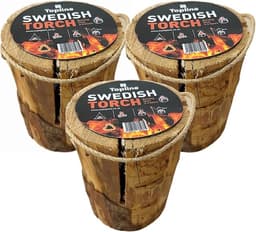
Stand the log upright on a surface that will not burn under heat from the base. Decking and dry grass fail that test. A spare slab, gravel, or a metal pit gives the foot somewhere to go. The log has to stand straight. A lean burns up one side, which the reviews already describe, and becomes a fall once the kerfs open. Check the cut while the wood is cold. A slit torch needs open vertical gaps. A centre-hole candle needs the bore clear. The Topline bullets claim one match. The three-pack is the top pick and the best value on price per stated log, as the best Swedish torch page explains, and a spare log is still the same cut.

Light the centre, then give it air

Put the flame where the cuts meet, or in the hole, not on the bark. Lekto and the Logsmith both start there, then use a gentle blow. If your torch has no firelighter, a match in the open cut is the substitute. Do not blow so hard that you scatter the ember. Do not start it with petrol, kerosene, or another accelerant. They flare while you lean over the top, and they do not open a closed cut. STIHL's UK page is useful for the chimney and for moisture at or below 20%: damp wood smokes, and very dry wood can burn fast. The DIY size on that page, about 30–60 cm by 50–100 cm, is not these packs. Limits on where you may light it are in Swedish torch garden rules.

When it smokes or dies

Smoke usually means there is no chimney. Moisture is one cause. A closed kerf is the other, and merchant how-tos often skip it. Buyers describe slots that had closed, a smoulder, and a flame that died in a light breeze. At least one person poured water on a log that would not stay lit. A later piece from the same order sometimes ran after the first only smoked, so the batch can be uneven. Widening a closed kerf is your modification, not the product as sold. Do it only while the log is cold, and keep the base intact. If supper depends on the flame, a pit you can refuel is the more honest tool, as Swedish torch versus a fire pit sets out.

Put it out and leave it outside

Water ends the fire. Devon and Somerset's advice is to stay and use water until it is fully out. Pour until the hissing stops, and pour again if you move the debris. The centre holds heat after the flame has died, and a black log can relight in a breeze. Do not carry it indoors, and do not stand it in a porch, tent, or garage. It has no flue. Leave the remains outside on the same spot until they are cold, not merely dark. If smoke fills a neighbour's windows, use the rules page. If the flame spreads to a fence, a shed, or a building, call 999. Dry wood, an open cut, a hard base, flame in the centre, no accelerant, and water at the end. The smoke line is the seller's.

Common questions

What if it only smokes?
Treat smoke as draught or moisture, not as a reason to add fuel from a can. A damp or mouldy log needs to dry. A closed kerf cannot feed the centre, which is the Topline pattern, along with flames that died in a breeze. Confirm the cuts are open and the log is out of the cross-wind.
Should you widen closed cuts?
Only while the log is cold, and only as your own alteration. Open a pinched slot enough for air, and keep the base intact. That is not how it was sold. A split log is worse than a smoky one. Do not cut it once it is alight.
Can you stand it on decking or dry grass?
Do not. Heat leaves through the base, and the reviews include scorched ground and logs that fall apart. Decking can burn. Dry grass hides embers. Use a spare slab, gravel, or a metal pit. Keep about three feet, 0.9 metres, from fences, sheds, trees, and awnings while it burns and while it cools.
How do you know it is out?
The flame going out is not the test. The centre stays hot, and a dark log can relight. Soak it until it stops hissing, check the cuts for glow, and leave it outside until it is cold. Devon and Somerset tell you to stay with an open fire until it is fully out. Do not carry a dead torch indoors to be sure.
What must you never use to start it?
Petrol, kerosene, and other accelerants. They flare in the kerfs while your face is over the log, and they do not open a closed cut. Use a match or a natural firelighter in the centre, on wood that is dry and open. The Topline listing does not include a firelighter.

Related pages

Sources

Public UK sources used for this comparison. Listing prices are from amazon.co.uk on 15 October 2026.

  1. GOV.UK — garden bonfires: the rules (retrieved 15 October 2026)
  2. GOV.UK — smoke control areas: the rules (retrieved 15 October 2026)
  3. GOV.UK — nuisance smoke: how councils deal with complaints (retrieved 15 October 2026)
  4. GOV.UK — selling wood for domestic use in England (retrieved 15 October 2026)
  5. Ready to Burn — Woodsure and HETAS for Defra (retrieved 15 October 2026)
  6. STIHL UK — Swedish fire log (retrieved 15 October 2026)
  7. Highways Act 1980, section 161A (retrieved 15 October 2026)
  8. Devon and Somerset Fire and Rescue — stay with summer fires (retrieved 15 October 2026)