Independent comparisons. We may earn from shop links. More info

How to use a fire hose reel

Updated: October 2026

You are the person standing next to a hose reel that is already on the wall, and a small fire has started in ordinary solid materials. How to use a fire hose reel is a short sequence with a hard stop: alarm and a clear exit first, then water only if you can still leave, then shut down and store. The [fire hose comparison](/hub/fire-protection/fire-hose) holds the hoses. Peter F. drew the steps from the Home Office guide, hose-reel manuals and UK fire-service maintenance notes, on 20 October 2026. Nothing here is a lab test. A purchase through our links can earn a commission at no extra cost to you.

You are the person standing next to a hose reel that is already on the wall, and a small fire has started in ordinary solid materials.

Our top picks

On this page

Before you pull hose

Raise the alarm and make sure people are leaving before you touch the drum. Call 999. If you are in a flat or a house, GOV.UK's fire advice is to get out, stay out and call 999. At work, use the reel only for a small Class A fire in ordinary combustibles, and only with the exit behind you. The Home Office guide says hose reels supplement extinguishers. A hose run across that doorway can hold a fire door open. If the only way to reach the fire traps you, leave. On a manual reel you open the isolating valve, then pull the hose. On an automatic reel, pulling the hose can open the valve, and the nozzle still starts shut. If you do not know which type of reel you have, leave it for the competent person who maintains it.

Jet, spray, and where to aim

BS EN 671-1 describes the nozzle positions as shut, spray and jet, and it recommends spray as the setting between shut and jet. You start at shut, you open to spray, and you move to jet only if the spray is not reaching the base of what is burning. Aim at the base of the fire, not at the flames in the air and not at the ceiling. Keep the nozzle shut while you move. An open jet in a corridor soaks the escape route and can push burning material.
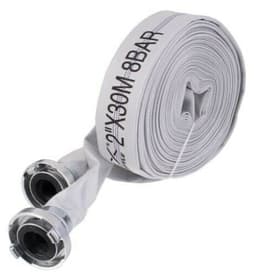
DAMBAT DAMBAT, 2 inch × 30 m

Testsieger

DAMBAT DAMBAT, 2 inch × 30 m
6.4/10about £49.95

Shut down and store

When the fire is out, or when you have decided to leave, shut the nozzle first, then shut the isolating valve so the reel is not left under pressure. Drain the hose. Rewind it evenly onto the drum. Close the nozzle for storage once the hose is drained. If the hose itself is perished, matching a spare is on replacement hose for a fire hose reel. If you are unsure the fire is out, leave the building and tell the fire service what you used.

The annual run-out is a test, not practice on a fire

Once a year a competent person runs the whole hose out under pressure. Dorset & Wiltshire Fire and Rescue describe that visit against BS 5306-1. It is maintenance under article 17 where maintenance is required, not a practice fire. If the hose fails that visit, the checks before you buy a replacement are on the fire hose buying guide.

Common questions

What do I do first if I am going to use a hose reel?
Raise the alarm, call 999, and check that the exit is behind you and not blocked by the hose. At home, get out and stay out. At work, continue only for a small Class A fire you can see, with a clear escape. On a manual reel, open the isolating valve and then pull the hose. On an automatic reel, pulling the hose can open the valve. The nozzle starts shut either way.
Should I use jet or spray?
Start on shut, open to spray, and use jet only if spray will not reach the base. BS EN 671-1 lists those three positions and recommends spray between shut and jet. Spray is easier to control in a small room. Jet reaches further and is easier to mis-aim. Shut the nozzle again before you move back along the hose.
Where do I aim the water?
Aim at the base of the burning material, from a position you can leave. Reel manuals describe that aim after the nozzle is open. Flames higher up, and smoke you cannot see through, are a sign to stop. If the fire is already spreading across the ceiling, leave. The reel is for a small fire you can still walk away from.
How do I put the hose away?
Shut the nozzle, shut the isolating valve, drain the hose, rewind it evenly, and leave the nozzle shut once it is empty. Do not leave the reel under pressure. Tell the responsible person that the reel was used so the hose, couplings and nozzle can be checked. If you are not sure the fire is out, leave that news with the fire service as well.
Can I use it on a chip pan or on live electrics?
No. Water is the wrong agent for a fat fire and for live electrical equipment. A chip pan will throw burning oil if you hit it with a jet or a spray. Live equipment can conduct. Those fires are a reason to get out and call 999. The reel supplements extinguishers for ordinary solid materials, which is the limit in the Home Office guide and in hose-reel manuals.
Who does the annual test?
A competent person does. The usual record is a full run-out under pressure, a check that couplings and the nozzle are watertight, a flow test, and a note in the log, pointing at BS 5306-1. That is maintenance, not a practice fire. If the hose is cracked, stuck or the nozzle is seized, the reel stays out of use until it is repaired and signed off.
When do I stop and leave?
Stop if the fire grows, if smoke thickens, if your exit is no longer clear, or if the hose would hold a fire door open. Stop immediately if the fire is fat or live electrics. Call 999 if you have not already, and get out. An unlimited supply of water is not a reason to stay longer. The Home Office warning is that people keep fighting because the water has not run out.

Related pages

Sources

Public UK sources from the research digest, last checked on 20 October 2026. amazon.co.uk prices and stars are the listings for B074P4HNQP, B09P5DTGVL and B09P5FQXL4.

  1. Regulatory Reform (Fire Safety) Order 2005, article 13 (retrieved 20 October 2026)
  2. Regulatory Reform (Fire Safety) Order 2005, article 17 (retrieved 20 October 2026)
  3. Home Office fire safety risk assessment guide (retrieved 20 October 2026)
  4. London Fire Brigade: hose (retrieved 20 October 2026)
  5. London City Hall DMFD90, provision of layflat hose (retrieved 20 October 2026)
  6. BSI, BS EN 694:2014, semi-rigid hoses for fixed systems (retrieved 20 October 2026)
  7. Dorset & Wiltshire Fire and Rescue Service, routine maintenance (retrieved 20 October 2026)
  8. Delta Fire: fire hose and the BS 336 coupling (retrieved 20 October 2026)