Indoor wall filler buying guide
An indoor wall filler buying guide has one job before price: match the hole to a stated depth, to whether the joint moves, and to the indoors-only wording. The [indoor wall filler comparison](/hub/fillers-adhesives-and-sprays/wall-filler-indoor) lists the twelve captured packs, their GBP prices, and their review counts. This page is the if-then. It does not rank those ASINs. A couple of millimetres belongs on [filler for hairline cracks](/hub/fillers-adhesives-and-sprays/wall-filler-indoor/sub/wall-filler-indoor-hairline-cracks). Prices were written up on 16 October 2026. Nothing here is a lab test.
An indoor wall filler buying guide has one job before price: match the hole to a stated depth, to whether the joint moves, and to the indoors-only wording.
An indoor wall filler buying guide has one job before price: match the hole to a stated depth, to whether the joint moves, and to the indoors-only wording. The indoor wall filler comparison lists the twelve captured packs, their GBP prices, and their review counts. This page is the if-then. It does not rank those ASINs. A couple of millimetres belongs on filler for hairline cracks. Prices were written up on 16 October 2026. Nothing here is a lab test.
Our top picks
| Badge | Product | Stated depth | Indoors or outdoors | After it sets | Note | Price | Offer |
|---|---|---|---|---|---|---|---|
| Best overall |  Polycell Polycell Multi-Purpose Polyfilla 330 g | Not on the seller bullets | Not on the seller bullets | Listing: 2 hour cure and hardening. Reviews: sand, then paint | 9.3 | about £3.49 | View offer |
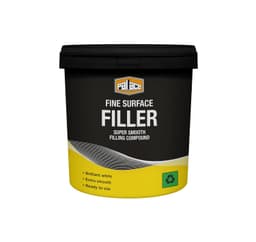
| Best value |  Palace Palace Fine Surface Filler 600 g | Layers no more than 3 mm | Interior | Feather edge, sand, then oil- or water-based paint | 8.5 | about £1.25 | View offer |
| Alternative |  Sika Sika All Purpose filler 600 g | Up to 9 mm deep and 25 mm wide | Interior and exterior; oil-based paint outdoors | Sand, then most paints, stains or wallpaper | 8.2 | about £4.49 | View offer |


On this page
Match the depth before the brand
Movement, indoors, and what you do after it sets
What this amazon.co.uk set actually contains
If-then before you add to basket
Common questions
Do I need fine filler or multi-purpose filler for a screw hole?
What depth can I fill in one pass?
Can I use a rigid filler on a skirting or frame gap?
Which of these tubs say indoors only?
Can I drill or screw into the fill?
Does a higher star rating mean a better filler?
When should I stop and call someone?
Related pages
Sources
Public UK sources used for this comparison. Listing prices are the GBP figures captured for these amazon.co.uk ASINs and were not re-checked on 16 October 2026.
- Polycell Multi Purpose Polyfilla Ready Mixed (retrieved 15 October 2026)
- Polycell Fine Surface Polyfilla (retrieved 15 October 2026)
- Polycell Deep Gap Polyfilla (retrieved 15 October 2026)
- Polycell Advanced Polyfilla (retrieved 15 October 2026)
- Polycell Flexible Gap Polyfilla (retrieved 15 October 2026)
- Polycell — fill awkward or large gaps (retrieved 15 October 2026)
- HSE — Construction dust (retrieved 15 October 2026)
- HSE CIS36 — Construction dust (retrieved 15 October 2026)