Independent comparisons. We may earn from shop links. More info

How to use a polyester resin anchor

Updated: 23 October 2026

The cartridge is on the bench, the hinge is off the gate, and the hole still has grey dust in it. The failures that show up next day are dust left in the hole, a pale mix with no hardener, and a nut tightened when the surface only felt firm. This is the sequence for an injection cartridge, not a ranking of the seven tubes on the [polyester resin comparison](/hub/fillers-adhesives-and-sprays/polyester-resin). The steps come from manufacturer install sheets and from repeated amazon.co.uk review failures. We did not install a stud for this page. A qualifying purchase through our amazon.co.uk links can earn us a commission at no extra cost to you.

The cartridge is on the bench, the hinge is off the gate, and the hole still has grey dust in it.

Our top picks

On this page

Clean the hole before you open the nozzle

Dust is the usual reason a sound cartridge underperforms. Polyester needs clean sides to key against. A puff, or one pass with a dusty brush, leaves a film the resin grips instead of the brick. BS 8539 is the buyer-facing point: a poor hole cancels a good resin. Drill to the rod’s diameter and depth, then clean before you cut the mixer open. Rawlplug’s note is blow, brush, blow, often four times each with a hand pump, or two and two with oil-free compressed air, starting at the back. If you cannot get the dust out, do not fill and hope.

Waste a bead until the colour is even

The two parts are mixed only when the bead is an even colour along its length. Extrude onto card until it is. Reviewers treat dark grey as mixed on the fischer cartridges, and pale or sandy as unset. Rawlplug’s sheet says pump until the resin is grey. A clip or a stalled piston can stop the hardener while resin keeps flowing, and the hole stays soft overnight. Do not pause once you start. At about 20°C Rawlplug allows about five minutes, and a tea break gels the nozzle. Discard the first pale bead. The hardener is an organic peroxide, so gloves and eye protection stay on, and keep the mix off threads you still need to turn.
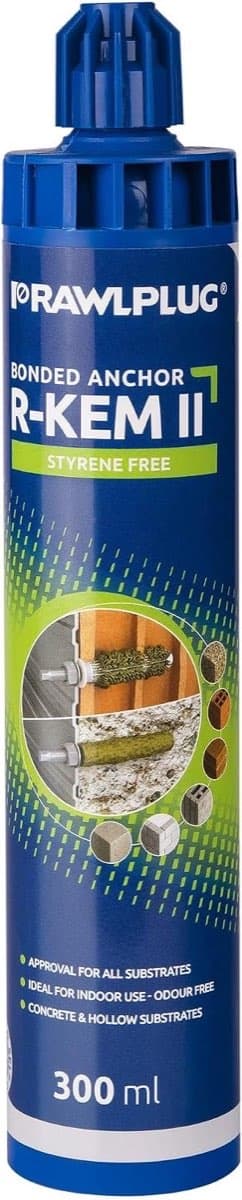
Rawlplug Rawlplug R-KEM II 300 ml

Testsieger

Rawlplug Rawlplug R-KEM II 300 ml
8.4/10about £12.10

Fill, twist, and leave it

Fill from the back so you do not trap air. Insert the mixer to the base and ease it out as the resin rises. A common note is to fill to about 70 per cent, then twist the stud in so the threads wet out. Do not load at gel. Cure is the time on that cartridge’s table at that concrete temperature. Rawlplug R-KEM II at 20°C is about 45 minutes to load, and TIMCO’s sheet is about 60 minutes at 15°C or about 30 minutes at 25°C. Wet concrete is marked as double on both. When to leave polyester is on polyester resin vs vinylester.

The stone paste is a different motion

Knife-grade polyester is not this sequence. Harbro’s vertical paste is spread with a blade and mixed by hand with a separate hardener, for marble, granite, onyx or travertine. There is no hole to blow, no mixer and no stud to twist. Injecting it will not work, and trowelling a cartridge up a sill makes it slump. Resin that escapes into a hollow block will not form the plug you planned, so a mesh sleeve is a different fixing, chosen before the gun is pressured.

Common questions

How do I clean the hole before the resin goes in?
Drill to the rod’s diameter and depth, then blow, brush and blow before any resin enters. Rawlplug’s note is at least four times each with a hand pump, or two and two with oil-free compressed air, starting at the back. A single puff leaves a film the resin bonds to. If the hole is overhead, or the load is safety-critical, a competent person should specify the clean.
What colour means the two parts have actually mixed?
An even colour along the bead: grey on the Rawlplug sheet, dark grey in fischer reviews. Pale, streaky or sandy resin has not picked up the hardener and stays soft. Extrude onto card until the colour is consistent, and throw that first bead away. If the colour never evens out, stop. A new mixer will not fix an empty hardener side.
How long can I wait before the nozzle blocks?
Not long enough for a pause. Once mixed resin sits in the nozzle it gels, and the next squeeze blocks or bursts the mixer. At about 20°C, Rawlplug’s working window is about five minutes, and TIMCO’s grid shortens as the concrete gets warmer. If you stop, fit a new nozzle and waste another bead until the colour is even. A mixer left on overnight will not restart.
When can I tighten the nut?
After the cure time on that cartridge, at the concrete temperature, not when the surface feels firm. Rawlplug R-KEM II at 20°C is about 45 minutes, about twice as long if the concrete is wet. TIMCO’s sheet is about 60 minutes at 15°C and about 30 minutes at 25°C, with the same doubling when wet. Ignore a listing row that says four weeks.
Why is the resin still soft the next day?
The usual cause in these reviews is hardener that never entered the mix: a pale or sandy bead, a clip that stopped the second component, or a blocked nozzle. A cold wall lengthens the cure beyond the 20°C table, and a wet hole can stop a standard polyester even when the colour looked right. Do not add water or seawater. Another bead of the same tube repeats a flooded-hole failure.
How is the stone paste different from a cartridge?
Harbro’s knife-grade paste is mixed by hand with its hardener and spread on vertical natural stone. You do not blow out a hole, waste a bead to a colour, or twist in a stud. A cartridge is the opposite motion: clean hole, static mixer, fill from the back, twist, wait. A tub and a hardener sachet is a stone repair, not a gate hinge.

Related pages

Sources

Public UK sources used for this comparison. amazon.co.uk prices, stars and review counts were taken from the listings on 20 October 2026.

  1. HSE plastics FAQ on styrene (retrieved 20 October 2026)
  2. UKHSA styrene incident management (retrieved 20 October 2026)
  3. fischer UK, FIS P Plus (retrieved 20 October 2026)
  4. Rawlplug UK, R-KEM II (retrieved 20 October 2026)
  5. TIMCO PE410 chemical resin (retrieved 20 October 2026)
  6. TIMCO PE safety data sheet (retrieved 20 October 2026)
  7. HSE PPIS14 styrene in contact moulding (retrieved 20 October 2026)
  8. amazon.co.uk listings for the seven ASINs in this set (retrieved 20 October 2026)