Independent comparisons. We may earn from shop links. More info

How to use epoxy resin from a 1:1 kit

Updated: 23 October 2026

You have a clear 1:1 kit on the bench and you have not poured it yet. The usual first failure is a sticky surface, a cup of bubbles, or a mix that heats up in the jug. How to use epoxy resin, for these bottles, is a volume measure, a short stir, a thin layer, and the clock on the listing in front of you. This is not a ranking. The [epoxy resin comparison](/hub/fillers-adhesives-and-sprays/epoxy-resin) is that table. Peter F. wrote this from the amazon.co.uk listings and public safety notes, not as a lab method. A qualifying purchase can earn us a commission at no extra cost to you.

You have a clear 1:1 kit on the bench and you have not poured it yet. The usual first failure is a sticky surface, a cup of bubbles, or a mix that heats up in the jug.

Our top picks

On this page

Set the room and the ratio first

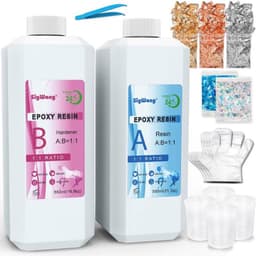
Where this set states a ratio, it is 1:1 by volume. Pour equal volumes. Do not call two equal weights 1:1 unless the label says weight. IModeur’s reviews say a wrong mix stays rubbery, and more hardener the next morning does not repair it. A Suzzam review says not to store the kit in a cold shed, and IModeur says full hardness takes longer in winter. Bring the bottles into the room before you mix. Craft Resin’s bullets here do not give working minutes. LET'S RESIN, IModeur, SigWong, and Suzzam are around 40 minutes. ISTOYO says 45. Fidton says 20–30. Working a Fidton kit as if you had 40 minutes puts you outside the bullet you paid for. Lay the cups out before you combine the two parts.

Mix slowly and pour out of the cup

Stir until the streaks disappear, scraping the sides and the bottom. Funxim’s bullet says about 2–3 minutes, and extra stirring does not help the bubbles. A fast whip folds air in. Unmixed resin on the cup wall can leave a tacky patch, which is why flood-coat makers move the mix into a second cup. Get the resin out of the jug. JDiction’s file has a table mould that got very hot, and Fidton’s file has a flash cure. Mix only what the layer needs. LET'S RESIN says to test a small amount. Do not wash a wet cup in the sink. A DR. RESIN review says to wipe cups while the mix is liquid. If a mix has smoked, do not repeat it bigger.

Bubbles on a thin coat

On a thin layer, bubbles are a surface problem. On a deep one, they are a heat problem. Give the surface a few minutes first. GlassCast’s sheet, for that product only, describes a light heat pass after about 5–10 minutes. Craft Resin UK says a quick torch only on thin coats, not on a deep pour. Keep it moving. Sealing and levelling are on the epoxy resin for table tops page. Do not copy a 6 mm figure onto SigWong, Funxim, JDiction, or Fidton. Those depth cells are empty. Heat is for a thin film, not for a cup that is already too hot to hold.

What 24 hours does and does not mean

A 24 hour line is not one event. IModeur separates dry in about 8 hours, cure in 24 hours, and full hardness in 72 hours, longer in winter. Several other bullets stop at 24 hours. Funxim states no full-cure time, and SigWong’s cell is unreadable. Wait before you sand or put a hot mug down. Sticky cases here include a large Suzzam mould, ISTOYO still soft after 30 hours or a week, LET'S RESIN soft at 24 hours, and a Fidton pour that never hardened. The pattern is a deep mass, a cold store, or a bad ratio. Do not add extra hardener. HSE guidance treats uncured epoxy as a leading cause of occupational dermatitis and a known skin sensitiser. If the piece will touch food, the clock does not answer that.

Common questions

Do I measure 1:1 by volume or by weight?
By volume, where these kits state a ratio. Equal amounts in a marked cup, not equal weights, unless your bottle says weight. IModeur’s 16 oz plus 16 oz split is still volume. A rubbery cure in that file is tied to the proportions.
What is working time on these kits?
LET'S RESIN, IModeur, SigWong, and Suzzam are about 40 minutes. ISTOYO says 45 minutes. Fidton says 20–30 minutes. Craft Resin’s bullets here do not give a minute figure. Working time is how long you can still move the mix. Mix less than a whole 8 litre tin for one coaster.
How do I get bubbles out without scorching it?
Spread a thin coat, wait a few minutes, then use a short moving pass of heat if the brand allows it on a thin layer. Craft Resin UK says not to torch a deep pour. A flame parked on one spot will mark the surface. Do not invent a torch step from another brand’s sheet.
Why is it still sticky the next day?
In these files the sticky cases are a large Suzzam mould, an ISTOYO mix after 30 hours or a week, a LET'S RESIN pour at 24 hours, and a Fidton pour that never hardened. Common companions are a deep mass, a cold shed, or a ratio that was not 1:1 by volume. Do not add extra hardener.
What do I do with leftover liquid?
Unmixed resin and hardener go back into their own bottles, closed, and out of a cold shed. Mixed resin should be spread thin or left to harden as a solid, not poured down the sink. One smoked batch is a reason to shrink the next mix, not to scale it up.

Related pages

Sources

Public UK sources used for this comparison. amazon.co.uk prices, stars and review counts are the listing figures for the twelve kits. Sources last checked on 22 October 2026.

  1. HSE construction skin FAQ (retrieved 22 October 2026)
  2. HSE COSHH skin page (retrieved 22 October 2026)
  3. HSE GB CLP (retrieved 22 October 2026)
  4. Regulation 1935/2004 Article 3 (retrieved 22 October 2026)
  5. England SI 2012/2619 Part 7 (retrieved 22 October 2026)
  6. Regulation 1895/2005 Annex I (retrieved 22 October 2026)
  7. GlassCast 3 datasheet (retrieved 22 October 2026)
  8. Craft Resin UK getting started (retrieved 22 October 2026)