Independent comparisons. We may earn from shop links. More info

How to repot a moth orchid into bark-based compost

Updated: October 2026

The flowers on your Phalaenopsis have dropped, and you want to know how to repot a moth orchid without burying the roots that grow in the air. The job is a refresh of bark-based compost, one pot size up at most, not a move into ordinary houseplant soil. Prices and the bag grid sit on the [orchid soil comparison](/hub/fertiliser-soil-and-bark-mulch/orchid-soil). The Products Compared editorial team drew the sequence from RHS, Gardeners' World, and Orchids UK on 21 October 2026, not from a home trial of every bag. A qualifying purchase can earn a commission at no extra cost to you.

The flowers on your Phalaenopsis have dropped, and you want to know how to repot a moth orchid without burying the roots that grow in the air.

Our top picks

On this page

When the bark is finished

Bark that has broken down holds water the way soil does. If the spike is still in bloom and the chips are still open, wait. A plant that arrived last month, with plump roots and sound chips, can stay put. A pot packed with black crumbs, or new roots circling for lack of air, should be done at the next quiet week. Keep the room above 16°C, the RHS floor for this genus.

Pot, tools, and a dry bag

Do not jump from a 12 cm pot to a 20 cm one because the bag looks generous. Empty compost around a small root ball stays wet. Have clean scissors or secateurs. Do not open dry compost with your head over the bag. Moisten dry media, and avoid a confined room. Orchids UK says to dampen very dry bark first. Miracle-Gro's label, for that compost, also says gloves and ventilation. A review of the UK GROW Elite 10 litre bag describes dust and twigs that needed a rinse. Wet dusty bark in a colander and let it drain.

The repot, in order

Soak the root ball so the old bark lets go. Tip the plant out and tease the spent compost off. A sour nursery moss plug in the middle should come away. Healthy roots are plump and silvery white, turning green when wet. Soft, brown, hollow roots can be cut back to firm tissue. Do not shave the plant back to a stump. Set the base of the leaves at the rim, not buried. Firm fresh bark-based compost so the plant does not wobble. Aerial roots stay in the air. Water through once, let it drain, and empty the saucer.

Where people go wrong

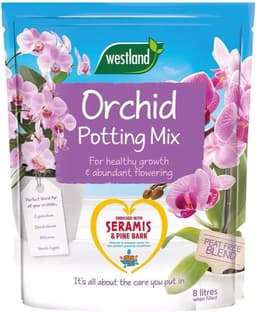
The RHS names three errors: multipurpose or loam compost, a pot that is much too big, and aerial roots buried in the mix. A Westland review says water did not pass and roots rotted. Another says water ran straight through. Look at the roots a week later. One Miracle-Gro review says both plants died after repotting. That is one account, not a rate. Miracle-Gro's label says feed after four weeks, moist rather than wet. Do not apply that line to a bark-only bag. If the plant is collapsing, ask a nursery rather than repotting again the same week. For the bag, use the orchid compost buying guide. If it is still in a plug, read orchid bark or moss first.

Common questions

When should I repot a moth orchid?
Repot when the compost is about two years old, or sooner if the plant is bursting the pot, and do it when root tips are green and active. The RHS uses that two-year mark. Orchids UK says every two to three years. Bark that has collapsed into wet crumbs is the practical sign, even if the calendar is a little early. A plant with sound chips and room in the pot can wait.
Can I repot while it is still in flower?
Gardeners' World says to wait until after flowering. The RHS allows a repot whenever the roots are active, which can overlap with a spike if the compost has failed. If the flowers are still good and the bark is still open, leave it. If the pot is anaerobic, the roots matter more than the last blooms. Do not repot as a routine on the day you bring a flowering plant home.
Do I need a clear pot?
A clear inner pot with drainage holes lets you see silvery roots, which is the RHS watering cue, and Gardeners' World uses one size up from the old pot. The outer cachepot can be opaque. What you cannot skip is drainage. A sealed ceramic pot with no hole will drown bark however coarse the chips are. Empty the saucer after you water through.
Should I cut all the roots?
No. Cut soft, brown, hollow roots. The RHS describes shortening healthy roots to about 12 cm, while Gardeners' World prefers trimming only roots that are too long or badly placed. If you are new to this, take the smaller cut. Leave firm silvery roots, and leave aerial roots outside the compost. A shaved root ball in a large pot is a common way to lose the plant.
What if the new pot is much bigger?
Do not use it. The RHS says not to overpot. Compost with no roots in it stays wet, especially in a cool UK room in winter. One size up is the usual step, for example from the nursery pot to the next clear pot that the root ball actually fills. Spare bark from a 10 litre bag can wait in a dry, closed sack for the next plant. It does not have to fill a larger pot today.
The compost has white fluff. Is that a failure?
Miracle-Gro's label says white mould on the compost is not harmful and disappears. That is the maker's line for that product, not a diagnosis of every white growth on every brand. Keep the bag and the pot in a ventilated space, and do not sniff dry compost, which is the RHS hygiene point. If roots are brown and soft, or the plant is collapsing, the problem is the wet mix, not a light surface film. Ask a nursery if you cannot tell the two apart.

Related pages

Sources

Public UK and maker sources from the research digest, used for this page in October 2026. Prices, stars and review counts are from the eight amazon.co.uk listings read on 21 October 2026. A peat-free line is quoted only where the listing or the maker's UK page prints it. A sterilised claim is seller text. Stars are not a laboratory test, and a shared review file is not a second trial.

  1. RHS, Phalaenopsis growing guide (retrieved 21 October 2026)
  2. BBC Gardeners' World, how to care for orchids (retrieved 21 October 2026)
  3. GOV.UK, horticultural peat sale announcement (retrieved 21 October 2026)
  4. Defra written answer, 12 September 2024 (retrieved 21 October 2026)
  5. Westland orchid potting mix (retrieved 21 October 2026)
  6. Miracle-Gro peat-free orchid compost 10 L label (retrieved 21 October 2026)
  7. RHS, minimising health risks in the garden (retrieved 21 October 2026)
  8. Sheffield & District Orchid Society, Phalaenopsis cultivation (retrieved 21 October 2026)