Orchid compost buying guide before you trust stars
You have a moth orchid on a UK windowsill, and the amazon.co.uk results all say orchid compost. This orchid compost buying guide is the order to use before you compare stars: which plant you have, what chip size it needs, how many litres you will use, whether the bag claims feed or peat free, and what the price per litre is once the volume field agrees with the title. The [orchid soil comparison](/hub/fertiliser-soil-and-bark-mulch/orchid-soil) holds the eight kept bags and their GBP prices. The Products Compared editorial team wrote this on 21 October 2026 from those listings and from public UK growing guides, with no lab trial. A qualifying purchase can earn a commission at no extra cost to you.
You have a moth orchid on a UK windowsill, and the amazon.co.uk results all say orchid compost.
You have a moth orchid on a UK windowsill, and the amazon.co.uk results all say orchid compost. This orchid compost buying guide is the order to use before you compare stars: which plant you have, what chip size it needs, how many litres you will use, whether the bag claims feed or peat free, and what the price per litre is once the volume field agrees with the title. The orchid soil comparison holds the eight kept bags and their GBP prices. The Products Compared editorial team wrote this on 21 October 2026 from those listings and from public UK growing guides, with no lab trial. A qualifying purchase can earn a commission at no extra cost to you.
Our top picks
| Badge | Product | Mix on the listing | Stated volume | Peat free on Amazon | Note | Price | Offer |
|---|---|---|---|---|---|---|---|
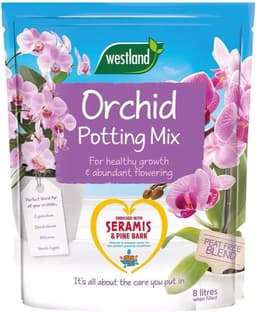
| Best overall |  Westland Westland Orchid Potting Mix 8 L | Bark and Seramis | 8 litres | Not on the Amazon bullets | 8.7 | about £8.40 | View offer |
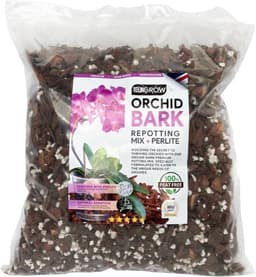
| Alternative |  UK GROW UK GROW orchid bark and perlite 5 L | Bark and perlite | 5 litres; unit count says 1 g | Not stated | 8.8 | about £9.99 | View offer |
| Best value |  Miracle-Gro Miracle-Gro Peat Free Orchid 10 L | Pine bark, 11 nutrients claimed | 10 litres | Yes, title and bullets | 8.5 | about £6.00 | View offer |

On this page
Start with the plant, not the brand
Chip size and what the listing actually names
Litres, settle, and the unit-count field
Feed, peat-free wording, and price per litre
Common questions
Is orchid compost the same as multipurpose compost?
What bark size does a moth orchid need?
How many litres should I buy for one supermarket orchid?
How do I know the bag is peat free?
Why does the Amazon unit count say 1 gram on a 5 litre title?
Related pages
Sources
Public UK and maker sources from the research digest, used for this page in October 2026. Prices, stars and review counts are from the eight amazon.co.uk listings read on 21 October 2026. A peat-free line is quoted only where the listing or the maker's UK page prints it. A sterilised claim is seller text. Stars are not a laboratory test, and a shared review file is not a second trial.
- RHS, Phalaenopsis growing guide (retrieved 21 October 2026)
- BBC Gardeners' World, how to care for orchids (retrieved 21 October 2026)
- GOV.UK, horticultural peat sale announcement (retrieved 21 October 2026)
- Defra written answer, 12 September 2024 (retrieved 21 October 2026)
- Westland orchid potting mix (retrieved 21 October 2026)
- Miracle-Gro peat-free orchid compost 10 L label (retrieved 21 October 2026)
- RHS, minimising health risks in the garden (retrieved 21 October 2026)
- Sheffield & District Orchid Society, Phalaenopsis cultivation (retrieved 21 October 2026)