Independent comparisons. We may earn from shop links. More info

Orchid bark vs moss for a UK supermarket moth orchid

Updated: October 2026

The moth orchid you bought still has a tight plug of moss around the base, and a bag of bark is sitting next to it, so the choice is orchid bark vs moss. In a UK living room the usual move is off that shop plug and onto bark-based compost, then you water the medium you actually have. The bags themselves are on the [orchid soil comparison](/hub/fertiliser-soil-and-bark-mulch/orchid-soil). The Products Compared editorial team compared the materials from UK society and RHS guidance on 21 October 2026. None of the eight kept listings is a sphagnum bag. A qualifying purchase can earn a commission at no extra cost to you.

The moth orchid you bought still has a tight plug of moss around the base, and a bag of bark is sitting next to it, so the choice is orchid bark vs moss.

Our top picks

On this page

Why the plug is there

A supermarket Phalaenopsis is often rooted into sphagnum or a synthetic plug. The Orchid Society of Great Britain says those plugs can suit a greenhouse and then suffer once watering is less regular at home. Sheffield & District Orchid Society says shop moss plugs are not a good long-term windowsill medium. You do not have to pull the plug out on the drive home. Check the roots when the blooms fade. The cuts are on how to repot a moth orchid. Bark, rather than more moss, is what changes how fast the pot dries.

What bark does in a pot

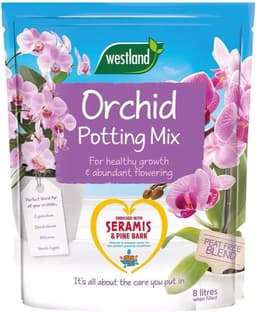
Gardeners' World treats moth-orchid compost as essentially pine bark. Coarse chips leave gaps, surplus water leaves by the drainage holes, and the roots dry back towards the silvery colour the RHS uses as a cue. Perlite and Seramis change the bark. They do not turn it into moss. A shared UK GROW review likes perlite because the mix does not hold water for long. A Westland review says water would not pass at all. Watch the roots after the first week. Seramis here is clay granules in the bark, not a tub of clay pebbles.

When moss stays in the recipe

Sheffield says some species do better in pure sphagnum. Gardeners' World gives slipper orchids coir, bark, perlite, and sphagnum at about 1:1:0.5:0.5, not a moth-orchid sack. A little sphagnum in bark changes the interval, because moss holds water much longer. A bark schedule on a moss pot rots roots. A moss schedule on a bark pot leaves the plant droughted. Damp bark is a handling step so chips are less dusty. A wet moss plug in a closed pot is a different object. For a Paphiopedilum, use the slipper ratio or a nursery mix for that genus.

Plants that are not this choice

Cymbidiums sit with moth orchids on coarser 8–15 mm bark, which is still bark, not a moss plug. A supermarket moth orchid wants bark-based compost in a clear, drained pot, with the shop plug out once you can see the roots. A listing that merely names Paphiopedilum, such as the UK GROW 2 litre bucket, has not printed the slipper ratio. A bullet that adds Vanda does not override growing that plant with no compost.

Common questions

Should I take the moss plug out?
Yes, once the flowers have faded and you can see the roots, if the plug is the tight nursery core inside a moth orchid. Sheffield says shop moss plugs are not a good medium once the plant is home, and the OSGB says to check the roots when the blooms fade and give them air. If the plug is still fresh and the roots through it are firm, tease it out at the repot rather than in the shop car park.
Is bark or moss better for a moth orchid in a UK home?
Bark-based compost is the better default. The RHS specifies it for Phalaenopsis and tells you not to use multipurpose compost. Moss in a plastic pot stays wet in a cool room, which is how roots fail after a greenhouse plant comes home. Pure sphagnum can still suit some species, which is Sheffield's exception, so this is not a ban on moss. It is a ban on leaving a shop plug in place and watering it like bark.
How often do I replace each medium?
Replace bark about every two years, which is the RHS interval, or every two to three years in Sheffield's wording, and sooner if it has broken into wet fines. Replace sphagnum about every year if you are using it. The two clocks are different because moss collapses and stays wet on a shorter cycle. A bag you bought for the repot is a refresh, not a soil that lasts the life of the plant.
Can I mix bark and moss?
You can, and slipper orchids are already described that way, with sphagnum as one part of a coir, bark, and perlite blend. For a moth orchid, a small amount of moss in bark makes the pot dry more slowly, which helps in a very warm room and hurts in a cool one. Do not add moss to fix a bark that is already fine and soggy. Change the watering to the wetter mix, or you will overwater the bark schedule you used last month.
What about Paphiopedilum?
Do not use a straight moth-orchid bark bag as the whole answer. Gardeners' World describes a handmade slipper mix of coir, bark, perlite, and sphagnum at about 1:1:0.5:0.5. A listing that merely names Paphiopedilum, such as the UK GROW 2 litre bucket, has not printed that ratio. If you are unsure of the genus, read the label before you copy a Phalaenopsis repot. The finer 5–8 mm grade is the Gardeners' World pointer for types other than moth orchids and cymbidiums.
Does a Vanda need this bag at all?
No. Gardeners' World grows Vanda with no compost. A bark or moss choice is the wrong frame. The plant wants its roots in the air, usually in a basket, with frequent watering and drying, not a pot of chips. Ignore a marketplace bullet that adds Vanda to a list of orchids the bag suits. That line does not override the no-compost practice.

Related pages

Sources

Public UK and maker sources from the research digest, used for this page in October 2026. Prices, stars and review counts are from the eight amazon.co.uk listings read on 21 October 2026. A peat-free line is quoted only where the listing or the maker's UK page prints it. A sterilised claim is seller text. Stars are not a laboratory test, and a shared review file is not a second trial.

  1. RHS, Phalaenopsis growing guide (retrieved 21 October 2026)
  2. BBC Gardeners' World, how to care for orchids (retrieved 21 October 2026)
  3. GOV.UK, horticultural peat sale announcement (retrieved 21 October 2026)
  4. Defra written answer, 12 September 2024 (retrieved 21 October 2026)
  5. Westland orchid potting mix (retrieved 21 October 2026)
  6. Miracle-Gro peat-free orchid compost 10 L label (retrieved 21 October 2026)
  7. RHS, minimising health risks in the garden (retrieved 21 October 2026)
  8. Sheffield & District Orchid Society, Phalaenopsis cultivation (retrieved 21 October 2026)