Mycorrhiza powder vs granules: garden hole or hydro
Amazon.co.uk will sell you the same search phrase as granules, powder, pouch and soluble powder, sometimes on products that reviewers say feel like grains. Mycorrhiza powder vs granules is a job match, not a texture contest. Dry garden product belongs on bare roots and rootballs in a hole. A water-dispersible powder belongs in a named hydro system. The [mycorrhiza comparison](/hub/fertiliser-soil-and-bark-mulch/mycorrhiza) keeps the grid. Prices and stars below are from those listings, not a lab test.
Amazon.co.uk will sell you the same search phrase as granules, powder, pouch and soluble powder, sometimes on products that reviewers say feel like grains.
Amazon.co.uk will sell you the same search phrase as granules, powder, pouch and soluble powder, sometimes on products that reviewers say feel like grains. Mycorrhiza powder vs granules is a job match, not a texture contest. Dry garden product belongs on bare roots and rootballs in a hole. A water-dispersible powder belongs in a named hydro system. The mycorrhiza comparison keeps the grid. Prices and stars below are from those listings, not a lab test.
Our top picks
| Badge | Product | Listed form | Job | How it meets roots | Note | Price | Offer |
|---|---|---|---|---|---|---|---|
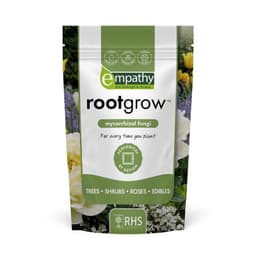
| Best overall |  Empathy Empathy Rootgrow mycorrhizal fungi 360 g | Granules | Garden hole | Dry sprinkle on roots | 8.8 | about £10.34 | View offer |
| Best value |  Plantworks Ltd Plantworks Rootgrow mycorrhizal fungi 150 g | Powder; reviews say grains | Garden hole | Grains on roots | 8.4 | about £6.79 | View offer |
| Alternative |  TNC TNC MycorrHydro soluble mycorrhizal fungi 75 g | Water-dispersible powder | NFT, flood and drain, DWC | Drench or tank; clogging reported | 7.2 | about £14.25 | View offer |


On this page
What the listing word powder actually means
Garden dry for holes and rootballs
Soluble powder for named hydro systems
Gel dip is a different pack
Common questions
Are Rootgrow 150 g and 360 g different forms?
Do I need granules for a pot-grown rootball?
Is a soluble powder better for bare-root roses?
When is TNC MycorrHydro the right form?
Will a garden pouch clog a hydro line?
What is the gel dip, and is it in this comparison?
Does powder on Amazon mean a fine dust?
Related pages
Sources
Public UK and maker sources from the research digest, used for this page in October 2026. Prices, stars and review counts are from the eight amazon.co.uk listings in that digest. An organic bullet is not a licence number. A root-volume line and a spore count were not measured here. No pouch is treated as a cure for rose sickness or as a UKCA-approved biostimulant.
- RHS, Mycorrhizal fungi (retrieved 20 October 2026)
- RHS, Trees and shrubs planting (retrieved 20 October 2026)
- RHS, Biostimulants (retrieved 20 October 2026)
- RHS, Replant disease (retrieved 20 October 2026)
- HSE, Biostimulants and plant protection (retrieved 20 October 2026)
- GOV.UK, Manufacturing and marketing fertilisers (retrieved 20 October 2026)
- AHDB, How should biostimulants be used? (retrieved 20 October 2026)
- Empathy, rootgrow 360 g (retrieved 20 October 2026)