Independent comparisons. We may earn from shop links. More info

How to apply lawn lime

Updated: October 2026

You already have a tested acid lawn and one named bag. How to apply lawn lime now means that bag's own grams, an even pass, and a wait before fertiliser or another test. This page is from Peter F., the DIY & tools editor, on 21 October 2026. He used the brand labels and the seven amazon.co.uk listings on the [lawn lime comparison](/hub/fertiliser-soil-and-bark-mulch/lawn-lime), plus Royal Horticultural Society and DAERA notes. Nobody here spread a trial strip. A qualifying Amazon purchase can earn us a commission at no extra cost to you. If the kit is already near 6.5 or at 7.0 or higher, put the bag away.

You already have a tested acid lawn and one named bag. How to apply lawn lime now means that bag's own grams, an even pass, and a wait before fertiliser or another test.

Our top picks

On this page

Check the test before you open the bag

The Royal Horticultural Society says not to lime at pH 7.0 or higher. A vinegar fizz on dry soil means this method does not apply. A reading inside three months of lime, fertiliser, or manure can mislead. If the number is already around 6.5, stop. Standing water needs drainage, not a heavier pass. Ericaceous plants at the edge stay off the granules. If the seller and the kilograms do not match the title, go back to best lawn lime. Moss you have not raked still blocks granules; scarifying is on lawn lime for moss.

Read the rate on your bag, not the next brand's

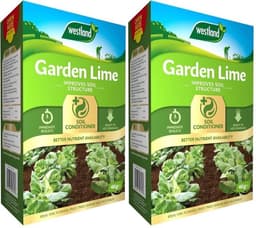
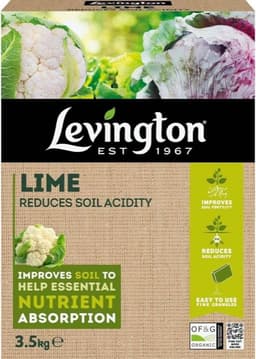
Westland's FAQ is 10 g per square metre because the particles are very small. Amazon bullets on the Westland twin pack in this set say 35–70 g, or one to two handfuls. Follow the bag in your hand. Do not average the two figures. Levington's label is a soil table. Maintenance is 50 g per square metre on clay, 75 g on loam, and 100 g on sand. Correction doses aimed at about 0.5 pH are 75 g, 125 g and 200 g. Split anything over 150 g into two passes. The printed coverage for 3.5 kg is 17.5–70 square metres once those higher doses are included. Worked cover, using each source's own rate only: a 4 kg bag at Westland's 10 g FAQ would cover 400 square metres; at 35–70 g the same 4 kg covers about 57–114 square metres. A 3.5 kg Levington bag at maintenance rates covers 70 square metres on clay, about 47 on loam, and 35 on sand. Do not put an RHS digging-in rate of 0.6–1.4 kg per square metre on turf. That table is for the top 20 cm of a bed. Encap's 400 sq ft bullet is a US area claim. If that is the bag you hold, follow its carton.

Spread, water in, and stay off a second dose

Spread the label rate evenly, and on a larger lawn walk in two directions. Keep granules off leaves and off ericaceous plants. Westland says children and pets may return immediately after its garden lime; do not extend that sentence to hydrated lime, or to Encap and Oldcastle. Water the granules in unless rain is already on the way. UK reviews of the Westland twin pack mention granules that stayed after heavy rain, so one watering is not a promise they vanish overnight. If the label asks for more than about 150 g per square metre, split the dose the way Levington does. Do not open a second bag because the grass did not green this week. Ground limestone can take months.

How long to wait before fertiliser or another test

Do not lime and feed on the same day. Levington says wait three weeks before fertiliser. DAERA and CAFRE say do not spread lime within three months of manure or urea, and that nitrogen can go on three weeks after liming in spring. A pH test inside three months of lime, fertiliser, or organic matter can mislead. Brands prefer autumn or before frost, and they also say the product can go on through the year. Avoid a dry brown lawn and frost if the label says so. DAERA notes that ground limestone can take up to six months to show on crop growth. If the later test is already near 6.5, stop. If it is still clearly acid, use that bag's table again. If the soil was never acid, you needed lawn lime or sulphur.

Common questions

How many grams per square metre do I put on the lawn?
The number on the bag you are holding. Westland's FAQ is 10 g per square metre; some Westland-style bullets say 35–70 g. Levington uses 50–100 g for maintenance, with higher correction doses. GreenBest's 100 g cap is for its own granules. There is no single UK lawn figure that fits every carton.
Should I water lawn lime in?
Yes, unless rain is imminent. Watering helps granules start to move toward the soil. It does not guarantee they disappear after one wet night, and UK reviews of the Westland twin pack mention granules that stayed put after heavy rain. Do not hose ericaceous plants at the edge while you water the turf.
Can I fertilise the same day?
No. Levington asks for three weeks before fertiliser. DAERA allows nitrogen three weeks after liming in spring, and it wants three months after manure or urea before lime. Same-day lime and feed is the mistake this page is for.
How long after manure or urea must I wait?
About three months, on the CAFRE and DAERA notes. A spring dressing of urea is not a reason to lime in the same season without that gap. The three-month window also applies to a pH test after organic matter.
When can I test the pH again?
Not inside three months of lime, fertiliser, or organic matter. The RHS says a test in that window can mislead. Diary a later retest rather than buying a second bag because this week's kit looks unchanged.

Related pages

Sources

Public UK and maker sources from the research digest, used for this page in October 2026. Prices, stars and review counts are from the seven amazon.co.uk listings captured on 19 October 2026. A moss line is a listing claim. A maker's pet line applies to that garden lime, not to hydrated lime or to every bag. This is not a laboratory test.

  1. RHS, lime and liming (retrieved 19 October 2026)
  2. RHS, soil pH and testing (retrieved 19 October 2026)
  3. RHS, moss on lawns (retrieved 19 October 2026)
  4. RHS, acidifying soil (retrieved 19 October 2026)
  5. Westland Garden Lime (retrieved 19 October 2026)
  6. Levington Lime (retrieved 19 October 2026)
  7. Fertilisers Regulations 1991 (retrieved 19 October 2026)
  8. CAFRE, the value of lime (retrieved 19 October 2026)