Independent comparisons. We may earn from shop links. More info

Peat-free cactus compost: labels, law and drainage

Updated: October 2026

You want to avoid peat, but the cactus-compost listings in front of you use terms such as organic, eco and premium without always stating what is in the bag. For peat-free cactus compost, the defensible rule is straightforward: look for the words peat-free on the pack or current product listing, then assess drainage separately. Our [cactus soil comparison](/hub/fertiliser-soil-and-bark-mulch/cactus-soil) identifies which amazon.co.uk titles print that claim. This guide explains the UK position in 2026, the four labelled options in this comparison and why a peat-free statement is neither a drainage score nor a promise of perfect environmental performance.

You want to avoid peat, but the cactus-compost listings in front of you use terms such as organic, eco and premium without always stating what is in the bag.

Our top picks

On this page

What you can claim about UK peat sales in 2026

Peat compost is not simply illegal to sell to UK amateur gardeners in 2026. The government announced an intention to end retail horticultural peat sales, but that announcement did not itself create an enforceable ban. A Defra document deposited on 29 January 2026 said the government remained committed to ending sales when parliamentary time allowed. Until legislation is enacted and commenced, copy claiming that retail peat compost has already been banned is inaccurate. That distinction matters when you shop. Peat-free is a voluntary product claim you must verify, not a legal assumption that every current bag satisfies. The RHS advises that if a bag does not explicitly say peat-free, it most likely is not. Check the wording on the physical pack, especially when a marketplace page combines old and new photos.

Read the exact words rather than green branding

Organic, natural, eco, sustainable and environmentally friendly do not mean peat-free. Nor do perlite, grit or Seramis prove that peat is absent. The only reliable shortcut is explicit peat-free wording on the current pack. A title may be seller-written, and reviews can be shared across variants. If the delivered bag lacks the advertised peat-free wording, contact the seller. Products must still match their description under UK consumer law. The 6-litre listing titled Miracle-Gro shows why evidence must remain product-specific. Some UK garden-centre pages describe Miracle-Gro cactus compost as peat-free, but the Amazon listing for ASIN B0844S5KQY does not print that claim and its brand field says VTANMS. Our comparison of the cactus-compost listings covers that identity conflict and the associated review limitations.

Which listings here print peat-free

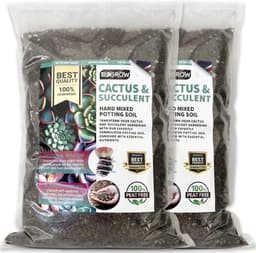
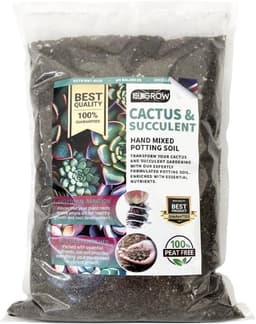
Four of the 11 titles contain peat-free wording. Three form one UK GROW Seramis family: B0B3LJMTD6 at 10 litres, B0B3LHJKS3 at 20 litres and B0B3LLXJLW at 30 litres. Their listings name grit, sand and Seramis. Calculated prices are about £1.20, £0.90 and £0.63 per litre. The fourth is UK GROW B0CN3RGQPD, a 20-litre bag at £16.99, about £0.85 per litre. Its title prints peat-free, but the listing does not name a drainage mineral, and the 5.0 stars come from only two ratings. The perlite bucket, the Plantalaya sizes, the aloe mix and the 6-litre Miracle-Gro-titled row do not print peat-free. That does not prove a laboratory test would find peat.

Peat-free does not mean free-draining

Peat substitutes can still hold a great deal of water. Coir, composted bark and wood fibre can remain damp around cactus roots, while grit or perlite creates a more open structure. You need printed peat-free wording and named drainage materials as two separate checks. The Seramis-titled products provide more pre-purchase detail because they also name grit and sand. The separate peat-free 20-litre heat-sealed bag gives no equivalent mineral list. Conversely, the 10-litre perlite bucket names an aeration component but does not print peat-free. A rainforest Christmas cactus generally wants more moisture retention than a desert cactus, and an aloe mix containing vermiculite may make sense where moderate moisture is useful. The cactus soil buying guide puts those checks in practical order.

RSS grades and missing evidence

The Responsible Sourcing Scheme for Growing Media uses an A–E rating that covers more than whether peat is present. A grade should be read from the pack or manufacturer evidence, not guessed from branding. None of the Amazon listings in this comparison prints an RSS grade. Ask the manufacturer if that detail matters, and do not treat a green bag or a low price as a substitute.

Common questions

Is peat compost illegal to sell in the UK?
No, not as a blanket statement in 2026. The UK government has committed to ending horticultural peat sales when parliamentary time allows, but an announced policy is not the same as legislation in force. Check current government guidance when buying, and rely on explicit peat-free wording rather than assuming every retail bag complies with a future ban.
How do I know whether a cactus bag is peat-free?
Look for "peat-free" printed on the physical pack or clearly stated for the exact product listing. The RHS says that if a bag does not say peat-free, it most likely is not. Check the delivered packaging because online photos and formulations can change, and do not transfer claims from a different size or retailer.
Do "organic" or "eco" mean peat-free?
No. Those terms do not establish whether peat is present. "Natural", "sustainable" and green-coloured packaging are equally insufficient. Only explicit peat-free wording supports that narrow claim. If you also care about wider sourcing impacts, look for an RSS grade or ask the maker for current supply-chain evidence.
Does peat-free compost drain faster?
Not necessarily. Coir, bark and wood fibre can all retain water, particularly in a fine or highly organic blend. Look separately for grit, sharp sand or perlite and consider the plant species. Peat-free describes the absence of peat; it does not measure drainage rate or guarantee suitability for desert cacti.
Which bags in this set print peat-free?
The three UK GROW Seramis-titled bags at 10, 20 and 30 litres print peat-free, as does UK GROW 20-litre ASIN B0CN3RGQPD. The Seramis sizes share one 166-rating block. No other title in this 11-product comparison provides enough listing evidence for a peat-free claim.
What does an RSS grade tell me?
The Responsible Sourcing Scheme rates growing-media ingredients using an A–E traffic-light approach and considers wider sourcing factors, not just peat. It can supplement a peat-free statement, but it must be read from evidence for the actual product. None of the Amazon files in this comparison displays an RSS grade.

Related pages

Sources

Public UK sources from the research digest, used for this page in October 2026. Prices, stars and review counts are the figures stored from the eleven amazon.co.uk listings on 19 October 2026. A drainage line and a peat-free line are listing claims. This is not a laboratory test. Selling peat compost was not shown as an offence in force in January 2026.

  1. RHS, cacti and succulents growing guide (retrieved October 2026)
  2. RHS, peat-free composts and mulches (retrieved October 2026)
  3. RHS, John Innes compost (retrieved October 2026)
  4. British Cactus and Succulent Society, containers, composts and repotting (retrieved October 2026)
  5. BBC Gardeners’ World, cactus soil (retrieved October 2026)
  6. Peat Free Partnership, legislation timeline (retrieved October 2026)
  7. UK Parliament deposited paper DEP2026-0072, 29 January 2026 (retrieved October 2026)
  8. Consumer Rights Act 2015, section 9 (retrieved October 2026)