Independent comparisons. We may earn from shop links. More info

Cactus soil buying guide for UK growers

Updated: October 2026

You have a cactus ready to move from its nursery pot, but the shelf offers cactus compost, succulent mix and ordinary multi-purpose compost with little explanation of the difference. This cactus soil buying guide gives you a reliable order of checks: identify the plant group, look for named drainage materials, buy a sensible volume, then verify peat-free wording and listing quality. Our [cactus soil comparison](/hub/fertiliser-soil-and-bark-mulch/cactus-soil) contains the current amazon.co.uk products and prices. The aim here is not to crown one bag, but to help you recognise which evidence matters before stars or branding sway the decision.

You have a cactus ready to move from its nursery pot, but the shelf offers cactus compost, succulent mix and ordinary multi-purpose compost with little explanation of the difference.

Our top picks

On this page

Start with the plant, not the brand

Most desert cacti need a medium that drains quickly and spends relatively little time wet around the roots. Many familiar succulents, including echeveria and haworthia, have broadly similar requirements, so dual cactus-and-succulent mixes can be a sensible starting point. A label covering many plants is a compromise, not proof that every species wants the same moisture. Aloe often tolerates slightly more moisture than a desert cactus. One product in this comparison names vermiculite for moisture retention as well as perlite. That may fit aloe, but it is not automatically helpful for a cactus whose roots rot in a damp pot. If you do not know your plant, identify it before buying. A Christmas cactus is a rainforest epiphyte and wants more moisture retention than a desert cactus.

Require the listing to name its drainage materials

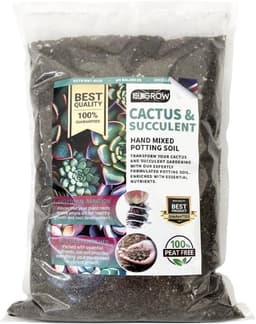
Fast draining is a result, not an ingredient list. Grit, sharp sand and perlite create larger air spaces and help water leave the root zone. The RHS suggests ready-made peat-free cactus compost or peat-free John Innes No. 2 with up to about 30% grit as a general approach. The British Cactus and Succulent Society describes equal parts John Innes and grit for many plants, with a higher mineral share for species from drier habitats. These are cultivation guides, not guarantees about a retail bag. In the current comparison, the 10-litre UK GROW bucket names perlite. The three peat-free Seramis-titled UK GROW bags name grit and sand as well as Seramis. By contrast, the Plantalaya variants call themselves fast draining but do not name the minerals on the product listing. That absence does not prove the mix is poor, but it gives you less information before purchase. Do not substitute builders' sand for washed horticultural grit.

Choose litres you can use and trust the right fields

Pack volume should reflect the new pots, not the number of plants alone. A plant's existing root ball takes up much of the pot. According to the seller, 4 litres fills a 14 cm pot, but treat that as a rough commercial claim. For one small repot, a 1- or 2.5-litre bag may be enough; for a collection, 10 to 30 litres reduces the price per litre. The Plantalaya litre titles show a unit-count field of 200 g across several sizes, and another 20-litre listing has a unit count of 1 millilitre. In those cases, the title and pack photograph are more useful than a misconfigured attribute. Our comparison of the current cactus-compost listings explains which review pools and product fields are shared or inconsistent.

Separate peat-free wording, price and review evidence

A peat-free label answers one question only: whether the seller explicitly represents the mix as containing no peat. It does not tell you how quickly the compost drains. In this comparison, four UK GROW titles print peat-free, while the remaining listings do not. Price per litre helps compare differently sized bags. The bulk end of this comparison is below about £1 per litre, the mid-range 10-litre options are around £1.20 to £1.50, and the small Plantalaya packs run from roughly £3.20 to £8.99. Do not let a low unit price outweigh missing drainage information. Finally, check whether reviews belong to the exact item. The three Seramis sizes share 4.6 stars from 166 ratings, while the three Plantalaya sizes share 4.4 from 17. That family-level feedback cannot distinguish one pack size. Follow the practical steps in our guide to repotting a cactus.

Common questions

Is cactus compost the same as multi-purpose compost?
No. Multi-purpose compost is designed to cover a wide range of plants and commonly holds water longer than a desert cactus needs. Cactus compost should have a more open structure, often using grit, sharp sand or perlite. A ready-made cactus bag can still be too organic for some species, so read the ingredients.
How many litres do I need for one pot?
There is no fixed answer because the root ball occupies space. As a rough shopping decision, one to a few litres is usually more plausible for a small windowsill repot than a 10-litre bag. A seller in this set claims 4 litres fills a 14 cm pot, but pot shape and root size can change that substantially.
Does peat-free mean fast draining?
No. Peat-free compost can use coir, bark, wood fibre or other organic materials that still hold considerable water. Drainage depends on the whole recipe and structure. Look separately for named mineral components such as grit, sharp sand or perlite, then use the printed peat-free statement to answer the sourcing question.
Can I use one bag for a Christmas cactus?
Possibly, but do not choose on the word "cactus" alone. A Christmas cactus is a rainforest epiphyte and wants more moisture retention than a desert cactus. A balanced mix with organic material and drainage is more suitable than an extremely dry mineral blend. Identify the plant and adjust watering accordingly.
Should I trust shared Amazon ratings?
Treat them as evidence about the product family, not the exact size. When 10-, 20- and 30-litre variants all display the same count, the reviews may cover several packs or formulations. Check review text, dates and variant labels, and do not let a shared star number replace ingredient and volume checks.
Is builders' sand suitable for cactus compost?
No. Builders' sand is not a reliable substitute for washed horticultural grit or sharp sand intended for growing media. Fine material may compact and its salt or lime content may be unsuitable. Use a horticultural product with a known particle size, especially when drainage is the reason for adding it.

Related pages

Sources

Public UK sources from the research digest, used for this page in October 2026. Prices, stars and review counts are the figures stored from the eleven amazon.co.uk listings on 19 October 2026. A drainage line and a peat-free line are listing claims. This is not a laboratory test. Selling peat compost was not shown as an offence in force in January 2026.

  1. RHS, cacti and succulents growing guide (retrieved October 2026)
  2. RHS, peat-free composts and mulches (retrieved October 2026)
  3. RHS, John Innes compost (retrieved October 2026)
  4. British Cactus and Succulent Society, containers, composts and repotting (retrieved October 2026)
  5. BBC Gardeners’ World, cactus soil (retrieved October 2026)
  6. Peat Free Partnership, legislation timeline (retrieved October 2026)
  7. UK Parliament deposited paper DEP2026-0072, 29 January 2026 (retrieved October 2026)
  8. Consumer Rights Act 2015, section 9 (retrieved October 2026)