Independent comparisons. We may earn from shop links. More info

How to use hydrangea colourant

Updated: October 2026

You have a responsive pink mophead, or a blue one that faded after a summer on the hose, and a tub that says it will shift the flowers. How to use hydrangea colourant through a British season is a soil drench from April to September, repeated, kept off the leaves. One watering in August, poured over the foliage, is the pattern that disappoints. This page follows the Westland label, because that is the named colourant in our set. It does not rank packs. Shelf prices are on the [blue fertiliser comparison](/hub/fertiliser-soil-and-bark-mulch/blue-fertiliser). We did not time a flower in a trial bed.

You have a responsive pink mophead, or a blue one that faded after a summer on the hose, and a tub that says it will shift the flowers.

Our top picks

On this page

When to start, and why a late first try shows little

According to the manufacturer, the season is April to September. In the Amazon reviews, people who saw pink move back towards blue started as the first flowers formed and watered at the base each week. A single late application is the complaint that ends with nothing happened. Colour is set as the sepals develop. A head that has already opened stays the colour it opened. Keep the seven-day interval while the shrub is in growth, and stop in September. Whether the cultivar can change is on the buying guide.

How much Westland colourant to mix

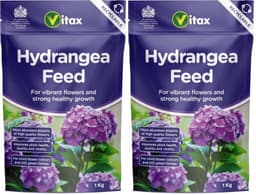
For an established shrub in the ground, according to the manufacturer, work 50 g per square metre into the soil, then dissolve 50 g in 5 litres of water every seven days and apply that under the shrub. For containers, the same label says 50 g per 5 litres of compost at potting, then the same weekly drench. One reviewer said the stated amount nearly killed a small plant. On alkaline soil the manufacturer allows ericaceous compost or a double rate. Double means twice the printed figure, not a second doubling the next week. Do not paste the 50 g figures onto a generic tub that says sprinkle 30 ml. If the pack is Vitax Hydrangea Feed, follow its planting and spring top-dressing line. Which tub to buy is on the best hydrangea colourant page.

Where the solution goes

The drench goes on the soil or compost under the shrub. According to the manufacturer, keep it off the foliage. In the Amazon reviews, people who watered the leaves reported white marks. The flowers do not dye like fabric. Pour slowly at the collar of the plant until the 5 litres are in the soil, and stop before the solution runs into a drain. Gloves and eye protection belong on before you open the tube, because the hazard is the dust and the solution. Pots and rainwater are on blue hydrangea in a pot.

When to stop, and when to get help

Stop if the leaves scorch, the foliage collapses, or a young plant wilts after a dose. One amazon.co.uk reviewer said the suggested amount nearly killed a plant. Do not answer that with a stronger mix the next Saturday. Water with plain water if the compost is not already sodden, and ask a nursery if the plant keeps declining after you have stopped. The safety data sheet classes the Westland powder as causing serious eye damage, hazard H318, signal word Danger. Wear eye protection and gloves, and store it away from food and children. If powder gets in an eye, rinse and call a poison centre or a doctor. The telephone printed on that sheet is +44 1480 443789. Do not wash spills into drains.

Common questions

When in the year do I start?
April to September, and earlier in that window is the useful start: as buds form, then every seven days while the shrub is growing. A first dose in late summer can still be put on the soil at the label rate. In the Amazon reviews, people who began late, or who stopped after one watering, often saw no colour change. September is the end of the manufacturer season. A white cultivar will not turn blue however early you begin.
How much goes in a watering can?
For Westland, dissolve 50 g in 5 litres and apply that to the soil under the shrub every seven days in the growing season, after an initial 50 g per square metre worked into the soil. In a pot the potting rate is 50 g per 5 litres of compost, then the same weekly drench. Use those figures on that product. A generic 30 ml line is a different instruction, and Vitax feed uses a planting and spring top-dressing rate of its own.
Can I pour it over the leaves?
Keep it off the foliage. According to the manufacturer, the solution belongs on the soil, and in the Amazon reviews people describe white marks when the leaves were wetted. The flowers are not dyed by contact. Pour at the base, slowly, so 5 litres soaks the root zone. If you have already marked the leaves, leave them, keep the next can on the soil, and do not scrub the residue with more product.
How long until the flowers change?
There is no day count we can honestly print. Reviews link a visible shift to weekly use from spring, and they link failure to one late application. Heads that are already fully coloured may stay as they are while later growth responds. Purple rather than a clear blue is a result people still report. Judge the shrub over the season. The Saturday after the first can is too soon.
What if the leaves scorch?
Stop. One reviewer reported a plant nearly killed at the stated amount, with poor leaf colour on another. A larger dose the next weekend is the wrong response. If the compost is dry, use plain water, and ask a nursery if the shrub keeps declining after you have stopped. Eye contact or swallowing is a medical call, as the Westland safety sheet says, on +44 1480 443789.

Related pages

Sources

Public UK and maker sources from the research digest, used for this page in October 2026. Prices, stars and review counts are the amazon.co.uk listings in that digest. The Westland dose and the 93% aluminium sulphate figure are from the manufacturer pages, not from the amazon bullets. A 5.0 from three ratings has no review text.

  1. RHS shrubby hydrangea growing guide (retrieved 22 October 2026)
  2. RHS acidifying soil (retrieved 22 October 2026)
  3. Westland Hydrangea Colourant (retrieved 22 October 2026)
  4. Westland safety data sheet, 8 January 2021 (retrieved 22 October 2026)
  5. BBC Gardeners' World, how to grow hydrangeas (retrieved 22 October 2026)
  6. Grow Scotland, hydrangea flower colour (retrieved 22 October 2026)
  7. Agriculture Act 1970, section 68 (retrieved 22 October 2026)
  8. Fertilisers Regulations 1991, Schedule 2 (retrieved 22 October 2026)