Independent comparisons. We may earn from shop links. More info

Biochar for pots and houseplants

Updated: October 2026

A bed rate in kilograms per square metre does not tell you what to put in a 12 cm houseplant pot, and a fine black dust is a different problem on a windowsill than on a border. You are mixing a share of the compost in the pot, charging plain char first, and keeping the fines outside the room until the mix is damp. This page stays on containers, hanging baskets and seedlings. The eight listings sit on the [biochar comparison](/hub/fertiliser-soil-and-bark-mulch/biochar). A qualifying purchase can earn a commission at no extra cost to you.

A bed rate in kilograms per square metre does not tell you what to put in a 12 cm houseplant pot, and a fine black dust is a different problem on a windowsill than on a border.

Our top picks

On this page

A share of the pot, not a kilo per square metre

Measure biochar as a fraction of the compost volume in that pot. Where the bag is silent, 5–10% by volume is the band Demeter and Carbon Bloom publish for containers, and it is a rule of thumb. Ten percent of a 10 litre pot is 1 litre of char. Demeter says about 10% for many houseplants, up to 20% for plants that like damper compost, and about 5% for cacti and succulents. Do not treat 20% as the default. A 1 litre bag is one 10 litre pot at that 10% rule of thumb, not a whole shelf. The Potting Pantry listing names houseplants, but the title says 10 litres while the model is TPP-BIOCHAR-1L and the unit count is 280 g. The charge-and-mix sequence in full is how to use biochar.

Houseplants, baskets and seedlings

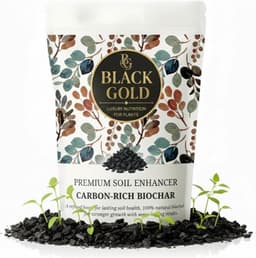
In the Amazon reviews, one Black Gold buyer used the char sparingly in hanging baskets with compost. Another mentioned a chilli grown in compost and that a little went a long way. That is a sequence the buyer reported, not a trial that proves the flowers came from the char. The 4.6 from 16 reviews is shared across the 1, 3 and 5 litre ASINs. Seedlings and cuttings should get the low end. Carbon Bloom suggests about 7.5% when sowing, on their page, for their product. The Potting Pantry bullets name seedlings and still say to charge the char first. Do not copy that recipe onto Black Gold. A seed tray is a small volume: 7.5% of 2 litres is 150 ml. Which bag fits the job is best biochar for a garden.

Dust, ericaceous plants and feed

The least messy small bag in this set, on listing text alone, is Black Gold 1 litre, because the litre fields agree and the included line mentions a resealable bag. EarthCraft at 105 g per stated litre is the grade reviewers called powder. If you already own it, dampen it outdoors before it meets a houseplant. The RHS says alkaline biochar is a poor match for ericaceous plants, and it puts that threshold at pH over 7. These bags do not print a pH. You still feed the pot. Straight char is a conditioner. It does not print an NPK on any listing here. If leaves yellow after you add a large dose of raw char, the sponge effect is the first thing to suspect.

Char is not a stand-in for perlite

Perlite, which The Potting Pantry bullets name as something you can blend with the char, is a different mineral. Char does not replace perlite in a recipe that was written for drainage and low weight. You can use both. You should not assume one stands in for the other because both look gritty. Keep perlite in the recipe if the plant was potted that way, and add char as the extra 5–10% rather than by deleting the perlite.

Common questions

How much biochar goes in a pot?
Where the bag gives no rate, use about 5–10% of the compost volume, which is the container band on Demeter's and Carbon Bloom's pages for their products. Ten percent of a 10 litre pot is 1 litre. Ten percent of a 5 litre pot is 0.5 litre. Cacti and succulents sit nearer 5% on Demeter's page. Go above 10% only when you are copying a seller who states that higher share for plants that like damper compost, not as a default for every houseplant.
Can I use it on indoor plants?
Yes, if you mix it outdoors or over a sheet and bring damp compost inside. Black Gold's title says indoor and outdoor. The Potting Pantry bullets name houseplants and a charging step, with a size conflict you should not ignore. EarthCraft names pots, and its reviews describe fine dust and torn bags, so it is the awkward one for a flat. A 1 litre pack is enough for a few pots at about 10%.
Is it safe in a vegetable pot or a chilli pot?
The listings that name vegetables or potting soil do not show a contaminant test, an EBC class or a pH. A Black Gold reviewer reported a chilli in compost and sparing use in baskets. That is not proof the char fed the plant. Use a modest share in ordinary potting compost, keep raw char charged, and do not put unlabelled dust on food crops if the bag split and you cannot tell what arrived.
Should seedlings get the same percentage?
Use the lower share. Carbon Bloom suggests about 7.5% when sowing, against about 10% in a finished houseplant pot, for their product. The Potting Pantry listing names seedlings and cuttings and still tells you to charge first. A dust-fine grade is easier to overdo in a seed tray, so measure in millilitres and cover the seed with compost, not with a cap of dry char.
Do I still feed the pot?
Yes. These listings do not show an NPK, and the RHS treats straight biochar as a physical conditioner. Compost and your usual liquid feed still do the nutritional work. Charged char can hold moisture and nutrients in its pores. It does not replace the feed on the schedule you already use for that plant.

Related pages

Sources

Public UK sources from the research digest, used for this page in October 2026. Prices, stars and review counts are from the eight amazon.co.uk listings in this set, captured for the 19 October 2026 scoring pass. No kept bag shows an EBC class, a Soil Association number, a pH or an NPK. RPS 366 is an England position for waste-code biochar, not a household rule for Scotland, Wales or Northern Ireland.

  1. RHS, biochar (retrieved 19 October 2026)
  2. GOV.UK, RPS 366 storing and spreading biochar (retrieved 19 October 2026)
  3. GOV.UK, LRWP 60 making biochar from waste (retrieved 19 October 2026)
  4. GOV.UK, check if your material is waste (retrieved 19 October 2026)
  5. legislation.gov.uk, PFC 3 soil improver (retrieved 19 October 2026)
  6. European Biochar Certificate (retrieved 19 October 2026)
  7. Carbon Gold soil improver (retrieved 19 October 2026)
  8. SoilFixer, biochar application rates (retrieved 19 October 2026)