Rodent mesh for the gap mice already use
You have found droppings by the air brick, a chewed corner under the deck, or a gap where the shed meets the slabs, and the roll in the basket has holes you could put a thumb through. Rodent mesh, in this amazon.co.uk set, means a small opening fixed over the route, with an overlap the animal cannot nose aside. A 6 cm garden grid will not do that job, however long the roll. Prices are on the [wire mesh comparison](/hub/fencing-and-wire/wire-mesh). The Products Compared editorial team read these listings on 16 October 2026, with no lab test. A qualifying purchase can earn a commission at no extra cost to you.
You have found droppings by the air brick, a chewed corner under the deck, or a gap where the shed meets the slabs, and the roll in the basket has holes you could put a thumb through.
You have found droppings by the air brick, a chewed corner under the deck, or a gap where the shed meets the slabs, and the roll in the basket has holes you could put a thumb through. Rodent mesh, in this amazon.co.uk set, means a small opening fixed over the route, with an overlap the animal cannot nose aside. A 6 cm garden grid will not do that job, however long the roll. Prices are on the wire mesh comparison. The Products Compared editorial team read these listings on 16 October 2026, with no lab test. A qualifying purchase can earn a commission at no extra cost to you.
Our top picks
| Badge | Product | Mesh opening | Size | Coating | Note | Price | Offer |
|---|---|---|---|---|---|---|---|
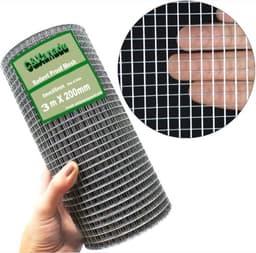
| Best overall |  C&Xanadu C&Xanadu 200 mm x 3 m rat mesh | 6 mm x 6 mm | 200 mm x 3 m | Hot-dip galvanised | 8.7 | about £11.58 | View offer |
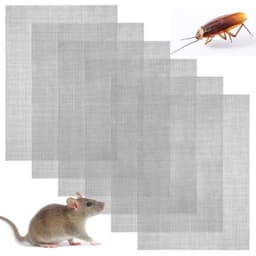
| Preis-Tipp |  Not stated 304 stainless mesh sheets, pack of 6 | 20-mesh | 6 sheets, 15 x 21 cm | 304 stainless | 7.9 | about £6.99 | View offer |
| Alternative |  JAHOMFAI JAHOMFAI 400 mm x 6 m rodent mesh | 6 mm x 6 mm | 400 mm x 6 m | Hot-dip galvanised | 8.1 | about £19.99 | View offer |

On this page
The hole has to be smaller than the animal
Air bricks and other vents
Decks, sheds and the edge on the ground
What mesh will not do
Common questions
What hole size is sold for mice and rats in this set?
Will chicken wire stop a rat?
Can I cover an air brick?
How wide a piece do I need?
Will mesh stop rats that are already indoors?
Should the whole garden fence be fine mesh?
Related pages
Sources
Sources from the research digest. amazon.co.uk listings in this comparison were checked for the 16 October 2026 score. We did not run a laboratory test.
- Town and Country Planning (General Permitted Development) (England) Order 2015, Schedule 2, Part 2, Class A (retrieved 15 October 2026)
- Planning Portal: Fences, gates and garden walls (retrieved 15 October 2026)
- GOV.WALES: Planning permission for fences, gates and garden walls (retrieved 15 October 2026)
- Scottish Government: Householder permitted development rights, Class 3E (retrieved 15 October 2026)
- GOV.UK: When is permission required? (retrieved 15 October 2026)
- Consumer Rights Act 2015, section 9 (retrieved 15 October 2026)
- Wildlife and Countryside Act 1981, section 1 (retrieved 15 October 2026)
- Hedgehog Street: Link your garden (retrieved 15 October 2026)