Chicken wire vs welded mesh: twist or square hole
You are covering a vegetable bed, patching a hutch, or closing a gap under the shed, and the two rolls are built differently. Chicken wire is hexagonal wire netting you can gather around a curve. Welded mesh is a grid with a joint at every crossing, so the hole stays squarer. Chicken wire vs welded mesh is that choice of joint. The [wire mesh comparison](/hub/fencing-and-wire/wire-mesh) holds the amazon.co.uk prices. The Products Compared editorial team used these listings on 15 October 2026, with no lab test and no British Standard claimed. A qualifying purchase can earn a commission at no extra cost to you.
You are covering a vegetable bed, patching a hutch, or closing a gap under the shed, and the two rolls are built differently. Chicken wire is hexagonal wire netting you can gather around a curve.
You are covering a vegetable bed, patching a hutch, or closing a gap under the shed, and the two rolls are built differently. Chicken wire is hexagonal wire netting you can gather around a curve. Welded mesh is a grid with a joint at every crossing, so the hole stays squarer. Chicken wire vs welded mesh is that choice of joint. The wire mesh comparison holds the amazon.co.uk prices. The Products Compared editorial team used these listings on 15 October 2026, with no lab test and no British Standard claimed. A qualifying purchase can earn a commission at no extra cost to you.
Our top picks
| Badge | Product | Construction | Mesh opening | Wire diameter | Note | Price | Offer |
|---|---|---|---|---|---|---|---|
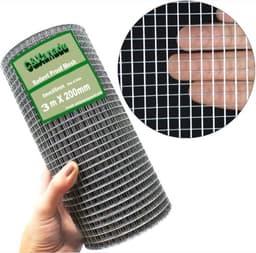
| Best overall |  C&Xanadu C&Xanadu 200 mm x 3 m rat mesh | Welded | 6 mm x 6 mm | Not stated | 8.7 | about £11.58 | View offer |
| Alternative |  Anesty Anesty chicken wire 40 cm x 10 m kit | Hexagonal | 15 mm x 25 mm | 0.5 mm | 8.5 | about £12.71 | View offer |
| Alternative |  UNU UNU chicken wire 0.4 m x 16 m | Hexagonal | 25 mm x 50 mm | 0.5 mm | 8.6 | about £9.99 | View offer |


On this page
They are not the same product
Choose chicken wire for shape, not for a shove
Choose welded mesh when the opening has to stay square
The recommendation, with the fox left out
Common questions
When is chicken wire the right buy?
When is welded mesh worth the stiffer roll?
Will chicken wire stop a fox?
Will welded mesh stop mice?
Which one is easier to cut and shape?
Do I still need posts?
Is green PVC welded mesh the same as chicken wire?
Related pages
Sources
Sources from the research digest. amazon.co.uk listings in this comparison were checked for the 16 October 2026 score. We did not run a laboratory test.
- Town and Country Planning (General Permitted Development) (England) Order 2015, Schedule 2, Part 2, Class A (retrieved 15 October 2026)
- Planning Portal: Fences, gates and garden walls (retrieved 15 October 2026)
- GOV.WALES: Planning permission for fences, gates and garden walls (retrieved 15 October 2026)
- Scottish Government: Householder permitted development rights, Class 3E (retrieved 15 October 2026)
- GOV.UK: When is permission required? (retrieved 15 October 2026)
- Consumer Rights Act 2015, section 9 (retrieved 15 October 2026)
- Wildlife and Countryside Act 1981, section 1 (retrieved 15 October 2026)
- Hedgehog Street: Link your garden (retrieved 15 October 2026)