Independent comparisons. We may earn from shop links. More info

How to install a wire mesh fence when the box is only a roll

Updated: October 2026

The roll is on the path, and the box you opened is mesh. In this set that is the normal delivery. Only the RIFNY kit describes posts. Everyone else still needs timber or metal posts, staples or ties, and a way to close the bottom edge. This page is that sequence for how to install a wire mesh fence once the roll is yours. The [wire mesh fence comparison](/hub/fencing-and-wire/wire-mesh-fence) is the table of rolls. Peter F. updated this in October 2026. We did not time an install or test a post. A qualifying purchase can earn a commission at no extra cost to you.

The roll is on the path, and the box you opened is mesh. In this set that is the normal delivery. Only the RIFNY kit describes posts.

Our top picks

On this page

What has to be in your hand before the roll opens

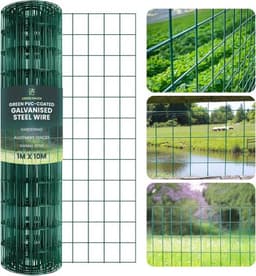
Count the fixings before you cut the tape. Green Haven tells you to attach the 1 m roll to timber posts with U-nail staples, and the box is steel wire fencing only. VOUNOT ships the roll and tells you to fix it to posts you already have. EzKamfort’s included line says none. Meanon includes 50 cable ties. LITLANDSTAR includes 150 zip ties and no posts. Steel boxes omit gloves, and TOYPOPOR reviews point at sharp ends. A 40 cm roll cannot be stretched into a tall fence. If you need the RHS rabbit height of about 120–140 cm plus a buried skirt, take the roll back to the wire mesh fence buying guide before you dig.

Posts, tension, and the fixing

Mesh Direct’s notes, written for mesh that shop sells, space posts at about 1.8 m and set the post upright before the mesh goes on. Galvanised U-staples sit about 10–20 cm apart. That is a trade range, not a measurement of these rolls, and none of the rolls includes the staples. Set a string, fix the start post, unroll, pull the mesh taut, and fix the next post before you move on. If the run is longer than one roll, overlap by about 15 cm and staple both layers. If a dog or a hen pushes from inside, fix the mesh on the animal side of the posts. On metal or concrete, use cable ties or tie wire. A push-in kit is not posts set in concrete.

A skirt, a bury, and the cut end

The bottom edge is where light mesh fails. For rabbits, the RHS wants the bottom 30 cm sunk and the lower 15 cm turned out, on a fence already 120–140 cm above ground. A 40 cm roll does not contain that much wire. For one plant, about 90 cm of netting without burial is a shrub cylinder, not a boundary. For hens, the RSPCA describes fencing about a foot into the ground or a skirt about 40 cm wide, and a house that locks at night. A staple-up of light hex is not that run. If a fox is the reason, this install is the wrong design. EzKamfort reviews say joints broke at the cut, and a fresh cut is bare metal. A lifted bottom is the hole the animal will use.

A temporary plastic kit, and when to stop

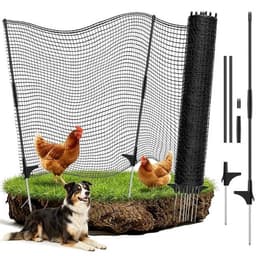
RIFNY stays above ground: join the short posts, push the stake, tie the 16 mm by 18 mm mesh, and treat it as temporary. A post count is not printed. Reviewers cut it for puppy lines. One says it will not keep chickens in, and one fence blew away. Hard ground sends you back to a dug post. Stop and call a fencer when the line beside a road may exceed 1 metre, the land is listed or under an Article 4 direction, or the boundary is disputed. Stop as well for a fox-proof run or a deer fence. A bed guard, a gate infill and a watched temporary line are the installs this set supports.

Common questions

Are the posts in the roll I just bought?
Only if you bought RIFNY. The bullets describe short posts, a connecting tube, a ground stake and 52 cable ties. They do not print a post count. Green Haven, VOUNOT, Thealyn, the hex rolls and EzKamfort are mesh. Meanon, LITLANDSTAR and Dnoifne add ties, not posts.
How do I fix mesh to a timber post?
Use galvanised U-staples and a hammer, or a staple gun loaded with fence staples. Mesh Direct suggests about 10–20 cm apart, with a shorter staple on light hex and a longer one on heavier welded mesh. Staples are not in these boxes. Pull the mesh taut before you drive them. That spacing is a trade method.
What do I do with the bottom edge for rabbits?
The RHS sinks the bottom 30 cm and turns the lower 15 cm outward. You need a roll tall enough to give that away and still leave 120–140 cm above ground. A 40 cm roll cannot. For one plant, about 90 cm of netting without burial is the RHS alternative, a shrub guard.
Do I need gloves to cut this wire?
Yes on steel. TOYPOPOR reviews and EzKamfort’s listing both point at sharp ends. The cut leaves bare metal. Plastic rolls such as Meanon are described as smooth. Gloves are still useful when a steel roll springs back. Do not expect them in the UNU box.
How is a plastic kit different from a steel roll?
RIFNY pushes together and ties on. A steel roll such as Green Haven or VOUNOT needs posts you buy separately, staples or ties, and a plan for the bottom edge. The kit is temporary. The steel roll is still only mesh until you add the posts.
How far apart should the posts be?
Mesh Direct uses about 1.8 m. Closer posts hold a light roll better. That figure is a trade method for mesh in general, not a test of these ASINs. A sagging 0.5 mm hex needs more support than a rigid welded metre.
When should I stop and call a fencer?
When the fence may exceed 1 metre beside a vehicular highway, the property is listed, an Article 4 direction applies, the boundary is disputed, or you are building a fox-proof run or a deer fence. Those are not a Saturday with a 40 cm roll and a handful of ties.

Related pages

Sources

Public UK sources and the amazon.co.uk listings used for this comparison. Prices stored 19 October 2026.

  1. Town and Country Planning (General Permitted Development) (England) Order 2015, Schedule 2, Part 2, Class A (retrieved 19 October 2026)
  2. Planning Portal: fences, gates and garden walls (retrieved 19 October 2026)
  3. GOV.WALES: planning permission for fences, gates and garden walls (retrieved 19 October 2026)
  4. Scottish Government, Planning circular 1/2024: Class 3E householder permitted development (retrieved 19 October 2026)
  5. Planning (General Permitted Development) Order (Northern Ireland) 2015, Part 3, Class A (retrieved 19 October 2026)
  6. Animal Welfare Act 2006, section 9 (retrieved 19 October 2026)
  7. RSPCA: chickens (retrieved 19 October 2026)
  8. RHS: rabbits (retrieved 19 October 2026)