Independent comparisons. We may earn from shop links. More info

How to install a picket fence

Updated: October 2026

You already know which fence you bought, and the video you found only shows posts, concrete and a string line. How to install a picket fence depends on the product in the box. A posted 0.9 m panel, a hammered wood roll, a plastic click panel and a screw-in steel leg are four jobs. The [picket fence comparison](/hub/fencing-and-wire/picket-fence) is where those four amazon.co.uk listings sit. Peter F. matched each method to the listing notes stored on 19 October 2026. This page is the sequence. It is not the ranking, and it is not the statute.

You already know which fence you bought, and the video you found only shows posts, concrete and a string line. How to install a picket fence depends on the product in the box.

Our top picks

On this page

Set posts for a panel picket

A posted picket starts with a string line. Clarke Fencing describes holes about 600 mm deep and about 250 mm across, with about 100 mm of gravel, then Postcrete. Wickes uses 450 mm to 600 mm, with concrete sloped so water runs off. Jacksons treat about 600 mm as usual. A DIY Fence drawing for a 0.9 m picket marks 450 mm as a minimum. Those are supplier figures, not a British Standard. The post in the ground should be Use Class 4. Do not put a cut end into the soil, and do not sit the post in a boot that holds water. Two rails suit about 0.9 m. A gate needs a stouter post. The type belongs on the picket fence buying guide. None of these four listings is that posted panel.

Tap in a wooden roll

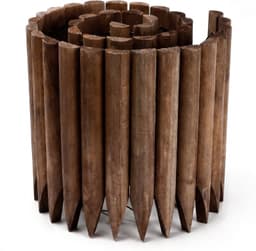
JonesHouseDeco is 120 cm by 30 cm by 1.35 cm, at about £25.99. The listing says the insert is tool-free. The first 50 UK reviews say you tap each picket gently into soft soil. A hard blow on dry or stony ground splits the wood. One person bought extra stakes for a curve, because they are not in the box. Lay the roll out first. A curve shortens the run, and 1.2 m does not become 2 m because you bent it. Treatment is not stated. One reviewer saw rot start after a year and pulled it after four. If the ground only yields to a heavy hammer, stop.

Click plastic panels and screw steel legs

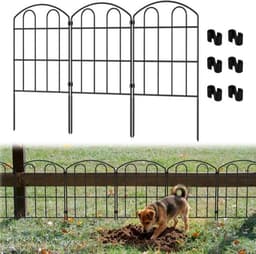
BURAKH is ten wood-effect panels, about 60 cm by 33 cm, at about £12.49. You push them in and click them. Separate stakes are not included. In the first 50 UK reviews the lugs snap while you join the panels, spokes break when the soil is not very soft, and one line buckled in the wind after a day. If a lug arrives broken, that panel is out of the run. LIANTRAL is ten panels, 61 cm by 33 cm, stated as 3.3 m, at about £23.48. You screw a pointed leg on, then hammer or push. The no-dig title skips the concrete hole. It does not mean the fence arrives standing. Powder coat clogs the threads. Hard pushing bends the wires, and 61 cm is not the height left above the bed.

When to stop

Stop if you do not know what is under the line. Wickes tells you to check for buried services before you dig or drive spikes. Stop on steep ground, or ground so soft that a 600 mm hole will not hold a post. Stop if you and the neighbour do not agree whose fence it is. The deeds answer that, not the side the posts face. A Scottish conservation area, a listed building, or an Article 4 direction can mean an application even when the height looks modest. Check picket fence planning permission before the first hole. A fencer is the right call when the boundary, the slope or the gate is the problem. If you buy through a link on this page, we may earn a commission at no extra cost to you. This is not a laboratory test.

Common questions

How deep should the posts be for a low picket fence?
Supplier guides cluster around 600 mm. Wickes gives 450 mm to 600 mm. A DIY Fence sheet for a 0.9 m picket shows about 600 mm and marks 450 mm as a minimum on that drawing. Soft or exposed ground wants the deeper end. These are not a British Standard. The four amazon listings in this set do not use that hole at all.
Do you put gravel under the post?
Yes, on the posted method. Clarke Fencing describes about 100 mm of gravel in the hole. Wickes and the treatment guidance also want ballast under the post so the end is not standing in a wet pocket. Shape the concrete so rain runs away. A border spike does not get this treatment. You are tapping wood or steel into the bed.
Should the concrete touch the bottom of the post?
The treatment guidance rejects a boot that traps water around the end. Gravel sits under the post, and the concrete is sloped at the top. A flat collar that holds a puddle against the timber shortens a Use Class 4 post. You also avoid putting a cut end, sawn on site, down into that hole.
How do you fit a wood picket roll without splitting it?
Fit the JonesHouseDeco roll only in soil that takes a point with a light tap. Work along the 1.2 m section, one pale at a time, and stop if the wood starts to split. The listing's tool-free line is not what the UK reviews describe. A curve may need extra stakes you buy yourself. Hard ground is a stop, not a cue to hit harder.
What if the plastic lugs snap?
On BURAKH, snapped lugs are the common UK complaint, sometimes on arrival and sometimes as you click the panels. That panel will not hold the run. Extra wooden stakes are what some reviewers add, and they are not in the pack. If several connectors in one set are damaged, you are looking at a return, because the joint is the fence.

Related pages

Sources

Public UK sources and the amazon.co.uk listings used for this comparison. Prices stored 19 October 2026.

  1. Planning Portal, fences, gates and garden walls: planning permission (retrieved 19 October 2026)
  2. Town and Country Planning (General Permitted Development) (England) Order 2015, Schedule 2 Part 2 (retrieved 19 October 2026)
  3. Welsh Government, planning permission for fences, gates and garden walls (retrieved 19 October 2026)
  4. mygov.scot, building a fence or wall at your house (retrieved 19 October 2026)
  5. Planning (General Permitted Development) Order (Northern Ireland) 2015, Part 3 (retrieved 19 October 2026)
  6. HM Land Registry, boundaries and boundary disputes (retrieved 19 October 2026)
  7. Wood Protection Association, buyer guide to preservative treated wood, September 2025 (retrieved 19 October 2026)
  8. Timber Development UK, fencing products (retrieved 19 October 2026)