BS 1722-11 fence panels: what the standard covers
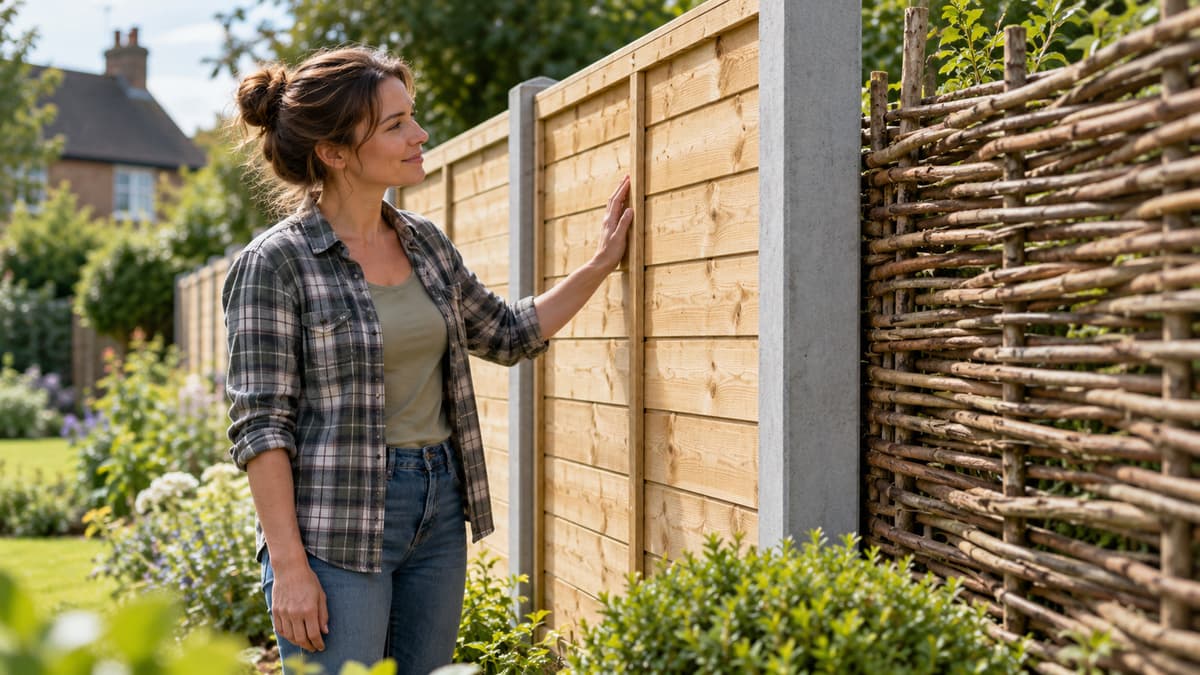
BS 1722-11 covers prefabricated softwood panels up to 2 metres. It does not certify willow hurdles or screening rolls. A missing claim is not a failed test.
On this page

A softwood panel fence is advertised as "to British Standard", and the willow hurdle beside it says nothing of the sort. BS 1722-11 fence panels are prefabricated softwood panels between timber or concrete posts. The part does not certify willow hurdles, framed willow or screening rolls.
The standard text was not copied here. What follows is the buyer-facing summary on the NBS index and on public catalogues of BS 1722-11:2006+A1:2018. Products Compared did not test a panel against the standard. Amazon links are affiliate links: a qualifying purchase can earn a commission at no extra cost to you.
In short
BS 1722-11:2006+A1:2018 specifies prefabricated softwood panel fences fixed between timber or concrete posts, and the public scope text stops at 2 metres above ground. Maintenance after installation is outside it. A catalogue note says these fences are not for animal or personnel loading, nor for some very exposed sites. Willow hurdles and amazon.co.uk screening rolls are a different construction, and none of the four rolls claims the standard. A missing claim is not a failed test. Planning permission is a separate question.
What this part of BS 1722 is for
BS 1722 is a family of fence specifications. Part 11, on the NBS publication index, is the specification for prefabricated wood panel fences, with amendment A1: materials, design, construction and installation of softwood panels fixed between timber or concrete posts. The 2006 edition came into effect on 30 November 2006 and superseded the 2000 edition. The amendment is dated 30 September 2018 on that index. A shop listing gives the amended document's publication date as 26 September 2018. Ask a seller for BS 1722-11:2006+A1:2018. "BS 1722" alone might be another part.
The public scope text covers the components, the construction, the dimensions and the tolerances. Larger sizes are often acceptable unless they stop parts fitting. Protective treatments are included. Maintenance after installation is outside the scope, so that line is not a care guide, and the clauses are not reprinted here. The PDF price on a standards shop is a document price, not a fence price.
If you are buying ordinary softwood lap panels between concrete posts, Part 11 is the name to ask about. Where a seller says the fence is made to that part, ask for the conformity wording the standard provides for. This article cannot check a batch. It can tell you when the name is used for a product the scope does not describe.
The 2 metre ceiling and what the note excludes
The public scope text does not cover fences of a height greater than 2 metres above ground level. A 2.1 metre softwood panel is outside this part. Two metres in planning guidance is a different test. In England and Wales the usual permitted-development figures are 1 metre next to a highway used by vehicles and 2 metres elsewhere, with listed buildings, Article 4 directions and, in Scotland, a different front-of-house test. The detail is in garden fence height rules. A panel inside Part 11's height can still need permission beside a pavement, and a hurdle this part never covered can still sit inside permitted development on a back boundary.
A catalogue note says these prefabricated wood panel fences suit housing, dividing boundaries and visual screens. They are not suitable for animal or personnel loading, nor for some very exposed areas such as headlands and high hills liable to abnormally high winds. That note belongs to this softwood system. It is not a wind-speed rating for a willow roll, and "to British Standard" is not a promise the panel will hold a dog. Mesh is the separate job, as will a wattle fence stop rabbits explains for the weave.
Exposed hills in that note are a reason to ask a fencer about the posts. That is the stop in when a garden fence needs a professional. The standard does not replace that judgement.
Willow hurdles are a different construction
A hurdle is rods woven by hand, willow or hazel, about 6 ft wide in the trade sizes on the maker pages, and tied to posts. Hazel Hurdle World specifies UC4 posts and cable ties, and wants the weave in the air. Musgrove's framed panels add treated timber battens around willow, from £66.60 to £129.00 on the page opened. The frame makes the bay look more like a softwood panel. The weave is still willow, and a batten edge does not change that.
No hurdle page used for this hub claims BS 1722-11. Calling both products fence panels does not import the standard. Framed willow fence panels keeps frame, ribbon hurdle and roll apart. Only the softwood system is a candidate for Part 11.
Maker life claims, five to ten years and the rival ranges, are not a durability clause of the standard. Do not look in Part 11 for how to oil willow. That maker disagreement is in how long willow hurdles last. If a merchant says "BS approved" with no part number, ask which part. A product that is not a softwood panel between posts is not this document.
Screening rolls are outside it too
The four rolls in our wattle fence comparison are Prime Plus at £44.99, Wadan at £46.99, Abaseen at £49.99 and the second Wadan title at £59.99. They are canes on wire. Abaseen is the top pick because the title and the specification both say 1.5 m by 4 m, with 4.5 from 125 reviews on that listing. None of the four records a BS 1722-11 claim. A roll is fixed to a fence that already exists, so it cannot conform to a specification for the softwood panels and posts.
The two Wadan listings share a review pool and disagree on size between the title and the specification. That is a measuring problem. The standard was not the claim. Prime Plus says the fixings are extra. Part 11's fit of components is about the softwood system, not cable ties in a roll box.
A cheaper roll instead of a softwood panel that might be specified to Part 11 is a form decision, set out in willow screening roll or a fence panel. You still need a sound support, and the height still has to be lawful. Country of origin, such as China on the Abaseen technical line, does not decide the standard. The construction does. An imported willow roll is still a roll.
A missing claim is not a failed test
A missing claim usually means a different product, not a test we ran. We did not run one. Challenge a softwood panel that advertises the standard and then will not name the part. Ask for BS 1722-11:2006+A1:2018 in writing when the fence is that prefabricated softwood kind and the claim matters. If the answer is another part of BS 1722, read that part's title before you treat it as a panel-fence specification.
"British Standard" on a preservative, a concrete post or a wire is another document. A UC4 post can be a treatment specification. It is not Part 11. Hazel Hurdle World's UC4 lengths are a maker instruction for hurdles. Quoting them does not pull the hurdle into the softwood-panel standard.
Planning permission is the other document. A specification, met or never applicable, does not answer the highway, the listed building or the Article 4 question. A conformity sentence is not a grant of permission. A council wants the height and the location, not a BSI shop receipt.
Common questions
Willow hurdles, framed willow and screening rolls sit outside the softwood-panel construction. Silence on those listings is not a fail, and the 2 metre scope limit is not planning permission. If you need the clauses, buy the standard. This page is the buyer-facing boundary around it.
Common questions
What is BS 1722-11?
Does it cover willow hurdles?
Does it cover a willow screening roll?
Is a fence over 2 metres inside this part?
Does the standard make a panel rabbit-proof or dog-proof?
If a listing does not mention BS 1722-11, has it failed the standard?
Does the standard tell me how to maintain the fence?
Is planning permission the same thing as meeting the standard?

Peter F. is the editor for DIY & tools at productscompared.co.uk. Comparisons in this category are checked against amazon.co.uk listings, review evidence and public UK sources.
Related articles

Framed willow panels and hurdles
A timber edge is still willow. It is not a prefabricated softwood panel system.

Willow screening roll or a fence panel
A roll is a cover. Part 11 is about softwood panels between posts.

Garden fence height rules in the UK
A 2 metre note in a standard is not the same test as planning permission.