Independent comparisons. We may earn from shop links. More info

Mechanical vs digital timer plug

Updated: October 2026

You have a lamp you want on at dusk, and two plugs in the basket that only diverge once you look at the face. A mechanical vs digital timer plug decision starts with that evening. A segment dial repeats one day. A weekly digital timer can change the times by weekday and can shift the switch-on while you are away. The [Timer switch comparison](/hub/electrical-equipment/timer-switch) sets both beside wired timers and a countdown switch, which answer other jobs. If every night is the same and you can turn the dial back after a power cut, the mechanical plug is the one to take home.

You have a lamp you want on at dusk, and two plugs in the basket that only diverge once you look at the face. A mechanical vs digital timer plug decision starts with that evening. A segment dial repeats one day.

Our top picks

On this page

Same day, every day

A mechanical timer plug repeats one day and then stops there. Press the segments for the hours you want power, then turn the ring so the marker sits on the time it is now. A 15-minute step fits a lamp from 18:00 to 23:00. The HBN three-pack steps in 30 minutes, so 18:10 will not land on a pin. Monday and Saturday share one pattern, and there is no random mode on these dials. On amazon.co.uk the Defender is £7.95 (4.4 from 14,239). The timer switch buying guide covers a heavier load than a lamp.

What a power cut does

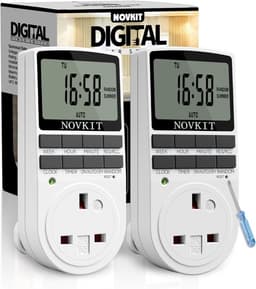
Lose the mains, or unplug the dial, and the ring stops. An hour later the segments still mark the same arc, and that arc is no longer 18:00. You turn the ring to the current time. These mechanical listings have no battery, so a shop line about clockwork riding through a cut does not describe them. NOVKIT and SURAIELEC state a battery that keeps the programme, and SURAIELEC names a Ni-Mh cell. The cell holds the clock and the stored times. The lamp stays off until the socket is live again. Weekday blocks and a button sequence take longer than a pin. Setting the pins, once a dial is in your hand, is on how to set a 24 hour plug timer.

Tick, and random mode

A tick often sends a mechanical timer out of a bedroom, because the dial motor clicks as it advances. Reviews in this set disagree. NOVKIT is called quiet beside a ticking dial and fiddly to programme. Defender’s 14,239 mechanical reviews include both a tick and silence. Random mode sits on the digital plugs and not on the mechanical ones here. SURAIELEC states a shift of 2 to 32 minutes. NOVKIT states random mode without a range, and one review found it less random than the title. Use the dial for a fixed 18:00. Use a stated digital range when you are away and that minute feels too regular.

The price of the extra features

The mechanical singles run from £4.25 to £7.95. The digital listings are twin packs: SURAIELEC at £16.99 and NOVKIT at £18.74. The extra outlay buys a week programme, a battery claim, and a random mode on the page. Nine reviews sit behind SURAIELEC’s 4.5, 3,114 behind NOVKIT’s 4.3, and 14,239 behind the mechanical Defender. The best timer plug page matches each listing to a job. A repeated day means the mechanical dial, with a reset after a cut. A changing week, or a random offset the listing states, means NOVKIT rather than the nine-review pack.

When neither plug-in is the answer

A 13 A plug suits one lamp, a fan, or indoor lights inside the stated wattage. A wired immersion needs a 16 A wired timer, and an electrician if you cannot isolate the circuit. A countdown switch drops the load after a few minutes and stores no day and no week. The top pick for the same minutes every night is a mechanical dial, though you turn the ring back to now after a power cut. Move to NOVKIT when weekdays differ or you want a stated random offset. SURAIELEC is a similar shape at £16.99 with far fewer reviews.

Common questions

Will a mechanical timer still be right after a power cut?
The ring stops when the supply stops. These mechanical plugs have no battery, so an hour without mains leaves the segments in place and the hour wrong. Turn the dial to the current time when the power returns. NOVKIT and SURAIELEC state a battery that can keep the programme. The lamp stays off until the mains returns, because the cell only backs up the clock.
I can hear a tick from the socket. Is that the dial?
A tick often comes from the motor in a mechanical segment timer, especially in a quiet bedroom. Defender reviews on that mechanical listing disagree about whether it ticks. NOVKIT is praised as quiet next to a ticking dial, and called fiddly in the same comments. Check the listing if the socket is beside a bed.
I am away for a week and the lights must not come on at 18:00 exactly. Which type has random mode?
Use a digital plug from this set. SURAIELEC states a shift of 2 to 32 minutes. NOVKIT states random mode without a published range, and one reviewer doubted how random it was. Mechanical dials here repeat the same minute. The offset only moves that minute, and a security claim on the box is marketing.
Why do people say digital timers are difficult if the listing says easy?
The first programme is a sequence of clock, weekdays, and on-off times, and several sheets want the backup charged before those times hold. A mechanical dial shows the day at once: pins down, pointer on now. Easy describes the idea. The complaints describe night one, which you can skip when your times never change.
Is the more expensive plug safer?
The dearer listings are the digital twin packs at £16.99 and £18.74, and that money pays for programmes, a battery claim, and random mode. Stars stay between 4.2 and 4.5, so price is a weak guide to safety. Match the stated current to the appliance, and stop if a timer runs hot, cracks, or smells.

Related pages

Sources

Public UK sources are listed below. Shelf prices and star lines are the figures on the saved amazon.co.uk listings.

  1. Electrical Equipment (Safety) Regulations 2016, regulation 35 (retrieved October 2026)
  2. GOV.UK consumer product safety (retrieved October 2026)
  3. Electrical Safety First, plugs and fuses (retrieved October 2026)
  4. Electrical Safety First, buying electrical goods online (retrieved October 2026)
  5. Approved Document P (England, 2013 PDF) (retrieved October 2026)
  6. BSI, BS EN IEC 60730-2-7:2020 (retrieved October 2026)
  7. Timeguard NTT01 instructions (retrieved October 2026)
  8. HSE electrical equipment user checks (retrieved October 2026)