Independent comparisons. We may earn from shop links. More info

Replace a solar garden light battery

Updated: October 2026

The stake lights along the path are going dark an hour after dusk, and the lantern by the back door is doing the same. Before you buy a new set of lights, the cell in the compartment is often the part that has worn out. Replacing a solar garden light battery means matching a 1.2 V NiMH AA cell, cleaning the panel, and knowing when the light itself is finished. The eight listings are the [Solar battery comparison](/hub/electrical-equipment/solar-battery). This is a householder procedure from those listings and from public UK notes, written by the Products Compared editorial team, not a strip-down of one brand of lantern.

The stake lights along the path are going dark an hour after dusk, and the lantern by the back door is doing the same. Before you buy a new set of lights, the cell in the compartment is often the part that has worn out.

Our top picks

On this page

Check the light before you buy cells

A new cell in a dirty light wastes the pack. BuyaBattery’s garden tips, a shop guide rather than a test of the ASINs here, put the checks in an order: clean the panel, look for water and corrosion, then see whether the LED still works, and only then replace the cell with 1.2 V NiMH of a similar capacity. You can check the LED with an ordinary primary cell, and only while the panel cannot charge. Cover the panel, fit the test cell the right way round, and see whether the LED comes on. If it stays dark, the diode or the switch is the fault. Take the primary cell out before you leave the light in the garden. If the seal is cracked, or the light is part of fixed wiring, stop.

Fit 1.2 V NiMH of a similar capacity

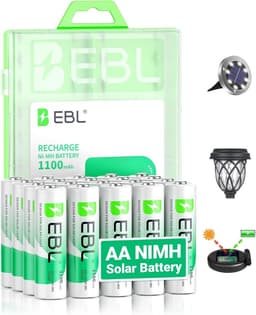
The four garden rows are all 1.2 V NiMH AA cells. KINREECELL and BOLIFIER are 12-packs at a stated 600 mAh. EBL is a 20-pack at a stated 1100 mAh. WENJOOP is a 4-pack at a stated 1600 mAh. Retailer guidance is to stay near the capacity printed on the old cell. A jump to 1600 mAh looks generous, and a small panel may not finish filling it when the days are short. Cell height is not printed on these listings, so measure the old cell against the new one in the compartment. Match plus and minus to the marks in the holder, and replace the cells in one light as a set. Mixing a new NiMH cell with an old one, or with the alkaline cell from the LED test, leaves the weaker cell dragging the run. Which carton suits a lot of lights sits on the solar battery buying guide. EBL’s page does not say how you charge the cells. The other three say the solar light or a separate NiMH charger.

First night and the faults that are not the cell

A dim first evening is often the shipping charge. KINREECELL’s bullet says about 30% for transport. BOLIFIER’s says about 40%. WENJOOP says the cells may be low after shipping and should be charged before first use. Leave the light in sun, or finish the charge on a NiMH charger, before you decide the capacity was wrong. If the light stays on in the day, clean the panel before you blame the new cells. A BOLIFIER buyer says the lights no longer switched off in daylight after the swap, and that review does not separate the cell from the sensor. KINREECELL, EBL and BOLIFIER reviews all include bodies where some cells did nothing. If half the carton is dead, the Consumer Rights Act 2015 is the route for goods that are not of satisfactory quality, through the seller.

Where the old cells go

Portable NiMH cells from these lights are battery waste, and they do not belong in the household bin. GOV.UK requires larger suppliers of portable batteries to take them back. Portable, in that rule, means a sealed battery under 4 kg. Many supermarkets already run a small battery tub. Bag leaking cells. The 109 kg cabinet elsewhere in this category is outside that portable take-back. KINREECELL’s bullet says recharge after the cells run flat and about every three months in storage. When the LED test fails, the seal has gone, or the light still dies after a few clear days, retire the lantern. Another 12-pack will not rebuild a charger that no longer works.

Common questions

What cell replaces the one in a solar stake light?
Use a 1.2 V NiMH AA cell close to the one you remove: 600 mAh from KINREECELL or BOLIFIER, 1100 mAh from EBL, or 1600 mAh from WENJOOP. Cover the panel and confirm the LED still lights before you buy.
Can I use alkaline AAs?
Leave alkaline cells out of a solar light that charges the holder. They are 1.5 V primary cells, and these listings sell 1.2 V NiMH. You may use one alkaline cell for a minute, with the panel covered, to test the LED, then remove it.
Should I replace one cell or all of them?
Replace the cells in one light as a set, which is what the WENJOOP listing tells you to do. An old cell beside a new one limits the run to the weaker cell. A single known-good cell is only a test, not the set you leave fitted.
The new cells are dim on night one. What does the listing say about shipping charge?
KINREECELL says about 30% charge for transport, BOLIFIER about 40%, and WENJOOP says to charge before first use. EBL’s spec block does not state a shipping charge. Give the panel a clear day before you judge capacity.
The light stays on in the day. Is that the battery?
Often it is the panel or the sensor, not the new cell. Clean the cover so the light can tell day from night. One BOLIFIER review reports lights that stayed on after a cell swap. If a clean panel still leaves the lamp on at noon, further cells will not correct it.
Where do the old NiMH cells go?
Take them to a shop that collects portable batteries under the GOV.UK take-back duty. These cells are sealed and well under 4 kg. Do not put them in the household rubbish, and bag any that have leaked.

Related pages

Sources

Public UK sources are listed below. Shelf prices and star lines are the amazon.co.uk figures in the listing files.

  1. GOV.UK: register energy devices in homes or small businesses (retrieved October 2026)
  2. Energy Saving Trust: battery storage (retrieved October 2026)
  3. HMRC VAT Notice 708/6 (retrieved October 2026)
  4. Approved Document P, electrical safety (retrieved October 2026)
  5. UK CAA: safety advice on what to pack (retrieved October 2026)
  6. GOV.UK: battery waste, supplier responsibilities (retrieved October 2026)
  7. BuyaBattery: garden solar light batteries (retrieved October 2026)
  8. Expert Reviews: solar power banks (retrieved October 2026)