Independent comparisons. We may earn from shop links. More info

Heat shrink tubing cable repair

Updated: October 2026

The outer sheath on a lamp lead is nicked, or you are looking at a cable in the loft, and a sleeve feels like the repair. Heat shrink tubing can cover a joint that is already properly made, on a lead you are allowed to work on. It is not the joint, and on fixed wiring it is not the enclosure. This page is that limit. The packs themselves are on the [heat shrink tubing comparison](/hub/electrical-equipment/heat-shrink-tubing). The rule below is from published UK commentary on BS 7671, not from a lab joint. A qualifying purchase can earn us a commission at no extra cost to you.

The outer sheath on a lamp lead is nicked, or you are looking at a cable in the loft, and a sleeve feels like the repair.

Our top picks

On this page

What a sleeve does not replace

A sleeve reinsulates. It does not make the electrical connection. The crimp, the solder, or the terminal still has to be the joint, made for that conductor. Sliding tubing over a twisted pair of wires and heating it is not a repair this page will describe, because the copper is still a twist. NICEIC commentary carried on Voltimum puts crimps inside an enclosure. The sleeve is not standing in for that connector. It also does not replace the box. Professional Electrician’s account of BS 7671:2018 Regulation 526.5 is that every joint and termination in a live conductor needs a suitable accessory, an equipment enclosure, or an enclosure completed with non-combustible building material. Unenclosed compression joints are their worked example of a departure. The article does not name heat shrink. The reading on this page is that a sleeve is not one of those three enclosures either. IET Wiring Matters, in Mythbuster 5 from March 2020, makes the same enclosure point with tape: the replacement for a missing sheath is a suitable enclosure, not PVC tape. A hobby sleeve is the same gap.

Fixed wiring

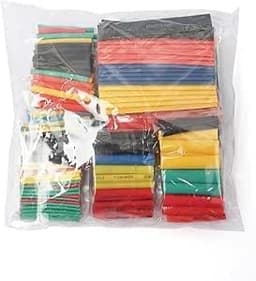
Fixed wiring is the cable that is part of the building: buried in a wall, clipped in a loft, leaving a consumer unit. Regulation 526.5, in the Professional Electrician account, is the requirement to enclose the joint. The three routes they set out are a suitable accessory, an equipment enclosure, or an enclosure completed with non-combustible building material. A heat-shrink pack from this amazon.co.uk set is none of those. Buying the adhesive-lined row does not change the list. The same enclosure point reaches extra-low voltage. Voltimum’s Elecsa note says Regulation 526.5 covers those joints as well, because the enclosure is about arcs and hot particles as well as shock. A 12 V garden light is not a free pass to leave a crimp in the open and call the sleeve the box.

Where a sleeve still belongs

A sleeve still belongs as insulation over a sound joint on a lead you may repair, where the joint is not being asked to be the enclosure for a fixed circuit. A short dry cover on a hobby lead, a model railway joint, or a low-voltage lead that is not part of the fixed installation is the ordinary use of the 45 mm kits. Zuchini’s UK texts include a table-lamp lead. That is a description of what a reviewer did, not a method for joining mains, and a burnt flex is still a stop. A stated dual wall does not, by itself, satisfy Regulation 526.5.

Reviews that are not a method

Zatyorg reviewers in this file mention a carpet-cleaner cable, and one suggestion in that discussion is two layers on 230 V. Two layers are still sleeving. They are not the accessory, the equipment enclosure, or the non-combustible building enclosure in the Professional Electrician account of 526.5. Do not read that review as a way to repair house wiring. Green-and-yellow in a hobby kit is not identification of a protective conductor. Daryunk’s UK review of 31 August 2026 says that pack has none. If the job is a joint you would have to bury, put the tubing down.

Common questions

Can heat shrink replace a junction box?
No. Regulation 526.5, as Professional Electrician sets it out, wants a suitable accessory, an equipment enclosure, or an enclosure completed with non-combustible building material. A sleeve is not on that list. The IET’s tape example is the same enclosure point, applied here to sleeving as a reading of that rule, not as a sentence in which the IET names heat shrink.
Is a crimp plus a sleeve enough inside a wall?
No. A crimp can be the joint. The wall is not automatically the enclosure, and a sleeve over the crimp does not complete one. Unenclosed compression joints are the departure in the Professional Electrician account. This page does not describe how to bury a joint.
Does the rule change for 12 V garden lights?
Not on the Voltimum Elecsa note. Regulation 526.5 is described there as covering extra-low voltage joints as well, because of arcs and hot particles, not only shock. A 12 V crimp left in the open is still an unenclosed joint. The voltage is not the exemption.
Can I sleeve a damaged appliance flex?
A sleeve can cover a sound joint on a lead you are allowed to repair, as insulation. A burnt mains flex is a stop, and a nick that has reached the copper is often a new flex rather than a tube. Zuchini reviews mention a table-lamp lead. That is a review, not a procedure for joining 230 V, and it does not move the joint inside an enclosure.
When is this a Part P question rather than a sleeve question?
When the work is in a dwelling and may be notifiable under Approved Document P, or when you are into a fixed circuit or a consumer unit. This page does not list which jobs are notifiable. That is the moment for a competent person. A sleeve size will not answer it.

Related pages

Sources

Public UK sources from the research digest, last checked on 21 October 2026. Shelf prices and star lines are the amazon.co.uk figures in the display file.

  1. BS EN 60684-3-212:2006, flexible insulating sleeving (retrieved 21 October 2026)
  2. BS EN IEC 60684-3-247:2019, dual-wall polyolefin sleeving (retrieved 21 October 2026)
  3. BS EN 60684-3-214, thick and medium wall polyolefin sleeving (retrieved 21 October 2026)
  4. Professional Electrician: enclosing electrical connections (retrieved 21 October 2026)
  5. GTSE: adhesive-lined versus standard heat shrink tubing (retrieved 21 October 2026)
  6. GTSE: a quick guide to heatshrink tubing (retrieved 21 October 2026)
  7. HellermannTyton UK insulation catalogue, 80:20 rule (retrieved 21 October 2026)
  8. GOV.UK: Approved Document P (retrieved 21 October 2026)