Independent comparisons. We may earn from shop links. More info

Heat shrink tubing buying guide

Updated: October 2026

You have a lamp lead in one hand and a butt connector wider than the copper, and the amazon.co.uk titles are selling piece counts. This heat shrink tubing buying guide is the check before the twelve-row table: the expanded size that must slide on, the recovered size that must grip, and the length left after the tube shortens. The shelf rows are on the [heat shrink tubing comparison](/hub/electrical-equipment/heat-shrink-tubing). Listings are amazon.co.uk. We did not shrink these tubes in a lab. A qualifying purchase can earn us a commission at no extra cost to you.

You have a lamp lead in one hand and a butt connector wider than the copper, and the amazon.co.uk titles are selling piece counts.

Our top picks

Lsnisni Lsnisni 2 m sleeve

Rank 2

Lsnisni Lsnisni 2 m sleeve
5.6/10about £10.99
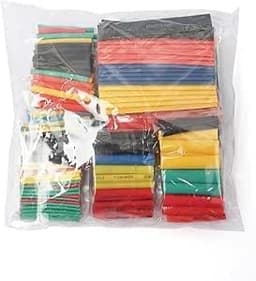
Zuchini Zuchini 164-piece kit

Best value

Zuchini Zuchini 164-piece kit
8.8/10about £3.49
On this page

Three measurements, not one

The number that has to come first is the expanded internal diameter, because the sleeve has to pass the widest point on the job, which is often the connector rather than the cable. GTSE’s UK sizing guide asks for about 20 to 30 percent clearance on that expanded size. That is a rule of thumb from that seller, not a measurement of these twelve packs. After the tube recovers, it still has to grip the insulation. Lay-flat width is a third figure. Hilltop’s size guide treats lay-flat as about 1.57 times the expanded internal diameter, and that 1.57 is Hilltop’s factor, not a test of any ASIN here. When a title prints one millimetre and a review measures another, you do not yet know which of the three numbers you bought.

Ratio in plain language

A stated 2:1 ratio means the tube is sold to recover to about half its expanded diameter. A stated 3:1 means about one third. Those are the plain readings in the GTSE and Hilltop guides, and they are still claims until you heat a piece. Huakayo’s kits both say 5:1. A UK review on the precut kit is titled barely 3:1. A UK review on the length set says it does not shrink at 5:1. Boloest’s five 1 m lengths say 4:1, and a UK review on 28 June 2026 puts the recovery a little over 2:1. If the recovered diameter has to land on a thin cable after clearing a fat connector, read those disputes before you pay for a ratio the page has not shown.

Length and piece count

Many of the cheap kits are short precuts. UK seller guides put longitudinal shrinkage around 5 to 10 percent, so a 45 mm piece can finish nearer 40 mm, and it still has to overlap the insulation on both sides of the joint. A butt connector plus two overlaps can use that whole length. A scuff along a lead cannot. Piece count is not length. Eventronic’s title says 27 m beside 600 pieces of 45 mm. Six hundred times 45 mm is 27 m of short pieces, not a continuous sleeve. Huakayo’s length listing says 12 m, and a UK review on 17 September 2026 says the goods arrived as folded lengths of about 30 cm, not as rolls.

Lines that are not a standard

None of these twelve listings names BS EN 60684-3-212, the polyolefin sleeving sheet that splits types by ratio and by whether they are flame retarded, or sheet 247 for dual-wall sleeving. A bullet that says flame retardant, marine, or IP56 is not that sheet. Eventronic’s bullets name IP56, and the same listing says EVA in the bullets and polyolefin in the specification. You cannot treat those lines as one material with one test report. Daryunk is the colour warning. A UK review on 31 August 2026 says yellow is scarce, there is no green-and-yellow, and not to buy the pack for UK wiring identification.

Common questions

Do I measure the cable or the connector?
Measure the widest point the tube has to slide over, usually the connector or the crimp, and then check the cable the tube must grip after it recovers. A sleeve chosen only for the copper can pass the wire and stop on the joint. GTSE’s 20 to 30 percent clearance is a seller rule of thumb for the expanded size, not a lab result for these ASINs.
Is the millimetre on the title the diameter or the flat width?
You often cannot tell from the title alone. Hilltop sells by expanded internal diameter and treats lay-flat as about 1.57 times that diameter, and that factor is Hilltop’s. Lsnisni’s size field says 30 mm while UK reviews measured about 48 mm and about 60 mm flat, then said the tube still shrank enough. Measure the piece when it arrives if the job needs a known flat width.
Will 45 mm cover a repair, or do I need a metre?
A 45 mm precut can cover a short butt or solder joint if you allow about 5 to 10 percent length loss and an overlap onto the insulation at each end. It will not cover a long scuff. Electrapick and Eventronic state 45 mm. Boloest states 1 m, and Lsnisni states 2 m. If the piece length is not on the listing, you do not know which of those jobs you are buying.
Does a higher piece count mean more useful sleeving?
No. Five hundred and sixty pieces of 45 mm are still short pieces, and 164 pieces with no length on the page might be shorter. Eventronic’s 27 m claim is the sum of 600 short pieces, not a reel. Use count when you want a box for several small joints. Use metres when you want to cut a cover to the damage.
Can I treat IP56 or a flame-retardant line as a British Standard?
No. None of the twelve names a 60684 sheet. IP56 on the Eventronic bullets is not a sleeving test report in this file, and a 5:1 title is already disputed by a UK review. Flame-retardant wording on a bullet is not sheet 212. If the job needs a named type, this set does not supply one.

Related pages

Sources

Public UK sources from the research digest, last checked on 21 October 2026. Shelf prices and star lines are the amazon.co.uk figures in the display file.

  1. BS EN 60684-3-212:2006, flexible insulating sleeving (retrieved 21 October 2026)
  2. BS EN IEC 60684-3-247:2019, dual-wall polyolefin sleeving (retrieved 21 October 2026)
  3. BS EN 60684-3-214, thick and medium wall polyolefin sleeving (retrieved 21 October 2026)
  4. Professional Electrician: enclosing electrical connections (retrieved 21 October 2026)
  5. GTSE: adhesive-lined versus standard heat shrink tubing (retrieved 21 October 2026)
  6. GTSE: a quick guide to heatshrink tubing (retrieved 21 October 2026)
  7. HellermannTyton UK insulation catalogue, 80:20 rule (retrieved 21 October 2026)
  8. GOV.UK: Approved Document P (retrieved 21 October 2026)