Independent comparisons. We may earn from shop links. More info

Adhesive lined vs standard heat shrink

Updated: October 2026

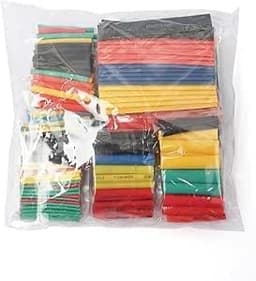
The title says waterproof, the joint is on a trailer plug that sees rain, and the £3.49 kit beside it is a bag of coloured tubes with no lining mentioned. Adhesive lined versus standard heat shrink is that choice: a plain wall that insulates when it is dry, or a dual wall whose inner layer is supposed to melt into the gaps. The shelf rows are on the [heat shrink tubing comparison](/hub/electrical-equipment/heat-shrink-tubing). The split below follows the amazon.co.uk files and GTSE’s UK guides. We did not water-test a joint. A qualifying purchase can earn us a commission at no extra cost to you.

The title says waterproof, the joint is on a trailer plug that sees rain, and the £3.49 kit beside it is a bag of coloured tubes with no lining mentioned.

Our top picks

On this page

What the two walls do

Standard, or single-wall, tubing is a sleeve that recovers onto the cable and insulates it. GTSE’s guide puts it on dry insulation, marking, and bundling. When it fits, it grips. It does not, by itself, fill an uneven crimp or keep rain out of a nick. Adhesive-lined tubing, often sold as dual wall, has a hot-melt inner layer. HellermannTyton’s UK catalogue describes that layer melting into gaps and sealing as it cools, on their own black connector sleeves. GTSE treats dual wall as the buyer’s name for an adhesive lining, and it also says dual wall is not always the better buy indoors. The wall is thicker, it costs more, and it needs enough heat for the adhesive to flow, not only for the outer jacket to shrink. Use adhesive when moisture can reach the joint, or when the splice is uneven: a vehicle lead, a boat lead, an outdoor low-voltage joint. Use single wall when the job is a dry indoor cover or a colour. Neither choice is proved by the word waterproof on a title. None of these twelve listings attaches a test report to that word.

Which listings say adhesive

The files that state a lining are both Huakayo ASINs, Xinsuo, Tooxwire, Lsnisni and Boloest. The files that do not state adhesive are Zuchini, Zatyorg, Daryunk, Electrapick and Blunivia. A tight result on those is insulation, not a seal. Eventronic is the awkward row. The specification says self-adhesive and polyolefin. The bullets say EVA and halogen-free, and they also name IP56. A specification line and a bullet that disagree are not a confirmed lining. Treat Eventronic as a kit whose adhesive claim is in conflict, not as one of the packs that simply says dual wall. IP56 in those bullets is not a water test in this file.

Ratio is not the seal

GTSE often talks about 3:1 as the usual adhesive ratio in trade stock. This set also prints 4:1 and 5:1, and UK reviews dispute those figures. Huakayo’s precut page says 5:1, and a UK review is titled barely 3:1. Boloest says 4:1, and a review on 28 June 2026 puts recovery a little over 2:1 while still calling the 12–40 mm sizes useful. A lower recovery can still cover a cable if you chose the expanded size with room. It will not turn a thin lead into a sealed 5:1 joint the title promised. If a UK review already says the recovery was lower, buy the pack only when that lower recovery still grips your cable. Do not pay as if the title’s ratio had been checked.

Flame wording

BS EN 60684-3-247 is the dual-wall polyolefin sheet, and that sheet is not flame retarded. Sheet 212 separates flame-retarded polyolefin types from types that are not, at 2:1 or 3:1, up to 135 °C in the standard’s scope. None of the twelve listings names either sheet. A bullet that says flame retardant and adhesive in the same breath has not shown you a type. A marine or waterproof word on a title is the same kind of claim. You can still choose a stated lining for a wet low-voltage joint. You cannot say the listing meets a British Standard, and you cannot say the joint is waterproof because the title used the word. Skip a 4:1 or 5:1 title that a UK review disputes unless the lower recovery those reviews describe still fits.

Common questions

Is dual wall the same thing as adhesive lined?
In the GTSE guides, dual wall is the name buyers use for a sleeve with an adhesive inner layer. HellermannTyton describes that layer melting into gaps on their own products. In this set, trust the file that says adhesive, dual wall, or hot-melt. Do not infer a lining on Zuchini, Electrapick, or the other packs that never state one.
Will ordinary 2:1 tubing keep rain out?
Not as a seal. A tight single wall insulates and can look weatherproof. GTSE keeps it for dry work. Rain, a trailer plug, or an uneven crimp is the adhesive job, and even then a stated lining is not a test report. None of these pages was water-tested for this comparison.
Which of these twelve listings actually say adhesive?
Both Huakayo listings, Xinsuo, Tooxwire, Lsnisni and Boloest. Eventronic says self-adhesive on the specification and EVA in the bullets, so that claim is in conflict. Zuchini, Zatyorg, Daryunk, Electrapick and Blunivia do not state a lining. A tight result on those is insulation.
Does 5:1 mean a better seal than 3:1?
Not in this set. Huakayo prints 5:1 and UK reviews say the recovery was lower, including a barely 3:1 title on the precut kit. Boloest prints 4:1 and a UK review says a little over 2:1. The seal, if any, is the adhesive, not the ratio printed on the title.
Can a listing be flame retardant and adhesive-lined to a British Standard?
Not on the evidence here. Sheet 247 is dual wall and not flame retarded. Sheet 212 is where flame-retarded types are separated. No listing names a sheet. A flame-retardant bullet next to an adhesive claim has not shown you either type.

Related pages

Sources

Public UK sources from the research digest, last checked on 21 October 2026. Shelf prices and star lines are the amazon.co.uk figures in the display file.

  1. BS EN 60684-3-212:2006, flexible insulating sleeving (retrieved 21 October 2026)
  2. BS EN IEC 60684-3-247:2019, dual-wall polyolefin sleeving (retrieved 21 October 2026)
  3. BS EN 60684-3-214, thick and medium wall polyolefin sleeving (retrieved 21 October 2026)
  4. Professional Electrician: enclosing electrical connections (retrieved 21 October 2026)
  5. GTSE: adhesive-lined versus standard heat shrink tubing (retrieved 21 October 2026)
  6. GTSE: a quick guide to heatshrink tubing (retrieved 21 October 2026)
  7. HellermannTyton UK insulation catalogue, 80:20 rule (retrieved 21 October 2026)
  8. GOV.UK: Approved Document P (retrieved 21 October 2026)