Ring or fork terminal
You are bolting a cable to a stud on a battery or a fuse holder, and the tub contains both closed rings and open forks. The stud is the decision. A ring or fork terminal is not chosen by piece count. A ring stays on until the nut comes off. A fork slides out when the nut is only loose, which is useful for service and weaker if the nut backs off. This page is that comparison for the listings in the [cable terminals comparison](/hub/electrical-equipment/cable-terminals). Ferrules and lever blocks are different joints. Prices are the amazon.co.uk figures captured on 21 October 2026.
You are bolting a cable to a stud on a battery or a fuse holder, and the tub contains both closed rings and open forks. The stud is the decision. A ring or fork terminal is not chosen by piece count.
You are bolting a cable to a stud on a battery or a fuse holder, and the tub contains both closed rings and open forks. The stud is the decision. A ring or fork terminal is not chosen by piece count. A ring stays on until the nut comes off. A fork slides out when the nut is only loose, which is useful for service and weaker if the nut backs off. This page is that comparison for the listings in the cable terminals comparison. Ferrules and lever blocks are different joints. Prices are the amazon.co.uk figures captured on 21 October 2026.
Our top picks
| Badge | Product | Stud or clamp | Contact metal | Listed voltage | Note | Price | Offer |
|---|---|---|---|---|---|---|---|
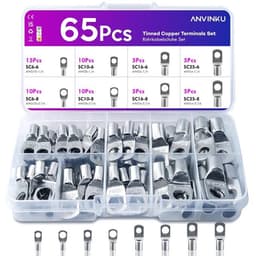
| Best overall |  ANVINKU ANVINKU 65 cable lugs | M6 and M8 in the type codes; spec stud field says 6 mm only | Polished copper with a tinned surface | 12 V DC | 8.2 | about £7.79 | View offer |
| Best value |  Gorffy Gorffy 300 insulated crimps | Male and female spade, fork and ring; 17 types | Tin-plated brass | 120 V | 8.8 | about £7.29 | View offer |
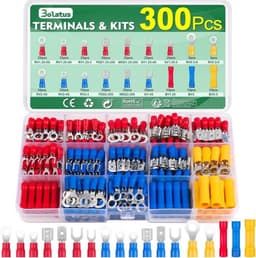
 Bolatus Bolatus 300 insulated crimps | Ring, fork, male and female spade, butt; 18 sizes | Tinned copper | 230 V AC | 8.6 | about £8.99 | View offer |

On this page
The stud decides, not the tub
A spade is not a fork
Match the hole, then the cable
Which boxes in this set actually contain a fork
Common questions
When is a ring the better stud terminal?
When is a fork enough?
Is a spade the same as a fork?
What hole do I need for an M6 or M8 stud?
Are the copper tube lugs rings or forks?
Does a ring survive vibration if the crimp is poor?
Can I use these rings on 230 V mains because they are tinned?
Related pages
Sources
Public UK sources from the research digest, used on 22 October 2026. Shelf prices and star lines are the amazon.co.uk figures for these 12 listings.
- Voltimum UK: Termination of conductors (retrieved 22 October 2026)
- IET Wiring Matters: Mythbuster 5, terminal blocks (retrieved 22 October 2026)
- IET EngX: Ferrule crimps (retrieved 22 October 2026)
- legislation.gov.uk: Building Regulations 2010, Schedule 1, Part P (retrieved 22 October 2026)
- legislation.gov.uk: Building Regulations 2010, regulation 12 (retrieved 22 October 2026)
- HSE: Electrical safety introduction (retrieved 22 October 2026)
- Electricity at Work Regulations 1989, regulation 16 (retrieved 22 October 2026)
- Furneaux Riddall: terminals guide (retrieved 22 October 2026)