Independent comparisons. We may earn from shop links. More info

Bootlace ferrules

Updated: October 2026

You are about to push a flexible lead into a screw or a cage clamp, and the strands are already splaying. A bootlace ferrule is one way to keep those strands together. It is not a legal requirement on every cable in a UK home, and a red collar is not a red crimp. This page follows that one job: fine strands, Regulation 526.9, the colour codes that get mixed up, and the two ferrule boxes in the [cable terminals comparison](/hub/electrical-equipment/cable-terminals). Ring terminals, battery lugs and lever blocks stay off this page. The amazon.co.uk prices were captured on 21 October 2026.

You are about to push a flexible lead into a screw or a cage clamp, and the strands are already splaying. A bootlace ferrule is one way to keep those strands together.

Our top picks

On this page

What Regulation 526.9 actually asks for

Regulation 526.9, as the IET explains it in Wiring Matters (March 2020), says fine strands need a suitable terminal or a treated end. A bootlace ferrule is the usual treatment when the terminal is a screw clamp that would otherwise spread the strands. The screw must not be what crimps the ferrule, and solder under a screw can cold-flow. Ferrules are not compulsory. The IET EngX discussion says so, and it says a terminal marked f is already intended for flexible conductors and should not take a ferrule as well. If the accessory in your hand is marked f, follow that mark. Neither box is a DIN 46228 certificate.

Solid twin-and-earth is not the same job

Solid conductors in twin-and-earth often need no ferrule. They are a single core that a properly sized screw or cage can hold without a sleeve. Adding a ferrule to 2.5 mm² solid lighting cable because the box was open can be the wrong size for the clamp. Flexible cord, pendant flex, and fine-stranded equipment wire are the cases where 526.9’s treated end actually comes up. Consumer-unit work, including a comment about RCBO tails, stays with a competent person under Part P.

Three colour codes, and red is the trap

Crimp terminals and ferrules do not share a colour language. On an insulated ring, red usually means about 0.5–1.5 mm². The French sequence paints 0.5 mm² white, 0.75 mm² blue, 1.0 mm² red, 1.5 mm² black and 2.5 mm² grey. The sequence UK sellers call German paints 1.5 mm² red. DIN 46228-4 paints 1.5 mm² black, so German on a UK box is not the same instruction as DIN. Neither box in this set prints a colour-to-size table. A red collar does not tell you the millimetres squared. You sort them against a chart you trust, or you measure the barrel against the cable, before you crimp. The steps for insulated terminals are on the how to crimp cable terminals page.

The square jaw, and the two boxes in this set

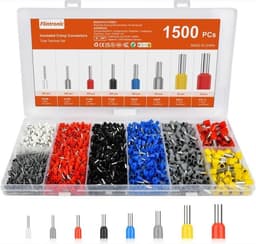
The red-blue-yellow ring tool is the wrong die. AivaToba’s ferrule kit includes a four-jaw ratchet, model HSC8-6-4A, at about £17.99. The bullet lists single ferrules and two types of twin ferrule. Flintronic’s box is the refill, at about £8.99, with no tool. The bullets disagree on the metal, one saying tinned copper and another tin-plated brass with a copper tube. Buy this box when you already own the square jaw. Buy the AivaToba kit when you do not. Two wires do not share a single ferrule. AivaToba lists twin ferrules for that. The insulated AivaToba ratchet has jaws for red, blue and yellow. Do not send a bootlace there.

Common questions

Are bootlace ferrules compulsory in the UK?
No. Regulation 526.9 asks for a suitable terminal or a treated end on fine strands. A ferrule is the usual treatment for a screw clamp, and the IET EngX thread says ferrules are not compulsory. A terminal marked f should not receive one. Solder under the screw is not the alternative, because it can creep.
Do I ferrule solid twin-and-earth?
Usually no. Solid cores are not fine strands, and a ferrule can be the wrong shape for a clamp that was meant to take the bare conductor. Flexible cord and equipment wire are the cases that raise 526.9. If the terminal maker tells you to ferrule a particular solid conductor, follow that sheet rather than a general habit.
What is a suitable terminal if I do not use a ferrule?
A terminal designed to hold that flexible conductor without spreading the strands. The f mark is the clue EngX gives. EN 60999-1, as Phoenix Contact states it, means the terminal should accept unprepared copper, so a ferrule is an option rather than a ban. If the mark is missing, use the maker’s instructions. Do not invent a suitable terminal from a CE line on a ferrule box.
Why is a red ferrule not a red crimp?
Insulated crimps use red for about 0.5–1.5 mm². French ferrule coding paints 1.0 mm² red and 1.5 mm² black. A UK sequence often called German paints 1.5 mm² red, while DIN 46228-4 paints 1.5 mm² black. Neither amazon.co.uk box here prints the table, so the collar colour is not a size until you know the code.
Which colour is 1.5 mm²?
It depends on the code. French coding, and DIN 46228-4, paint 1.5 mm² black. The sequence UK sellers often call German paints 1.5 mm² red. Electric Centre’s French list also puts 0.5 mm² on white, 0.75 mm² on blue, 1.0 mm² on red and 2.5 mm² on grey. Do not treat German on a UK carton as DIN.
Which of these two boxes includes the four-jaw tool?
AivaToba’s ferrule kit, at about £17.99, includes the four-jaw ratchet HSC8-6-4A and twin ferrules. Flintronic’s box, at about £8.99, is 1,500 ferrules and no tool. The insulated AivaToba ratchet is a third product. Its parts line mentions ferrule pliers, and its jaws are for insulated terminals.
Can I put two wires in a single ferrule?
No. Use a twin ferrule, which the AivaToba bullet lists in two types. Two conductors forced into one sleeve are a common way to split the barrel. The flintronic box does not describe twin ferrules, so do not assume they are in that refill.

Related pages

Sources

Public UK sources from the research digest, used on 22 October 2026. Shelf prices and star lines are the amazon.co.uk figures for these 12 listings.

  1. Voltimum UK: Termination of conductors (retrieved 22 October 2026)
  2. IET Wiring Matters: Mythbuster 5, terminal blocks (retrieved 22 October 2026)
  3. IET EngX: Ferrule crimps (retrieved 22 October 2026)
  4. legislation.gov.uk: Building Regulations 2010, Schedule 1, Part P (retrieved 22 October 2026)
  5. legislation.gov.uk: Building Regulations 2010, regulation 12 (retrieved 22 October 2026)
  6. HSE: Electrical safety introduction (retrieved 22 October 2026)
  7. Electricity at Work Regulations 1989, regulation 16 (retrieved 22 October 2026)
  8. Furneaux Riddall: terminals guide (retrieved 22 October 2026)