Independent comparisons. We may earn from shop links. More info

SDS vs masonry drill bit

Updated: October 2026

You have a set in the basket and a drill on the floor, and you are not sure the shank will lock. SDS vs masonry drill bit is a chuck question first and a wall question second. A 10 mm hole can be made by either family, and BuildWiz’s point is that neither bit fits the other machine. Buy SDS-Plus only when that chuck is on the drill. The batch is on the [stone drill bit comparison](/hub/drilling-and-accessories/stone-drill-bit). Products Compared compared these amazon.co.uk listings with public UK shank guides on 15 October 2026, and did not run a lab test.

You have a set in the basket and a drill on the floor, and you are not sure the shank will lock. SDS vs masonry drill bit is a chuck question first and a wall question second.

Our top picks

On this page

The shanks do not interchange

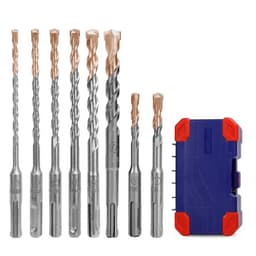
An SDS-Plus bit will not lock in a three-jaw chuck, and a straight bit will not snap into an SDS-Plus chuck. B&Q says SDS bits snap in and move up and down. SDS-Plus is about 10 mm with four grooves. SDS Max is about 18 mm and does not take Plus bits. Heller’s “under about 5 kg” line describes the class, not your drill. WORKPRO is the only SDS-Plus set here. Bosch CYL-3 is cylindrical. Do not clamp that grooved shank in a keyless combi chuck.

Ordinary brick can stay on a combi drill

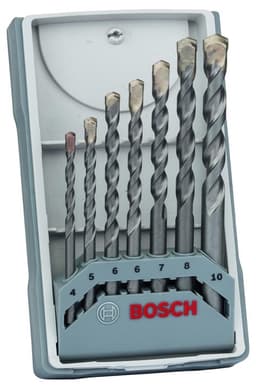
A combi drill with hammer is enough for common brick and a modest number of plugs, if the carbide shank fits the three-jaw chuck. Homebuilding moves to an SDS rotary hammer for very hard brick, a hole about 10 mm or larger, or many holes. Bosch CYL-3, at about £16.52, is 4–10 mm on a cylindrical shank, and the listing cites ISO 5468. Reviewers who like the set still reach for SDS when the concrete is hard. PGM does not change an SDS chuck. Plug diameter is on the stone drill bit buying guide.

Hard concrete and a lot of holes point to SDS-Plus

Buy WORKPRO when the machine is an SDS-Plus rotary hammer and the holes are in brick or concrete. The set is about £16.99, 4.6 stars from 1,361 reviews, with a case, 110 mm bits and 5–12 mm at 160 mm. The seller excludes tile, glass and mirror. Porcelain needs a diamond bit, on drilling porcelain and stone tile. This set will not fit an 18 mm SDS Max chuck. If the badge on the case is worn, look at the slots, not the word hammer on the box.

One recommendation, with the chuck as the condition

If the chuck is a three-jaw, buy a cylindrical, three-flat or flatted carbide bit. In this batch that is Bosch CYL-3, Bullitt, Camdios or toolant. If the chuck is SDS-Plus and the material is concrete or hard brick, buy WORKPRO. If the first surface is porcelain, buy neither as the first bit. One 8 mm plug in common brick does not require a rotary hammer you do not own. Once the shank matches, the order of the hole is on how to drill into brick.

Look at the chuck, not the word hammer

SDS-Plus for an SDS-Plus hammer in brick or concrete. A cylindrical or three-flat carbide bit for a three-jaw combi in ordinary brick. Diamond, with the hammer off, when the first surface is porcelain. A qualifying purchase through our links can earn a commission at no extra cost to you.

Common questions

Will the WORKPRO set fit a combi drill?
No. WORKPRO is the SDS-Plus set here, with a grooved shank that slides in an SDS-Plus chuck. A three-jaw chuck is the wrong receiver. B&Q treats SDS bits as separate from masonry bits for a normal chuck. BuildWiz allows an adapter the other way, so a round bit can run in an SDS drill. For the combi, buy Bosch CYL-3, Bullitt, Camdios, or toolant.
Will a Bosch CYL-3 bit fit an SDS-Plus chuck?
Not directly. This CYL-3 listing is a cylindrical shank for an impact drill, 4–10 mm, at about £16.52. An SDS-Plus chuck expects the grooved shank, about 10 mm, not a smooth cylinder. An adapter can hold a round bit in an SDS drill, which BuildWiz calls the useful direction. That is an extra part, not a snap-in fit.
Is SDS the same as SDS-Plus, and does either fit SDS Max?
SDS-Plus is the common rotary-hammer shank, about 10 mm with four grooves, and people often shorten the name to SDS. SDS Max is about 18 mm. SDS Drill UK and Heller both say the two do not interchange. WORKPRO is Plus, so it will not fit a Max machine. Heller’s “under about 5 kg” line describes that class of tool. It is not a weight for your drill.
When is a hammer drill enough for brick?
A combi drill in hammer mode is enough for ordinary brick and a few plugs, with a carbide bit that fits the three-jaw chuck. Homebuilding moves to SDS-Plus for very hard or engineering brick, for holes around 10 mm and up, or for many holes. One 6 mm shelf fixing is the combi case. A lintel of repeated 10 mm holes is where the combi becomes the slower tool.
Can an adapter fix a mismatch, and which way?
An adapter is useful when a round or hex masonry bit has to run in an SDS drill. That is the direction BuildWiz describes. Clamping an SDS-Plus shank in a keyless three-jaw chuck is the mismatch to avoid, because the grooves are meant to slide under the hammer. Do not buy WORKPRO for a combi drill and plan to adapt it. If the drill is a combi, change the set.
Why is the SDS set the wrong buy for a porcelain tile?
WORKPRO’s listing excludes tile, glass, and mirror. Porcelain needs a diamond bit with the hammer off. That is a third family, not a compromise between a masonry tip and an SDS shank. After you are through the tile, a masonry bit of the same diameter can drill the brick behind it, and the hammer belongs only then.
Does a PGM or ISO 5468 line change the chuck?
No. A mark on a cylindrical bit does not make it fit an SDS chuck. In this scheme the ISO 5468 line is for cylindrical shanks. Bosch’s amazon.co.uk CYL-3 listing cites ISO 5468, and the range page states a PGM guarantee for that family. It was not checked on the physical box here, and it does not move WORKPRO into a three-jaw chuck.

Related pages

Sources

Sources are the public UK pages and the twelve amazon.co.uk listings used for this comparison. Figures were taken from those pages for the October 2026 update.

  1. HSE CN3: drilling controls (retrieved 16 October 2026)
  2. HSE INDG463: silica dust, workplace exposure limit (retrieved 16 October 2026)
  3. HSE CIS36: construction dust and RPE (retrieved 16 October 2026)
  4. Consumer Rights Act 2015, section 9 (retrieved 16 October 2026)
  5. PGM and ISO 5468 (retrieved 16 October 2026)
  6. Bosch Professional CYL-3 concrete drill bits (retrieved 16 October 2026)
  7. Homebuilding: drilling into tile (retrieved 16 October 2026)
  8. Toolstore UK: drill bits buying guide (retrieved 16 October 2026)