Independent comparisons. We may earn from shop links. More info

Stone drill bit buying guide for the wall you have

Updated: October 2026

You are in a UK hallway with a combi drill, a red wall plug, and a box that lists concrete, tile, glass and metal as if they were one job. A stone drill bit buying guide should name the surface the tip will touch first, the shank that fits the chuck you already own, and the diameter printed on the plug packet. This page does not rank those sets. Prices and star counts stay on the [stone drill bit comparison](/hub/drilling-and-accessories/stone-drill-bit). Products Compared read the listings and public UK guides on 15 October 2026, and we did not drill a test wall.

You are in a UK hallway with a combi drill, a red wall plug, and a box that lists concrete, tile, glass and metal as if they were one job.

Our top picks

On this page

Start with the wall, not the brand

Common brick, a concrete lintel and a porcelain tile are different jobs, even when one title names all three. B&Q treats masonry, SDS and tile as separate bits. CMT splits brick and block, where a straight carbide bit in a percussion drill is usual, from structural concrete, where they point towards SDS-Plus. A glazed slab is the third case, because a carbide tip often skates. Diamond, hammer off, is the route for porcelain. The GZCYMY set is 1–2.5 mm and weighs 10 g, so a mention of stone does not make it a wall bit.

The shank has to fit the drill you own

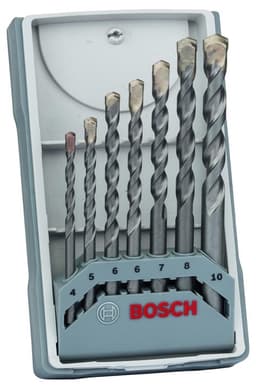
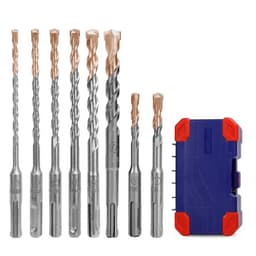
A 10 mm masonry bit and a 10 mm SDS-Plus bit can make the same hole, and BuildWiz’s point is that neither bit fits the other machine. A three-jaw chuck wants a cylindrical, flatted, hex or three-flat shank. An SDS-Plus chuck wants the grooves. WORKPRO is the SDS-Plus set here, and the seller excludes tile, glass and mirror. Bosch CYL-3 is cylindrical. Similar shelf prices do not make those bits interchangeable. LEKOMESH is an M14 thread, so a drill needs an adapter. If the bit may not lock, read SDS-Plus or a masonry bit before you pay.

Diameter follows the plug, and the colours are not a standard

Plug colours are a shop convention, not a British Standard. BuildWiz lists red at 6 mm, with 5.5 mm as a tighter hole in soft block. Toolstore UK states 5.5 mm with red plugs and 7 mm with brown plugs. Fastbuild tells you to read the packet. The sleeve in your hand is the instruction. Ten identical 6 mm bits are enough only when every fixing is the same plug.

PGM is for an anchor hole, not for a picture hook

PGM is an inspection mark for bits used with anchors whose European Technical Assessment assumes that mark. It is about that specified hole, not a plastic plug behind a shelf. Bullitt’s title claims PGM certification. That is a listing claim, not a mark checked on a physical bit. Bosch’s CYL-3 listing cites ISO 5468, and the UK range page uses PGM wording for the family. That is still not a check of model 2 607 017 082. Toolstation’s five-bit pack, 2607017081, is a different set.

Surface, then shank, then the packet

If the chuck is a three-jaw and the wall is common brick, buy a carbide bit in the diameter on the plug packet. If the chuck is SDS-Plus, buy an SDS-Plus bit. If the first surface is porcelain, buy diamond and keep the hammer off. The glaze job is on drilling porcelain and stone tile. A qualifying purchase through our links can earn a commission at no extra cost to you.

Common questions

Which bit do you buy for common brick if you only have a combi drill?
Buy a carbide masonry bit with a straight, three-flat or cylindrical shank, in the diameter on the plug packet, and use hammer once the bit has a dimple to follow. B&Q and CMT both treat that as the ordinary brick and block choice. A very hard engineering brick or a long run of holes is where an SDS rotary hammer starts to earn its place. An SDS-Plus set will not lock in the three-jaw chuck you already own.
Will an SDS-Plus set fit that combi drill?
An SDS-Plus shank is grooved so it can slide in an SDS chuck. BuildWiz and B&Q both say it is not the masonry bit for a normal three-jaw chuck. The WORKPRO set in this batch is that shank, and the seller also says it is not for tile, glass or mirror. An adapter that lets a round bit run in an SDS drill can be useful the other way. Putting the SDS bit into the combi drill is the mismatch to avoid.
What diameter matches a red wall plug, and why do guides disagree?
Guides disagree because the colour is a shop habit, not a British Standard. BuildWiz prints 6 mm for red, with 5.5 mm as a tighter hole in soft block. Toolstore UK prints 5.5 mm for red and 7 mm for brown. Fastbuild prints 5.5–6 mm and tells you to read the packet. Use the figure on the sleeve you are about to push into the wall.
When is a diamond bit the right buy instead of carbide?
Buy diamond when the first surface is porcelain, glazed stone, or a ceramic tile that has already polished a masonry tip, and keep the hammer off. Carbide remains the bit for the brick or block behind the tile, after you change bits. A title that merely adds the word tile to a masonry set is not the same purchase. Speeds, wax and water depend on the bit in your hand.
Do you need a PGM mark for a shelf, or only for a specified anchor?
A shelf on a plastic plug does not need a PGM mark. PGM matters when an anchor’s approval assumes a bit inspected to that scheme, which PGM ties to ISO 5468. Bullitt claims the mark on the listing, and Bosch’s CYL-3 listing cites ISO 5468, but neither line was verified on a bit for this page. A curtain rail in common brick follows the plug packet and a sharp carbide tip.
Is a 6 mm-only box enough, or do you need 4–10 mm?
A 6 mm-only box is enough when every plug on the job is that size, and it becomes awkward as soon as you meet a smaller yellow plug or a larger brown one. A 4–10 mm set covers the ordinary domestic spread, though you should still read the packet rather than trust the colour. Ten copies of one diameter are spares. Five different diameters are a kit, if the shank fits the drill you will use.

Related pages

Sources

Sources are the public UK pages and the twelve amazon.co.uk listings used for this comparison. Figures were taken from those pages for the October 2026 update.

  1. HSE CN3: drilling controls (retrieved 16 October 2026)
  2. HSE INDG463: silica dust, workplace exposure limit (retrieved 16 October 2026)
  3. HSE CIS36: construction dust and RPE (retrieved 16 October 2026)
  4. Consumer Rights Act 2015, section 9 (retrieved 16 October 2026)
  5. PGM and ISO 5468 (retrieved 16 October 2026)
  6. Bosch Professional CYL-3 concrete drill bits (retrieved 16 October 2026)
  7. Homebuilding: drilling into tile (retrieved 16 October 2026)
  8. Toolstore UK: drill bits buying guide (retrieved 16 October 2026)