Independent comparisons. We may earn from shop links. More info

Drill bit for porcelain tile

Updated: October 2026

You are fixing a rail to a porcelain tile in a UK bathroom, and the masonry bit that went through the hallway brick is skating on the glaze. A drill bit for porcelain tile is a diamond bit, used with the hammer off and cooled as that listing describes. The brick behind the tile is a second hole, with a masonry bit of the same diameter. Prices for the batch sit on the [stone drill bit comparison](/hub/drilling-and-accessories/stone-drill-bit). Products Compared read these amazon.co.uk listings and public UK tile guides on 15 October 2026, and did not run a lab test.

You are fixing a rail to a porcelain tile in a UK bathroom, and the masonry bit that went through the hallway brick is skating on the glaze.

Our top picks

On this page

Porcelain is not the same job as common brick

Porcelain is denser than ordinary ceramic, and a tungsten carbide tip is the wrong first tool. Homebuilding points to a carbide spear for softer ceramic and to diamond for porcelain. A Bullitt review called that set useless on the glaze, and WORKPRO’s listing excludes tile, glass and mirror. If the bit polishes a shiny patch, treat the tile as porcelain. Marble and granite sit with porcelain in Bosch DIY’s UK guide. Bosch EXPERT HardCeramic is not in this batch.

Hammer off until you are through the tile

Mark the hole, then drill in rotary only. Masking tape gives the diamond a bite if it skates. Keep the pressure light, because porcelain cracks when you lean on it. Bosch DIY UK and Jungheinrich keep the hammer off on the tile. Stop when the sound changes. Do not copy Topps Tiles’ grinder speed of about 11,000 rpm onto a hex bit listed at 2,000–5,000 rpm. When resistance drops, change to a masonry bit of the same diameter. The brick sequence is on how to drill into brick.

Wax and water are not a promise of a long life

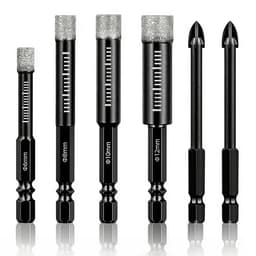
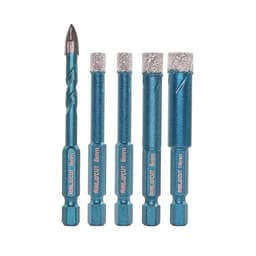
Wax is coolant packed into some diamond bits. Reviewers still used water, including on bits sold as wax-cooled. MINLAYCUT, a hex set at about £19.99 from 6 mm to 10 mm, includes a carbide guide. High speed burned bits, and about two holes is a life some reported. BRSCHNITT is four 6 mm bits at about £18.99. One reviewer completed many 16 mm porcelain holes with water. Another was struggling by the sixth hole, and wax blocked a core. Camdios, a masonry set, has a review of about three porcelain holes.

Which diamond set in this batch matches the hole

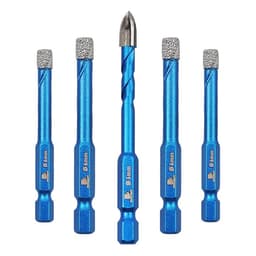
Choose by diameter and by the shank. YESHLiky at about £6.56 is 6–12 mm on a hex shank, stated at 2,000–5,000 rpm, with eight reviews. BRSCHNITT is four copies of 6 mm. LEKOMESH at about £43.99 is ten 6 mm M14 bits, stated at 6,000–11,000 rpm, and a drill needs an adapter. MINLAYCUT is the hex set from 6 mm to 10 mm with a guide bit. Shanks are on the stone drill bit buying guide.

Diamond on the glaze, masonry behind it

If the first surface is porcelain, use a diamond bit with the hammer off and the speed on that listing. MINLAYCUT is the 6–10 mm hex set with a guide bit, and some bits lasted about two holes. BRSCHNITT is four 6 mm copies. YESHLiky adds 12 mm at about £6.56, on eight reviews. A qualifying purchase through our links can earn a commission at no extra cost to you.

Common questions

Can you drill porcelain with the masonry bit you use on brick?
A masonry bit that cuts common brick is a poor way through porcelain. Homebuilding calls a tungsten tip the wrong tool there, and Bosch DIY UK describes masonry bits as a poor way through the glaze. In this batch a Bullitt review called the bits useless on porcelain, and WORKPRO’s listing excludes tile. If the tip has polished a shiny patch, change to diamond and keep the hammer off.
Do ceramic and porcelain take the same bit?
Softer ceramic can take a carbide tile bit. Porcelain, marble, and granite are the diamond job in the Homebuilding, Screwfix, and Bosch DIY UK guides. If you are unsure, a bit that skates and polishes means you are on the harder side. Use a masonry bit of the same diameter only after you are through the glaze, and keep the hammer off until then.
Should the hammer be on, and when do you turn it on again?
Keep the hammer off from the first touch of the glaze until you break through. Bosch DIY UK and Jungheinrich both say that. Turn it on again only if the backing is brick, block, or concrete, and only after you change to a masonry bit. A drop in resistance means you are through. Driving the diamond bit on into the wall cracks the tile from behind or polishes the brick.
Do you use water, wax, or both?
Use the cooling on your own listing. Wax does not always replace water. MINLAYCUT is sold with wax, and reviewers still dipped the bits. High speed burned those bits. On BRSCHNITT, water was said to prolong life, and wax trapped the core in one report. Do not copy Topps Tiles’ grinder speeds onto YESHLiky’s 2,000–5,000 rpm listing, or onto LEKOMESH’s stated 6,000–11,000 rpm.
How many holes should you expect from a budget diamond bit?
Expect a handful, and expect the reviews to disagree. MINLAYCUT reviewers reported wear after about two holes. A Camdios review, on a masonry set, was finished after about three porcelain holes. BRSCHNITT includes many 16 mm holes with water in one report and a struggle by hole six in another. Eight YESHLiky reviews are too few for a life figure.
What bit do you use once you are through the tile?
Change to a masonry bit of the same diameter if the wall is brick or block, and use the hammer only in that material. Bosch DIY UK and Jungheinrich both describe the switch. If the backing is not masonry, leave the hammer off. A diamond bit does not become the plug bit just because it pierced the glaze.
Which set is a single 6 mm size, and which runs from 6 to 12 mm?
BRSCHNITT is four 6 mm diamond bits at about £18.99. LEKOMESH is ten 6 mm bits at about £43.99 on an M14 thread, not a hex shank a combi chuck closes on directly. YESHLiky at about £6.56 runs 6, 8, 10 and 12 mm, with only eight reviews. MINLAYCUT at about £19.99 covers 6–10 mm on a hex shank and includes a guide bit.

Related pages

Sources

Sources are the public UK pages and the twelve amazon.co.uk listings used for this comparison. Figures were taken from those pages for the October 2026 update.

  1. HSE CN3: drilling controls (retrieved 16 October 2026)
  2. HSE INDG463: silica dust, workplace exposure limit (retrieved 16 October 2026)
  3. HSE CIS36: construction dust and RPE (retrieved 16 October 2026)
  4. Consumer Rights Act 2015, section 9 (retrieved 16 October 2026)
  5. PGM and ISO 5468 (retrieved 16 October 2026)
  6. Bosch Professional CYL-3 concrete drill bits (retrieved 16 October 2026)
  7. Homebuilding: drilling into tile (retrieved 16 October 2026)
  8. Toolstore UK: drill bits buying guide (retrieved 16 October 2026)