Independent comparisons. We may earn from shop links. More info

Ryobi drill for brick: when a combi is enough

Updated: 2026-10-23

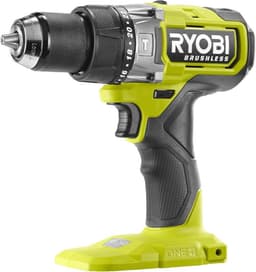
You have a plug to go into a brick or block wall, and a green Ryobi drill is the tool on the side. A Ryobi drill for brick in this amazon.co.uk set is only the listing that states a hammer or percussion mode, used with a masonry bit, for an ordinary plug hole. This page, dated 22 October 2026, stays on that one job. It is not a ranking of torque, and it is not a lab test. A qualifying Amazon purchase can earn us a commission at no extra cost to you. Every ASIN is on the [Ryobi cordless drill comparison](/hub/drilling-and-accessories/ryobi-cordless-drill).

You have a plug to go into a brick or block wall, and a green Ryobi drill is the tool on the side.

Our top picks

On this page

Which of these drills claim masonry

Four of the five listings make a masonry claim, and they do not make it in the same words. The two R18PD3 kits are combis whose bullets include masonry. The R18PD3-0 title says percussion. Its drill-type cell says Basic Drill, and the bullets do not print the word hammer, so you are trusting the title. The RPD18BL2-0 bullets name hammer drill in masonry, and they state brushless, 95 Nm and 2,100 rpm. The battery is not in that box. The R18DD3-0 does not belong in that list. The title is a compact drill driver and the bullets do not state masonry. You still need a masonry bit. A wood bit or the kit's double-ended screwdriver bit will polish the brick and stop. The R18PD3 instructions give that model a masonry capacity of 13 mm. Do not copy it onto the brushless cells. How the collar is set is the Ryobi drill clutch settings page.

Plug holes in brick and block

A combi hammer is the usual household tool for a plug in standard brick or lightweight block. BuildWiz puts that job at 6 mm or 8 mm plugs and says the combi fails on dense concrete, engineering brick, a lintel, or a hole much past about 16 mm. That is one writer's line, not a Ryobi specification. A curtain-pole plug is the job. A run of fixings along a concrete lintel is not. Set the collar to the hammer mark, fit the masonry bit with the battery off, and keep the drill square. Pull the bit out so the dust can leave. Amp-hours do not add hammer blows. They decide whether you pause to swap packs, not whether the wall is concrete.

When to stop and fetch an SDS

Stop when the bit is not progressing. BuildWiz's about 30 seconds and no progress is that writer's rule of thumb, not a figure in the R18PD3 manual. One UK review of the R18PD3-0 describes smoke on the third use while drilling in soil. That is one report, and smoke is a stop. Repeated concrete, engineering brick, lintels and a long row of deep holes are SDS+ work. The R18SDS-0 is the ONE+ SDS example on the UK site, quoted at 1.3 J and a bare price of £149.99. It is not an ASIN in this comparison. A stated 95 Nm on the brushless combi does not replace it. Newton-metres on a chuck drill are not joules on an SDS piston. These files do not print an A(8) figure for any ASIN here.

The drill driver is the wrong body

The R18DD3-0 is £54 and it looks like the other green bodies. It will not make a plug hole in brick because you bought a masonry bit. There is no hammer behind the chuck, and the listing never claimed one. Do not make do with the highest clutch number. The clutch is for screws, and the drill icon is for timber and metal. Neither mark hammers. If the only Ryobi you own is the R18DD3-0, the next purchase in this set is a percussion title or a kit whose bullets state masonry. After the plug is in, take the collar off the hammer mark before you drive the screw.

Common questions

Can a Ryobi combi drill brick?
Yes for ordinary plug holes, if the listing states a hammer or percussion mode and you use a masonry bit. In this set that is the two R18PD3 kits, the R18PD3-0 percussion title, and the RPD18BL2-0. It is not a tool for repeated concrete, engineering brick or lintels. Those jobs are an SDS+, which is not one of these five drills.
Do I need hammer mode for a wall plug?
For a plug in brick or block, yes. The hammer mark, with a masonry bit, is what breaks the material. The drill icon alone is for timber, metal and plastic. Select the hammer only for that hole, then take it off before you drive the screw into the plug. A plug in plasterboard does not need the hammer.
When do I need an SDS instead?
When the holes are in concrete, engineering brick or a lintel, or you are drilling many deep holes rather than a few plugs. Ryobi UK treats the SDS+ as that heavier tool. The R18SDS-0, at 1.3 J on the UK site, is the example, and it is not in this Amazon set. A higher printed newton-metre on a combi does not turn it into that hammer.
What bit goes in the chuck?
A masonry bit, sized for the plug, typically the 6 mm or 8 mm plug BuildWiz describes for ordinary brick. Seat it with the battery off. Do not use the kit's double-ended screwdriver bit, and do not use a wood bit. The R18PD3 manual's 13 mm masonry line is for that model only. It is not the brushless listing's capacity cell.
Why is the drill smoking or stalling in the wall?
The bit is not cutting, the flutes are packed, or the material is harder than a combi hammer. Stop. One R18PD3-0 review describes smoke while drilling in soil, and the brushless file includes stalls under load. Forcing the next minute does not add a hammer mechanism. Clear the bit, check the mode, and change tool if the wall is concrete.

Related pages

Sources

Public sources listed in the research digest, plus the amazon.co.uk listings stored for this comparison. Page updated 22 October 2026.

  1. Ryobi UK, R18PD3-0 combi drill (retrieved 22 October 2026)
  2. Ryobi UK, how to choose batteries and chargers (retrieved 22 October 2026)
  3. Ryobi UK, does the charger matter (retrieved 22 October 2026)
  4. Ryobi UK, product registration and warranty (retrieved 22 October 2026)
  5. Ryobi UK, different types of drills (retrieved 22 October 2026)
  6. R18PD3 instructions (retrieved 22 October 2026)
  7. GOV.UK, Supply of Machinery (Safety) Regulations 2008 (retrieved 22 October 2026)
  8. HSE, hand-arm vibration regulations (retrieved 22 October 2026)