Independent comparisons. We may earn from shop links. More info

How to use a Makita rotary hammer

Updated: 23 October 2026

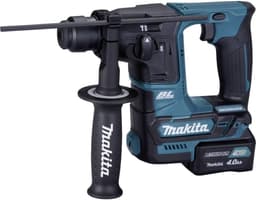
You have the hammer out of the case, a masonry wall in front of you, and a bit that may not even be in the box. This is how to use a Makita rotary hammer for a hole in brick, block or concrete: lock a shank the chuck can hold, catch the dust, and take your hand off the trigger when the time or the task has changed. It is not a ranking of the five listings. Which tool you should have bought is on the [Makita rotary hammer comparison](/hub/drilling-and-accessories/makita-rotary-hammer). A qualifying Amazon purchase can earn us a commission at no extra cost to you. There is no lab test.

You have the hammer out of the case, a masonry wall in front of you, and a bit that may not even be in the box.

Our top picks

Makita Makita HR2630/1 110 V

Best overall

Makita Makita HR2630/1 110 V
7.5/10about £158.50
Makita Makita DHR242RTJW 18 V kit

Alternative

Makita Makita DHR242RTJW 18 V kit
7.4/10about £549.49
On this page

Fit a bit the chuck can hold

None of the five included lines lists a drill bit. SDS-Plus is about 10 mm. SDS-Max is about 18 mm. They do not share bits. The HR2630/1, the DHR242RTJW and the HR2663 name SDS-Plus. The HR4013C/1 names SDS-Max. The HR166DSMJ amazon page prints a 16 mm chuck cell and does not print SDS-Plus. If the shank in your hand is the other system, stop. Clean the shank, then grease it. The HR4013C/1 is the only listing here that includes bit grease. Seat the bit until the chuck clicks, then pull it toward you. A locked SDS bit still slides a little. That float is normal. A bit that pulls straight out is not locked. One United Kingdom review of the HR2630/1 says the bit came out after about a month and the tool then stopped.

Drill so the dust does not hang in the room

Masonry dust can contain respirable crystalline silica. For a short hole, HSE sheet CN3 says capture the dust at the bit with a collector or with M or H class extraction, start slowly, and keep the bit turning as you withdraw. When drilling is the main job, CN3 wants a hood, an M or H class extractor, and respiratory protection at APF 20. A household vacuum is not that extractor. The DHR242RTJW includes a DX06. A UK review says the seal depends on setting the depth. The HR2663 includes a HEPA attachment, but its voltage cell says 120 V, so do not use it as the worked example for a UK site. A HEPA mechanism is not a reason to drop APF 20.
Makita Makita HR2630/1 110 V

Testsieger

Makita Makita HR2630/1 110 V
7.5/10about £158.50

Know when to take your hand off the trigger

The Control of Vibration at Work Regulations 2005 set an action value of 2.5 m/s² A(8) and a limit of 5 m/s² A(8). HSE's INDG175 says a hammer-action tool often reaches the action value in about 15 minutes and the limit in about an hour. That is a guide for this class of tool, not a timer on these boxes. Makita UK declares 9.3 m/s² for HR166D hammer drilling and 5.7 m/s² for the HR4013C, each with an uncertainty K of 1.5. Gloves are not protection. AVT on the HR4013C/1 does not reset the action value. Noise actions are 80 and 85 dB(A), and the limit is 87 dB(A). If the work would cross a vibration or noise limit and nobody has assessed it, stop.

Stop when the task is no longer drilling

Confirm what is in the wall before the first hole. Cables, pipes and a neighbour's side of a party wall are not things the chuck will warn you about. A lintel or a slab you cannot see the back of belongs with someone who can specify the repair. Hammer-only is named on the HR2630/1 and is not named on the HR166DSMJ bullets. Three modes on the DHR242 listing, without the names, is not a licence to chase. Stop if the bit jams, if the hammer action dies, or if you smell burning. One UK review of the HR2630/1 describes a machine that caught fire within a minute on a small hole. This page does not describe a repair. Which shank you should have matched is on the SDS Plus vs SDS Max page.

Common questions

How do I lock an SDS bit so it stays in?
Clean the shank and grease it. Push it into the chuck until you feel it seat, then pull it back toward you. It should not come out in your hand. A small amount of in-and-out movement after it locks is how an SDS bit is meant to sit. The HR4013C/1 is the only listing here that includes bit grease.
Why does a locked bit still move in and out?
SDS bits are designed to slide a short distance once the chuck has locked the rotation. That float lets the hammer mechanism strike the end of the shank. If the bit pulls straight out, it is not locked. One UK review of the HR2630/1 says the bit came out and stayed out, and the tool then stopped. Retest a new bit.
What dust control does a short hole need?
For a short hole, HSE CN3 points to capturing dust at the tool: a collector, or cordless extraction in M or H class. Start slowly, and keep the bit turning as you withdraw. When drilling is the main job, add a hood, an M or H class unit, and RPE at APF 20. A household vacuum is not the control HSE describes.
Does the DX06 or the HR2663 extractor mean I can skip a mask?
No. An extractor reduces what gets into the room when it is seated and the filter matches the job. CN3 still wants APF 20 when drilling is the main task, on top of M or H class extraction. A UK review of the DX06 says the result depended on setting the depth so the hood sealed.
How long is too long on a hammer setting?
INDG175's rule of thumb for hammer-action tools is about 15 minutes to the 2.5 m/s² A(8) action value and about an hour to the 5 m/s² limit. That is not a personal timer for your arms, and it is not a number printed on these amazon pages.

Related pages

Sources

Public UK sources and Makita UK pages from the research digest, last checked on 21 October 2026. Shelf prices and star lines are the amazon.co.uk figures in the display file.

  1. HSE INDG175, hand-arm vibration (retrieved 21 October 2026)
  2. HSE, Control of Vibration at Work Regulations (retrieved 21 October 2026)
  3. HSE HSG141, electrical safety on construction sites (retrieved 21 October 2026)
  4. HSE CN3, construction dust (retrieved 21 October 2026)
  5. Control of Noise at Work Regulations 2005, regulation 4 (retrieved 21 October 2026)
  6. Makita UK, HR166D (retrieved 21 October 2026)
  7. Makita UK, HR4013C (retrieved 21 October 2026)
  8. IET Wiring Matters, reduced low voltage (retrieved 21 October 2026)