Independent comparisons. We may earn from shop links. More info

Makita 110V rotary hammer

Updated: 23 October 2026

You are on a results page where one Makita says 110 V, another says 120 V, and the socket in the kitchen is neither of those. A Makita 110V rotary hammer in this set will not run from that 13 A socket, and cutting the plug off is not the fix. Two of the five listings are titled 110 V, one is a 120 V Canadian listing, and two are battery kits that avoid the lead. Prices sit on the [Makita rotary hammer comparison](/hub/drilling-and-accessories/makita-rotary-hammer). A qualifying Amazon purchase can earn us a commission at no extra cost to you. There is no lab test, and this page does not tell you how to rewire a plug.

You are on a results page where one Makita says 110 V, another says 120 V, and the socket in the kitchen is neither of those.

Our top picks

Makita Makita HR2630/1 110 V

Best overall

Makita Makita HR2630/1 110 V
7.5/10about £158.50
On this page

Three corded listings, three different supplies

The HR2630/1, ASIN B016362Q3S, is £158.50. The title says 110 V and 26 mm SDS-Plus, and the bullets name three modes, including hammering only. The voltage cell says 127 V. A United Kingdom review says the plug is a site-transformer plug and will not fit a normal UK socket, and that the return window had already closed. The HR4013C/1, ASIN B00FKRLU02, is £730.00. The title says 110 V and SDS-Max. A cell says a 110 V power outlet and the voltage cell says 100 V. The first 50 written reviews are from the United States, Canada and Japan. The title and the technical cell do not match, and you do not smooth them into one number.

What the site supply actually is

On a UK building site, HSE wants cordless tools or a 110 V supply from a centre-tapped transformer, so that a fault to the case is about 55 V to earth rather than the full mains. The IET describes the same reduced low voltage: up to 110 V between the lines, and about 55 V from either line to earth. You plug the tool into the transformer. You do not plug the tool into the 13 A socket the transformer itself is using. A house does not become a site because you bought a 110 V hammer. Taking a site tool home to a ring main is the error this page is about.
Makita Makita HR2630/1 110 V

Testsieger

Makita Makita HR2630/1 110 V
7.5/10about £158.50

Do not change the plug

Fitting a 13 A plug, or a travel adaptor, to a 110 V tool is outside this page. HSE's guidance is that the tool has to match the supply on the rating plate. This article will not give you a wiring sequence, a fuse size, or a way to run the 120 V HR2663 from a 110 V transformer. If the plate and the socket disagree, the tool goes back or it stays on the supply the plate names. For the HR2630/1 the title says 110 V and the cell says 127 V. For the HR4013C/1 the title says 110 V, one cell says a 110 V outlet, and another says 100 V. A transformer hired for 110 V tools does not correct a 120 V Canadian tool.

The two listings that do not need a lead

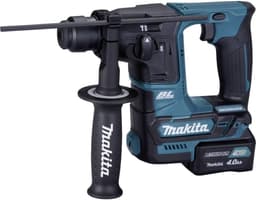
If the only socket you have is a 13 A BS 1363, the corded rows are the wrong basket. The HR166DSMJ at £204.95 is the 12 V CXT kit with two 4.0 Ah batteries, a charger and a Makpac. The DHR242RTJW at £549.49 is the 18 V LXT kit with two 5.0 Ah batteries, a charger, a DX06 and a Makpac. One United Kingdom review says the 12 V charger arrived with a two-pin European plug. A bullet says the 18 V kit is not compatible with G-series batteries. The 12 V kit does not name a hammer-only mode. Choosing between those two is the job of the buying guide.

Common questions

Will the HR2630/1 or the HR4013C/1 plug into a kitchen socket?
The titles say 110 V, and a UK review of the HR2630/1 says the plug is a site-transformer plug that will not fit a normal UK socket. The HR4013C/1 title also says 110 V, and a cell says a 110 V power outlet. The included line has no 13 A adapter. A kitchen socket is 230 V through a 13 A plug.
What is a centre-tapped 110 V supply in plain language?
It is the yellow site transformer arrangement HSE expects when a corded tool is used on site. You get up to 110 V between the two lines, and about 55 V from either line to earth, which is the figure the IET explains. The tool plugs into the transformer. The transformer is what meets the higher supply.
Is 120 V on the HR2663 the same as site 110 V?
No. The HR2663 voltage cell says 120 V and the manufacturer line says Makita Canada. UK site practice in this guide is 110 V from a centre-tapped transformer, about 55 V to earth. A 120 V tool is a different rating. This page does not describe a way to run it slower on a site transformer, and it does not call £329.53 a 230 V bargain.
Can I cut the yellow plug off and fit a 13 A plug?
No. This page will not give you that method. A 110 V tool on a 230 V socket is the wrong supply, and HSE's line is that the tool matches the plate. The HR2630/1 review already shows the plug that would not fit a house socket. Changing it is not a workaround this guide supports.
Which two listings avoid the lead altogether?
The HR166DSMJ at £204.95 and the DHR242RTJW at £549.49. Both include batteries and a charger. They still need a charger plug that fits the socket you have. One UK review says the 12 V charger came with a two-pin European plug. The 18 V kit is not a 110 V tool with the lead deleted. It is an LXT kit, and a bullet says it is not for G-series batteries.

Related pages

Sources

Public UK sources and Makita UK pages from the research digest, last checked on 21 October 2026. Shelf prices and star lines are the amazon.co.uk figures in the display file.

  1. HSE INDG175, hand-arm vibration (retrieved 21 October 2026)
  2. HSE, Control of Vibration at Work Regulations (retrieved 21 October 2026)
  3. HSE HSG141, electrical safety on construction sites (retrieved 21 October 2026)
  4. HSE CN3, construction dust (retrieved 21 October 2026)
  5. Control of Noise at Work Regulations 2005, regulation 4 (retrieved 21 October 2026)
  6. Makita UK, HR166D (retrieved 21 October 2026)
  7. Makita UK, HR4013C (retrieved 21 October 2026)
  8. IET Wiring Matters, reduced low voltage (retrieved 21 October 2026)