Independent comparisons. We may earn from shop links. More info

Makita combi drill or SDS

Updated: 2026-10-23

You need a hole for a wall plug, the listing says hammer, and you are not sure whether that means a soft internal brick or a concrete lintel. A combi here drills, drives screws, and has a ratchet hammer up to the diameter the listing states. An SDS-plus rotary hammer uses a piston, a sliding bit and often a chisel mode. None of the four amazon.co.uk rows is an SDS tool. The [Makita drill comparison](/hub/drilling-and-accessories/makita-drill) stays with those four combis. Collar steps sit on the [how to use a Makita combi drill](/hub/drilling-and-accessories/makita-drill/sub/makita-drill-how-to-use) page. There is no lab test, and a qualifying purchase can earn a commission at no extra cost to you.

You need a hole for a wall plug, the listing says hammer, and you are not sure whether that means a soft internal brick or a concrete lintel.

Our top picks

Makita DHP487Z brushless body

Best overall

Makita DHP487Z brushless body
9.4/10about £86
Makita DK18015X2 twin pack

Best value

Makita DK18015X2 twin pack
9.4/10about £182.50
On this page

A ratchet hammer is not an SDS

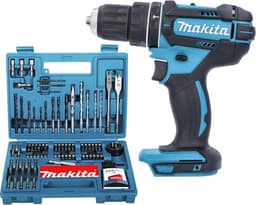
A combi such as the DHP487 has a three-jaw keyless chuck, a clutch, two gears, and a ratchet that hammers while the chuck turns. The bit is a round straight shank. As ITS describes Makita's range, that round shank stays on the combi and SDS bits go in a rotary hammer. These listings give newton-metres and, on one row, a masonry diameter. They do not give joules. Do not invent an impact-energy number for the DHP487, the DHP482 or the HP457. Use a combi when the hole is a brick plug inside the stated diameter and you also need the tool for screws and timber. Move to an SDS for concrete, chasing, chiselling, or a sharp masonry bit that is not advancing. A second combi does not change the mechanism.

What these listings actually claim

The DHP487Z is the only row that states the masonry number: 13 mm in masonry, 13 mm in steel, 36 mm in wood, a 13 mm chuck and 40 Nm. Makita UK's DHP487 page agrees on 13 mm masonry and describes a brushless LXT combi, not an SDS. That cell is a plug in material the ratchet can cope with. Reviews praise the hammer for general use. They do not describe all-day concrete. Both twin packs name a combi hammer, an HP457 or HP457D, plus a TD127D impact driver, and neither states a masonry diameter. Combi hammer in a bullet is not a 13 mm rating borrowed from the DHP487. The TD127D hits a hex shank. It does not hold a masonry bit, and it is not a small SDS.
Makita DHP487Z brushless body

Testsieger

Makita DHP487Z brushless body
9.4/10about £86

When to leave this set

Leave this set for concrete, chasing or chiselling. A combi has no chisel mode. An SDS-shank bit will not lock in the DHP487's keyless chuck. Fit a straight-shank masonry bit, or stop. Forcing the slotted shank into a three-jaw chuck risks a slip, and it still does not give you a piston. Chasing a cable, cutting trunking or breaking out a tile bed is chiselling. None of these four will do it. Hire an SDS, or buy a DHR-style tool. A structural concrete fixing is a professional job if you cannot assess the load. The best Makita drill page can still choose a combi for timber and screws.

Dust, cables and vibration

Masonry dust can contain silica. HSE's CIS36 sheet says capture the dust rather than treating a mask as the first control. For one or two plugs at home, a vacuum at the hole is the practical version. For paid work, the control has to match the time in the dust. The vibration action value is 2.5 m/s² A(8) and the limit is 5 m/s² A(8). Makita UK declares the DHP487 at 10.5 m/s² in concrete and 1.3 m/s² in metal, with a K of 1.5. HSE's rough guide is about 15 minutes a day on hammer-action tools. Do not paste those figures onto the DHP482 or the HP457. Look both sides of a wall for cables, and isolate the circuit if you are unsure.

Common questions

Will any of these four drills chisel or chase a wall?
No. They are combis, or a combi plus an impact driver. None has a chisel mode, and none takes an SDS bit in an SDS chuck. Chasing and breaking out need a rotary hammer. The DHP487's hammer is a ratchet behind a three-jaw chuck, stated for 13 mm masonry.
What masonry size does the DHP487 listing state?
13 mm. The amazon bullets and the Makita UK DHP487 page both state 13 mm in masonry, with 13 mm in steel and 36 mm in wood on the listing. A plug hole at or under that diameter is the claim. A larger hole is a different tool.
Does the DHP482 listing state a hammer mode?
No. The type cell says combination drill, and the specification table does not state hammer mode or a masonry capacity. The chuck cell is 12.7 mm. This page does not promote the amazon row to a 13 mm masonry tool by borrowing the DHP487.
Are the TD127D impact drivers a masonry drill?
No. The TD127D in both twin packs is a hex impact driver. It delivers rotational hits to a hex-shank driver bit. It does not hold a straight-shank masonry bit in a three-jaw chuck, and it is not an SDS. The combi in the same carton is the only candidate for a plug hole.
When is a brick plug still a combi job?
When the wall is ordinary brick or lightweight block, the bit is a sharp carbide bit matched to the plug, and the hole advances inside the diameter the listing states. On the DHP487 that diameter is 13 mm. If the bit stalls twice, the wall has left this job description.
When should you stop and use an SDS?
Stop when the material is concrete, engineering brick, or anything that is not advancing under a sharp bit. Stop for chasing, chiselling, and a structural concrete fixing. Stop if you are about to put an SDS-shank bit in the combi chuck. Hire or buy a rotary hammer for that work.

Related pages

Sources

Sources for this comparison, last checked on 22 October 2026.

  1. Makita UK DHP487 product page (retrieved 22 October 2026)
  2. Makita UK DHP482 technical PDF (retrieved 22 October 2026)
  3. Makita UK warranty (retrieved 22 October 2026)
  4. Part Shop Direct BL1813G battery (retrieved 22 October 2026)
  5. Control of Vibration at Work Regulations 2005, regulation 4 (retrieved 22 October 2026)
  6. HSE vibration in construction (retrieved 22 October 2026)
  7. HSE noise for employers (retrieved 22 October 2026)
  8. HSE CIS36, control of silica dust (retrieved 22 October 2026)