Independent comparisons. We may earn from shop links. More info

How to use long screwdriver bits

Updated: 2026-10-23

You already have a long bit in the driver, the screw is a PZ2 in a carcass, and you do not want a rounded head. Extra length turns a small tilt into a miss at the tip, which is how a 150 mm bit walks out and chews the recess. This is how to use long screwdriver bits: seat them with the tool off, keep the shank in line, start slowly, and stop at the first click or walk. The steps follow UK safety guidance and nine amazon.co.uk packs saved on 21 October 2026. None of those packs is described as insulated. The [long bits comparison](/hub/drilling-and-accessories/long-bits) is the product table.

You already have a long bit in the driver, the screw is a PZ2 in a carcass, and you do not want a rounded head.

Our top picks

On this page

Set the bit before you pull the trigger

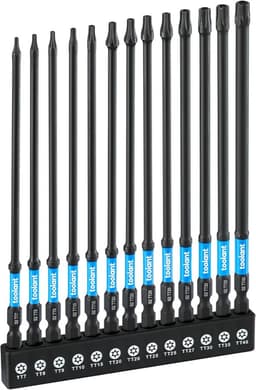
Switch the driver off before the bit goes near the screw. Seat the tip so it fills the recess, then check that the 1/4 inch hex has locked. A bit that wobbles in the chuck will wobble more at 150 mm. iFixit's fit rule is the same idea: fill the recess, use the largest size that seats, and do not pry. That page is a US guide, not a chart of UK screw sizes. Saxton, Rennie and the toolant set claim a magnetic tip. A magnet holds a steel screw while you find the hole. It does not turn a PH2 bit into a PZ2 bit. If the tip clicks with the tool still off, it is the wrong size or the wrong family.

Keep a long bit in line

A 25 mm insert hides a small lean. A 150 mm or 152 mm bit shows it. The driver, the shank and the screw need to be one axis. If your wrist drops, the tip climbs the recess and cams out. BuildWiz says keep the bit seated and in line. On a long bit the far end moves further for the same angle at your hand. Use the shortest bit that reaches. If a 90 mm bit already seats, leave the 150 mm bit in the case. Bestgle lists 100 mm, and one UK review puts usable stick-out nearer 80 mm in the driver. Brace the tool against the carcass. If you tilt to clear a shelf, the tip walks.

Start slow and stop early

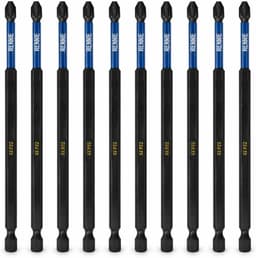
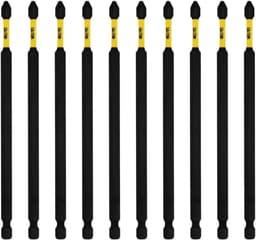
Start at a low speed and let the screw cut its own thread, or follow the existing thread, before you add pace. On a combi drill, a clicking clutch is a stop. On an impact driver the stop is a sharp click, a tip that jumps, or a head that starts to shine. The first walk is the moment to stop. Stop when the head is flush enough for the job. Driving on to be sure keeps hammering a screw that has already stopped. Ten identical PZ2 bits, as in the Saxton pouch or the Rennie case, exist so you can bin one and fit the next. A mixed set with one PZ2 does not give you that spare.

Eyes, a cracked tip, and when to stop the job

HSE guidance treats debris from power-driven tools as a reason for eye protection. A long bit that snaps throws a small piece of steel. Wear eye protection at home and at work. At work, PUWER 1998 regulation 12 covers equipment that can rupture or eject. That duty sits with the employer, and the debris risk is still there for a householder. Bin a cracked tip. Do not use the shank as a pry bar. A bent bit will walk even if the drive was right. None of the nine listings is insulated. Keep these bits off live conductors. Call a professional for a specified structural fixing, for live electrical work, and when a safety-critical cover will not release. A cupboard hinge is ordinary DIY. A joist hanger with a stated fixing schedule is not.

Common questions

How do you start a screw on a long magnetic bit?
With the driver switched off, stick the steel screw to the magnetic tip and seat it fully in the recess. Check the hex is locked. Start slowly and stop if the tip clicks out. The magnet only holds the screw. Pronese reviews disagree about how strong that magnet stays.
How straight does the driver need to be?
Straight enough that the shank, the tip and the screw are one line. On a 150 mm bit, a small lean lifts the tip out of the cross. Brace against the workpiece. If you cannot see the head, feel for a seated tip with the tool off. The first click means you stop and square up.
When do you stop so the head does not round?
Stop at the first walk, the first cam-out click, or as soon as the head looks shiny. On a combi drill, a clicking clutch is a stop. On an impact driver, ease off when the blows no longer turn the screw. Replace a rounded screw.
Should you wear eye protection?
Yes. HSE guidance treats fragments from power-driven tools as a reason to protect your eyes. A tip that shatters, which UK reviews describe on several of these packs, is a small fast piece of metal. That applies on an impact driver and on a combi drill.
Can you use a long bit as a pry bar?
No. The shank is for turning a screw in line. Prying bends it, and a bent 150 mm bit walks out of the next head. iFixit's rule is the same: do not pry. A bent bit goes in the bin with a cracked one.
When should a professional take over?
Hand over live electrical work, a fixing a drawing specifies as structural, and any safety cover that will not release. At work, a cracked bit comes out of service under PUWER. A hinge or a flat-pack cam is ordinary use if the drive matches and the tip is intact.

Related pages

Sources

Public UK sources from the research digest, last checked on 21 October 2026. Shelf prices and star lines are the amazon.co.uk figures used for this comparison.

  1. BuildWiz, screwdriver bits (retrieved 21 October 2026)
  2. Bolts.co.uk, common recess styles (retrieved 21 October 2026)
  3. UK Planet Tools, Bahco 59/S54BC bit lengths (retrieved 21 October 2026)
  4. Bosch Professional GB, extra-hard hex screwdriver bits (retrieved 21 October 2026)
  5. ISO 1173:2001, assembly tools for screws and nuts, drive ends (retrieved 21 October 2026)
  6. HSE, PUWER overview (retrieved 21 October 2026)
  7. HSE L25, personal protective equipment at work (retrieved 21 October 2026)
  8. Which?, faulty product advice (retrieved 21 October 2026)