Independent comparisons. We may earn from shop links. More info

How to use a log splitter drill bit

Updated: 23 October 2026

The cone is already in the chuck, the offcut is on the ground, and the first squeeze of the trigger is the moment a log starts to spin. How to use a log splitter drill bit, for this page, is that first session: a drill you can hold, a piece that cannot rotate, an entry at the edge, and a trigger you release the instant the cone binds. You should leave knowing when to stop, not how to force a buried bit. If you are still choosing, the ten listings sit in the [log splitter drill bit comparison](/hub/drilling-and-accessories/log-splitter-drill-bit). The notes below follow Electrical Safety First's drill advice and the exclusion lines on these amazon.co.uk listings.

The cone is already in the chuck, the offcut is on the ground, and the first squeeze of the trigger is the moment a log starts to spin.

Our top picks

On this page

Set the drill before the log

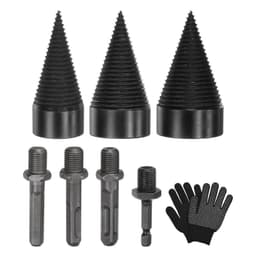
Fit the shank with the battery out or the plug pulled, then tighten the chuck and fit the side handle. Wear goggles, tie hair back, and keep loose sleeves away. A glove that arrived in a box is not a reason to wear a loose glove against that thread. Use drill mode and low gear. Do not select hammer mode because a bullet mentions a hammer drill. A compact driver is the wrong body: you need both hands on the tool when the torque comes back. If the only tool you can find is an impact driver, put the cone away.

Brace the wood and start at the edge

The log has to be unable to spin. Brace it against a fixed stop or a piece that cannot roll, and do not hold the offcut in a free hand while the thread is turning. Both hands stay on the drill, one of them on the side handle. Secure loose wood with a clamp or a heavy object. Start at the edge, or in an existing check, not in the centre. The three-cone listings say start at the edges and hold the wood so it does not rotate, and that the bit is not for wood that is too hard, too wet or knotty. Believe that exclusion even when the title names oak. An axe or a wedge is the other tool, on the log splitter drill bit vs axe page.

The first pass and when to release

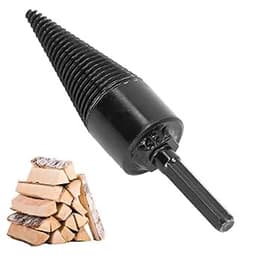
Let the thread pull the cone. Light, steady pressure is enough on a small dry piece. If you have to lean your weight on the drill, stop. One UK review in this capture describes a wrist injury with a battery drill. Release the trigger as soon as the cone binds or the drill twists in your hands. UK reviews on screwed adapters say the opposite: reverse unscrews the shank and leaves the cone in the wood. If that happens, stop. The buried cone and a damaged chuck belong on the log splitter drill bit stuck page.

When this session should stop

Stop when the drill smells, the chuck cracks, or the body kicks hard enough that you cannot hold it. A cracked chuck is a repair, not a second attempt on the same log. Stop when the wood is wet, knotted or larger than the listing allows. A cone in this class is not a substitute for a hydraulic splitter. At work, PUWER 1998 treats the drill as work equipment for a trained user. HSE's L114 excludes hand-held tools, so it is not a guarding code for this cone. If you will sell the firewood in England, under 2 cubic metres, Ready to Burn is a 20% moisture rule for the seller. That rule does not make the cone safe to force.

Common questions

Where on the log do I start?
Start at the edge, or in a check that is already open, on a small dry piece that cannot roll. Do not start in the centre. Listings in this capture print that edge start. A centre start is how the cone screws in without a split path and then jams. If the only clear face is a knot, choose another offcut. The listing that excludes knotty wood is describing this moment, not a later problem.
What speed and which drill mode?
Low gear, drill mode, light pressure. Hammer mode is off, even if the box art shows a hammer drill. The cone is a screw, not a percussion bit. There is no rpm figure in this capture to chase, and no watt minimum to meet. If the drill will only run fast, it is the wrong tool for this bit. Let the thread pull. The moment you are forcing it, the speed setting is no longer the issue. Release the trigger.
How do I stop the log spinning?
Brace it before you start, against something that cannot move, and keep both hands on the drill. Do not hold the offcut in one hand and the drill in the other. A spinning log means the brace failed or the entry was too central. Trigger off. Chasing it with more speed repeats the same fault. Secure loose wood the way Electrical Safety First describes for any drill: a clamp or a heavy object, not your foot as the only method.
Can I use a hammer drill or an impact driver?
Use a drill that has a side handle and a low gear, in drill mode. A hammer drill body is acceptable only if you leave the hammer action off. The bullets that name an SDS-type rotary hammer are not an instruction to run hammer mode. An impact driver is a mistake: the blows and the short body are the wrong match for a cone that binds. If that is the only cordless tool you own, do not fit the bit.
What do I wear, and what do I leave off?
Wear goggles. Tie hair back. Take off loose sleeves and jewellery. Do not add a glove just because one was in the box. A loose glove against a turning thread is a catch point, not protection. Ear protection is worth putting on if the session runs long, which is how Electrical Safety First puts it for drills. Keep children and pets out of the line of the log. None of that replaces bracing the wood.
What do I do the moment the cone binds?
Release the trigger. Do not lean harder, and do not hold reverse in the hope that the cone will walk out. On the screwed adapters UK reviews describe, reverse unscrews the shank and leaves the cone in the wood.

Related pages

Sources

Public UK sources for the safety and firewood points. Listing prices, stars and review text are the amazon.co.uk captures. Those files were not re-checked on 22 October 2026.

  1. HSE, PUWER overview (retrieved 22 October 2026)
  2. HSE, Safe use of woodworking machinery (L114) (retrieved 22 October 2026)
  3. GOV.UK, Selling wood for domestic use in England (retrieved 22 October 2026)
  4. GOV.UK, Smoke control area rules (retrieved 22 October 2026)
  5. Electrical Safety First, drills (retrieved 22 October 2026)
  6. BSI, BS EN 62841-2-1 scope (retrieved 22 October 2026)
  7. Consumer Rights Act 2015 (retrieved 22 October 2026)
  8. betterout.co.uk, drill-powered conical wood splitter (retrieved 22 October 2026)